
How to Identify the Follis of Constantine I and Crispus
Read the CONSTANTINVS obverse legend, the two-bust reverse and its CRISPVS wording, the mint mark, and the coin's small size to attribute this Constantinian bronze.
Read the full Follis of Constantine I and Crispus encyclopedia entry →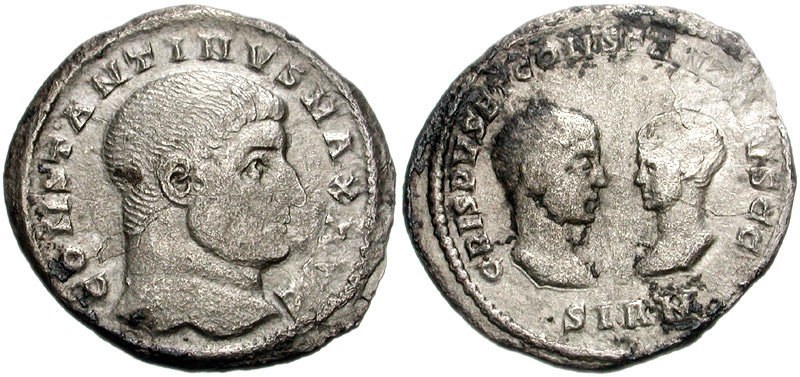
Begin with the obverse legend, which names the senior emperor. It should circle a right-facing portrait, laureate, diademed, rosette-diademed, or helmeted depending on the issue, and be built on the name CONSTANTINVS, in forms such as CONSTANTINVS AVG or CONSTANTINVS P F AVG. The word AVG (Augustus) marks the senior ruler. Be careful not to mistake legends reading CONSTANTINVS IVN NOB C, which name the son Constantine II as junior Caesar, for the emperor himself.
Turn to the reverse, the key to this dynastic type. Look for two busts facing right representing Constantine and Crispus, and read the surrounding legend closely. Wording naming CRISPVS, often CRISPVS NOB CAES, confirms the son's presence; NOB CAES (nobilissimus Caesar) is the junior title he held from 317 to 326. Matching the paired busts to a legend that names both figures is what separates this issue from the many single-portrait Constantinian reverses.
Find the mint mark in the exergue, the horizontal strip below the reverse design. A short group of letters, an abbreviated mint city plus a workshop numeral, identifies where the coin was struck; Constantinian mints of the 320s include Trier, Lyon, Arles, Rome, Ticinum, Siscia, Thessalonica, Nicomedia, and Antioch, among others. This mark is essential for precise attribution and distinguishes otherwise similar coins.
Check size and metal to place the piece in the series. It should be a small bronze module, roughly 18 to 20 mm and about 2 to 3.5 grams, with a brown or green patina and sometimes surviving silvering in the recesses. Coins that are unusually large and heavy belong to the earlier, pre-reduction follis, while pieces that are unusually light, sharp-edged, seamed, or glossy may be casts or tourist replicas.
Authenticate anything uncertain or valuable. Cast fakes often show a raised seam around the edge, soft or bubbly detail, and an unnaturally uniform surface, whereas genuine struck coins have crisp devices and honest wear. For confirmation, compare against standard references (RIC volume VII) or consult a specialist in ancient coins or a reputable grading service rather than relying on a single photograph.
Frequently asked questions
How do I tell Constantine I from his son Constantine II?
Read the full obverse legend. The senior emperor carries AVG (for example CONSTANTINVS AVG or CONSTANTINVS P F AVG), while his son Constantine II is written CONSTANTINVS IVN NOB C, using the junior Caesar title. The added IVN and NOB C are the giveaways.
What confirms that Crispus is on the coin?
The reverse legend. Wording that names CRISPVS, typically CRISPVS NOB CAES, together with the paired right-facing busts, ties the coin to Constantine's eldest son during his years as Caesar, AD 317 to 326.
Where is the mint mark?
In the exergue, the band beneath the reverse busts. It is a short group of letters, an abbreviated mint city plus a workshop number, and it pins down where the coin was struck.
How can I spot a fake?
Watch for a raised seam around the edge, soft or bubbly detail, and an unnaturally smooth surface, all signs of casting. Genuine struck coins show crisp devices and natural wear. Have doubtful or valuable pieces checked by an ancient-coin specialist.