Duro (5 Pesetas)
A large .900 silver five-peseta crown struck under Spain's Provisional Government, with a profile head personifying Hispania and a crowned coat of arms reverse.
- Country
- Spain
- Denomination
- Duro
- Metal
- Silver
Got a coin like this?
Identify any coin from a photo, free.
Overview
The Duro is the popular name for Spain's large silver five-peseta piece, and the 1869 issue documented here was struck under the Provisional Government (Gobierno Provisional) that took power after the 1868 revolution. Roughly 37 mm across and about 25 grams of .900 fine silver, it is a substantial crown-sized coin — the workhorse silver denomination of the newly created peseta system.
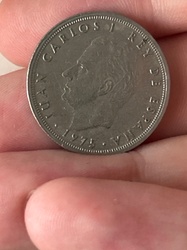
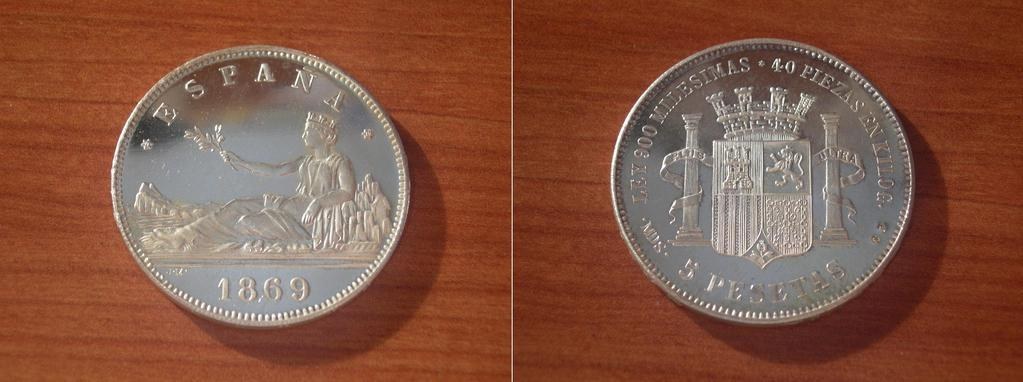
The observed coin shows a helmeted head in profile on the obverse, a female personification of Spain (Hispania), and the Spanish coat of arms beneath a crown on the reverse. Both faces carry Spanish legends, and the date 1869 marks the first years of the peseta as Spain's monetary unit.
Called the duro in everyday speech — a name carried over from the old five-peseta-equivalent of twenty reales — this coin circulated as everyday hard currency and is today one of the most collected types of modern Spanish silver.
History & Background
In September 1868 the revolt known as La Gloriosa (the Glorious Revolution) deposed Queen Isabella II, and a Provisional Government took charge of the country. Among its early acts was a monetary reform that made the peseta Spain's official unit and aligned the coinage with the international standard of the Latin Monetary Union, under which a five-unit silver coin weighed about 25 grams of .900 silver.
The five-peseta silver piece — the duro — was the largest of the new coins and began to be struck in 1869 while Spain had no reigning monarch, hence the emblematic figure of Hispania rather than a royal portrait. This interim period preceded the short reign of Amadeo I and the First Spanish Republic, so the Provisional Government duros belong to a distinctive, transitional chapter of Spanish history.
The design set the pattern for the peseta silver that followed: later kings placed their own portraits on the obverse, but the crowned coat of arms and the crown-sized silver format continued for decades. The 1869 duro therefore stands at the very start of the peseta coinage that endured until the euro.
How to Identify
The obverse of the observed coin shows a helmeted head in left-facing profile — a personification of Spain (Hispania) — surrounded by a Spanish legend and the date 1869. The reverse displays the Spanish coat of arms, quartered with the emblems of the historic kingdoms, ensigned by a crown, and often flanked by the Pillars of Hercules with the denomination and legend around.
A key diagnostic on these coins is the pair of small six-pointed stars set beside the design, which contain tiny incuse numerals. On the Provisional Government duros the large date reads 1869 (or 1870), but the little stars record the actual year of striking, so a coin dated 1869 may have been minted in 1869 or a later year. Look closely at the stars under magnification to read those digits, and check for the assayer or control letters as well.
The coin is crown-sized: expect roughly 37 mm diameter, about 25 grams weight, and a lettered or reeded edge consistent with a .900 silver Latin Monetary Union five-unit piece. A bright ring when tapped, the correct heft, and a soft grey silver tone are all consistent with the genuine metal.
Value & Collectibility
As a widely struck circulating silver crown, the 1869 duro is common enough that most well-worn examples trade close to their silver content, with a modest collector premium. Value rises sharply with preservation, sharp strike, and original surfaces, and certain star-date and die combinations are notably scarcer than others, so the small star numerals can matter a great deal to specialists.
Because the true minting year is recorded in the stars rather than the large date, two coins both reading 1869 can differ substantially in scarcity and price. For that reason this type is best appraised piece by piece, with the star dates verified, rather than by a single blanket figure.
The 1869 duro is also one of the most heavily counterfeited Spanish silver coins, both by period forgers and by modern copies, so authenticated or third-party-graded examples command a premium and give buyers far more confidence.
Frequently asked questions
Why does a coin from 1869 have no king's portrait?
It was struck under Spain's Provisional Government after the 1868 revolution that deposed Isabella II, during a period with no reigning monarch. Instead of a royal bust it carries a personification of Spain, Hispania, on the obverse.
What does the word 'duro' mean?
'Duro' is the popular Spanish name for the five-peseta coin, carried over from the earlier five-peseta-equivalent of twenty reales. It refers to the large silver piece rather than being an official denomination printed on the coin.
What are the little stars on the coin?
They are small six-pointed stars containing tiny numerals that record the actual year the coin was struck. The large date may read 1869 while the stars indicate the true minting year, so they are important for dating and attribution.
How much silver does it contain?
The duro is a crown-sized coin of roughly 25 grams at .900 fineness, giving close to 22.5 grams of pure silver, in line with the Latin Monetary Union five-unit standard.
Duro (5 Pesetas) guides
In-depth guides for identifying, valuing, and collecting Duro (5 Pesetas).
Duro (5 Pesetas) identified by the community
Real coins identified with Coin Identifier.