How to Identify the Duro (5 Pesetas)
A collector's guide to recognizing Spain's 1869 Provisional Government silver duro by its Hispania head, crowned arms, crown-sized silver fabric, and star dates.
Read the full Duro (5 Pesetas) encyclopedia entry →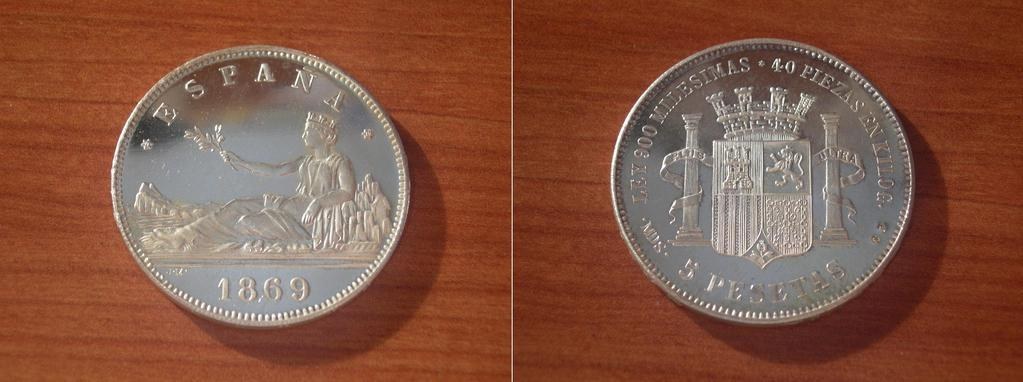
Confirm the Format First
The duro is a crown-sized silver coin, so start with metrology. Expect a diameter around 37 mm, a weight near 25 grams, and .900 silver that shows a soft grey tone and rings brightly when tapped. A coin that is noticeably light, undersized, or dull and greasy-looking may be a base-metal forgery, of which this type has many.
Read the Obverse
The obverse of the 1869 issue shows a head in profile personifying Spain (Hispania), rendered in a helmeted or crowned classical style, with a Spanish legend around and the large date 1869. Because there is no royal portrait, do not look for a king's name — the emblematic head is itself the clue that the coin belongs to the Provisional Government period rather than to a monarch's reign.
Read the Reverse and the Star Dates
The reverse carries the Spanish coat of arms beneath a crown, typically with the Pillars of Hercules to the sides and the denomination and legend around. The single most important detail on these coins is the pair of small six-pointed stars: under magnification each star holds tiny incuse numerals giving the real year of striking. Always read those digits, because a coin with a large 1869 date can have been struck later, and the star year strongly affects scarcity and attribution. Note any assayer or control letters as well.
Watch for Look-Alikes
The crowned-arms silver format continued under later Spanish rulers, so similar-looking five-peseta duros exist with the portraits of Amadeo I, the First Republic, Alfonso XII, and Alfonso XIII. The quickest way to separate the 1869 Provisional issue is the emblematic Hispania head instead of a named royal bust, together with the 1869 date. Confirm the denomination — five pesetas — spelled out on the reverse rather than assuming it from size alone.
Authentication Cautions
The duro is among the most counterfeited modern Spanish coins. Beware of cast copies with seams or a grainy surface, wrong-weight strikes, silver-plated base metal, and coins where the star numerals are blurred, absent, or inconsistent with known die pairings. Tooling or re-engraving in the fields is another warning sign. Because premium examples are worth well above bullion, have any promising piece weighed, measured, and — for higher grades — authenticated by a reputable third-party grading service before you buy.
Frequently asked questions
How do I tell the 1869 duro from later five-peseta coins?
Look at the obverse: the 1869 Provisional Government issue shows an emblematic head personifying Spain rather than a named king. Later duros carry royal portraits of Amadeo I, Alfonso XII, or Alfonso XIII, so a portrait-free obverse with an 1869 date points to this type.
Where are the star dates and why do they matter?
They are the small six-pointed stars set beside the design; each holds tiny numerals giving the true year of striking. Since the large date can differ from the actual mint year, reading the stars under magnification is essential for correct dating, scarcity, and value.
How can I check the silver without damaging the coin?
Weigh and measure it first — a genuine duro is about 25 grams and roughly 37 mm — and note the soft grey tone and bright ring when gently tapped. Avoid acid tests; if in doubt, use a specialist or third-party grading service rather than a destructive method.
Is a worn 1869 duro worth anything?
A well-worn example is still a substantial silver coin and generally trades near its silver value with a modest collector premium. Sharper, better-preserved pieces and scarcer star-date combinations are worth considerably more, so the stars are worth checking even on circulated coins.
Duro (5 Pesetas) identified by the community
Recent Duro (5 Pesetas) coins identified with Coin Identifier.