
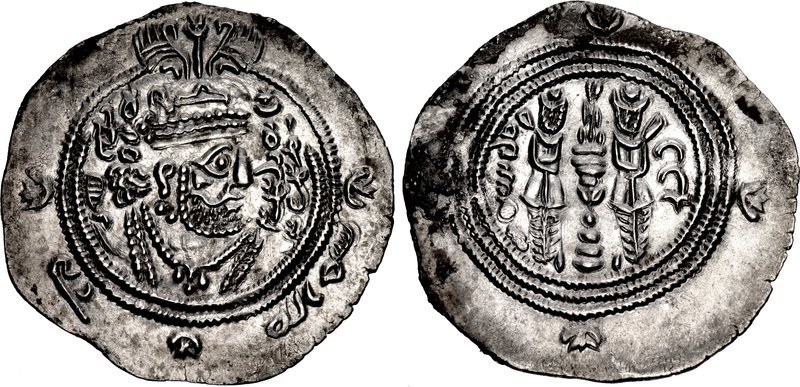
Dirham of Sistan
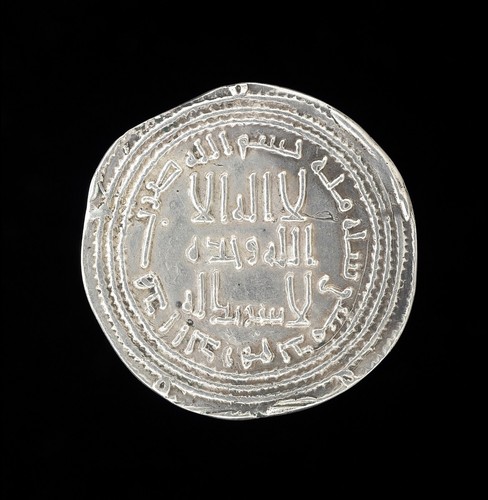
A silver Umayyad dirham struck at the Sijistan (Sistan) mint in AH 82 (701–702 CE), its faces filled with Kufic Arabic inscriptions ringed by concentric borders.
- Country
- Islamic (Sistan region)
- Denomination
- Dirham
- Metal
- Silver
Got a coin like this?
Identify any coin from a photo, free.
Overview
The Dirham of Sistan is a thin, broad silver coin struck in the Islamic world during the early Umayyad period, dated in our example to AH 82 (701–702 CE). Both faces are covered not with portraits but with lines of Arabic religious text in the angular Kufic script, arranged in a central field and enclosed by one or more concentric circular borders — the geometric "pattern" seen in the photograph is formed by these ringed inscription bands rather than by any figural design.
This is a classic example of the reformed, purely epigraphic dirham that became the standard silver coin of the Islamic caliphate. The central legend on one side carries the Muslim declaration of faith, while the surrounding margin names the mint — here Sijistan (Sistan) — together with the year of striking. The opposite face bears further Quranic and religious inscriptions in the same disciplined script.
Struck in good silver on a wide, flat flan, the coin was everyday money for a vast trading empire. Surviving pieces are prized today both as historical documents and as fine specimens of early Islamic calligraphy in metal.
History & Background
By the late seventh century the Umayyad caliphs, ruling from Damascus, had inherited coinage that still imitated Byzantine and Sasanian models, often with rulers' images. Around AH 77–79 the caliph Abd al-Malik ibn Marwan carried out a sweeping monetary reform that swept away human and animal figures and replaced them with pure Arabic text — chiefly the shahada (declaration of faith) and Quranic verses. The dirham dated AH 82 belongs to this reformed series, struck only a few years after the new standard was introduced.
Sijistan, or Sistan, lay on the eastern frontier of the caliphate, a region of the Iranian plateau straddling today's Iran–Afghanistan border and long an important agricultural and caravan zone. Provincial mints such as this one struck dirhams to local demand while following the empire-wide design, so that a coin from Sistan is essentially identical in layout to one from Wasit, Basra, or other Umayyad mints — the mint name in the margin being the key distinguishing feature.
These silver dirhams circulated across an enormous area, from North Africa to Central Asia, and were hoarded and traded far beyond the caliphate's borders. Their standardized weight and reliable fineness made them a trusted medium of exchange for generations, and they are found today in hoards stretching into eastern Europe and beyond.
How to Identify
The defining feature is that both faces are entirely inscriptional: there are no portraits, animals, or pictorial devices. Instead you see horizontal lines of Kufic Arabic in a central field, encircled by one or two plain concentric rings, with a curved marginal legend running around the rim. That concentric-ring layout is what reads as a "geometric pattern" at a glance.
On one side the center typically carries the shahada in several short lines; the surrounding margin names the mint and gives the date, opening with a formula such as "In the name of God, this dirham was struck in Sijistan in the year..." The other side carries a longer religious inscription (drawn from the Quran) in the central field, again ringed by a border legend. Reading the marginal script is what confirms both the mint of Sistan and the year AH 82.
Physically the coin is silver, thin and broad — usually around 25–29 mm across but only lightly dished, with a typical weight in the region of 2.7–3.0 grams for a full-standard dirham. The metal is pale grey silver, often with old toning. Because dozens of Umayyad mints used the same design, attribution rests almost entirely on reading the Arabic mint name and date rather than on any difference in imagery.
Value & Collectibility
Reformed Umayyad dirhams were struck in very large numbers and survive in quantity, so common mints and dates are affordable and frequently seen in the market. Value is driven mainly by the specific mint, the year, the completeness and sharpness of the inscriptions, and the state of preservation of the silver.
A coin naming a scarcer provincial mint such as Sijistan, and carrying a clearly legible date, generally draws more interest than a worn, off-center piece where the margins are flat or unreadable. Well-struck examples with full marginal legends, bright or attractively toned silver, and no cracks or corrosion sit at the upper end; clipped, holed, corroded, or partially illegible coins are worth considerably less.
Precise prices vary widely with grade and demand and should be treated as context rather than fixed figures. Because early Islamic silver is also imitated and forged, provenance and expert attribution add meaningfully to value, and any exceptional or rare mint-and-date combination is best assessed by a specialist in Islamic coinage.
Frequently asked questions
Why are there no pictures or faces on this coin?
It belongs to the reformed Umayyad coinage introduced by Caliph Abd al-Malik in the 690s CE, which replaced all figural images with pure Arabic religious text. The 'pattern' you see is lines of Kufic script framed by concentric circular borders.
What does the writing say?
The central inscriptions carry the Muslim declaration of faith and Quranic verses. The curved marginal legend records where and when the coin was struck — here naming the mint of Sijistan (Sistan) and the year AH 82 (701–702 CE).
Where is Sistan?
Sistan, historically Sijistan, is a region on the eastern edge of the old Islamic caliphate, in the borderland of what is now southeastern Iran and southwestern Afghanistan. It was a frontier mint striking coins to the empire-wide standard.
Is the coin really silver?
Yes. Umayyad dirhams of this type were struck in good silver on thin, broad flans, typically weighing around 2.7–3.0 grams. The pale grey metal often shows old toning.
Is a Sistan dirham rare or valuable?
Reformed Umayyad dirhams survive in large numbers, so many are affordable. Value depends on the specific mint and date, how legible the inscriptions are, and the condition of the silver; scarcer mints and clearly dated, well-struck coins bring more.
Dirham of Sistan guides
In-depth guides for identifying, valuing, and collecting Dirham of Sistan.
Other coins you may enjoy
Gold Dinar of Jaqmaq
1438-1453 CE
Ilkhanid Dirham
13th–14th century (Ilkhanate, c. 1256–1335 CE)
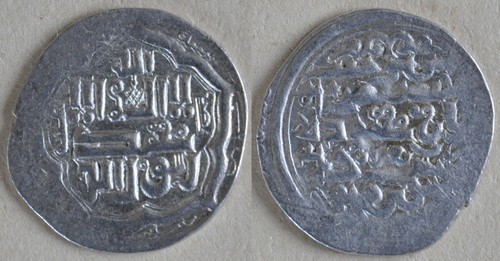
Ilkhanid Dirham of Ghazan
14th century (c. 1295-1304 CE)
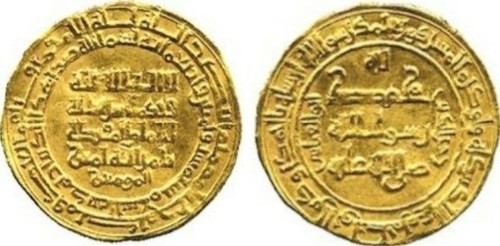
Gold Dinar of al-Muqtadi
c. 467-475 AH (1074-1082 CE)
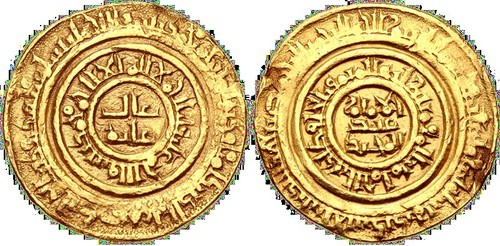
Gold Dinar of al-Hafiz li-Din Allah
AH 544 (AD 1149–1150)
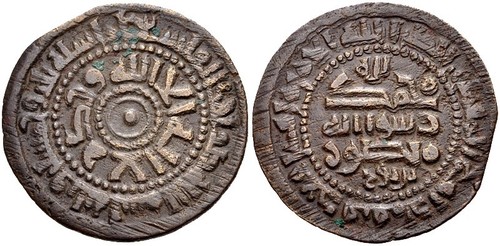
Samanid Dirham
9th–10th century CE (roughly AH 3rd–4th century)
Copper Fals of Barquq
1382–1389 CE (first reign of Barquq)
Copper Fals of as-Salih Salih
Mid-14th century CE (reign of as-Salih Salih, AH 752–755 / 1351–1354 CE)
Gold Dinar of Malik Shah I
AH 465–485 (1072–1092 CE)
Ilkhanid Dirham of Abu Said
c. 1316-1335 CE (AH 716-736)
Silver Dirham of Salm ibn Ziyad
c. 682-683 CE
Silver Dirham (LACMA M.2002.1.437)
8th century CE (roughly AH 80s–190s)