
How to Identify the Dirham of Sistan
A collector's guide to attributing an Umayyad silver dirham of Sijistan: the all-script design, reading the mint and date, size and metal, and forgery cautions.
Read the full Dirham of Sistan encyclopedia entry →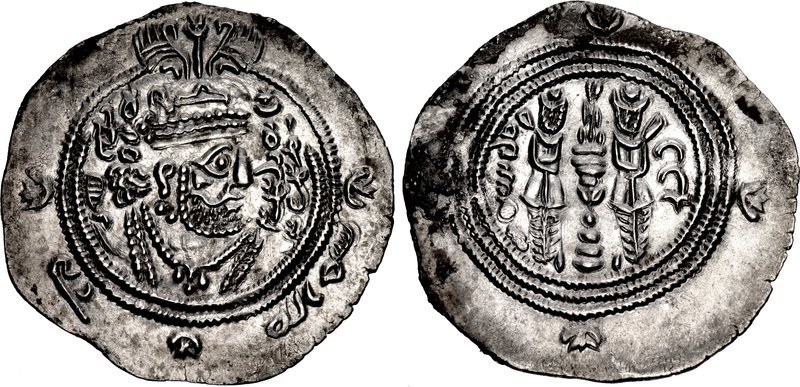
Start by confirming the coin is fully epigraphic. A dirham of this type has no portrait, animal, or pictorial device on either side — only lines of angular Kufic Arabic in a central field, wrapped by one or two plain concentric rings and a curved legend running around the margin. If you see any human or figural image, you are not looking at a reformed Umayyad dirham but at an earlier Arab-Sasanian or imitative issue.
Attribution depends on reading the Arabic, so orient the coin by its inscriptions. One face carries the short declaration of faith stacked in the center; its margin is the mint-and-date legend, which opens with a formula meaning roughly 'In the name of God, this dirham was struck in [mint] in the year [date].' Locating the mint word — Sijistan — and the written-out year is what fixes the coin as a Sistan dirham of AH 82. The other face bears a longer Quranic inscription in the center with its own border legend. Because every Umayyad mint used this identical layout, the marginal text is the only reliable way to tell Sistan from Wasit, Basra, or any other mint.
Check the physical characteristics. Expect a thin, broad silver flan roughly 25–29 mm in diameter and only lightly dished, weighing in the region of 2.7–3.0 grams when full and unclipped. The metal should be pale silver, sometimes with grey or iridescent toning; a coin that is markedly underweight, heavily clipped, or that has flat, blank margins may be difficult or impossible to attribute because the mint and date live in exactly those margins.
Beware of look-alikes and fakes. Many mints struck near-identical dirhams, so never assume a mint from style alone — always read the legend. Early Islamic silver is also widely forged and cast: watch for soft, mushy lettering, casting seams or bubbles, an unnaturally uniform surface, wrong weight, or a spelling of the mint or date that does not match published references. Tooled margins and modern 'improved' inscriptions are also encountered.
When the stakes are high, corroborate the reading against a standard catalogue of Umayyad silver and, for scarcer mint-and-date combinations such as Sistan, seek an opinion from a specialist in Islamic coinage. Good provenance, a legible full legend, and confirmed weight and diameter together make attribution far more secure than any single feature on its own.
Frequently asked questions
How do I tell which mint struck the coin?
By reading the curved marginal legend on the face that bears the declaration of faith. It names the mint and year in written-out Arabic. For this coin that margin names Sijistan (Sistan); the design itself is shared by all Umayyad mints, so only the text distinguishes them.
What size and weight should a genuine dirham be?
Typically a thin, broad silver flan about 25–29 mm across, only lightly cupped, and weighing roughly 2.7–3.0 grams when complete. Significant underweight, clipping, or corrosion should raise questions and can also erase the mint and date.
How can I spot a fake?
Look for cast seams, bubbles, or soft blurry Kufic lettering, an unnatural surface, wrong weight or diameter, and mint or date spellings that do not match published references. Compare against a catalogue and, for scarcer mints, consult an Islamic-coin specialist.
Could a figural coin be a Sistan dirham too?
No. The reformed Umayyad dirham is purely inscriptional. A silver coin from this region showing a portrait or fire-altar is an earlier Arab-Sasanian type, not this reformed epigraphic dirham dated AH 82.