
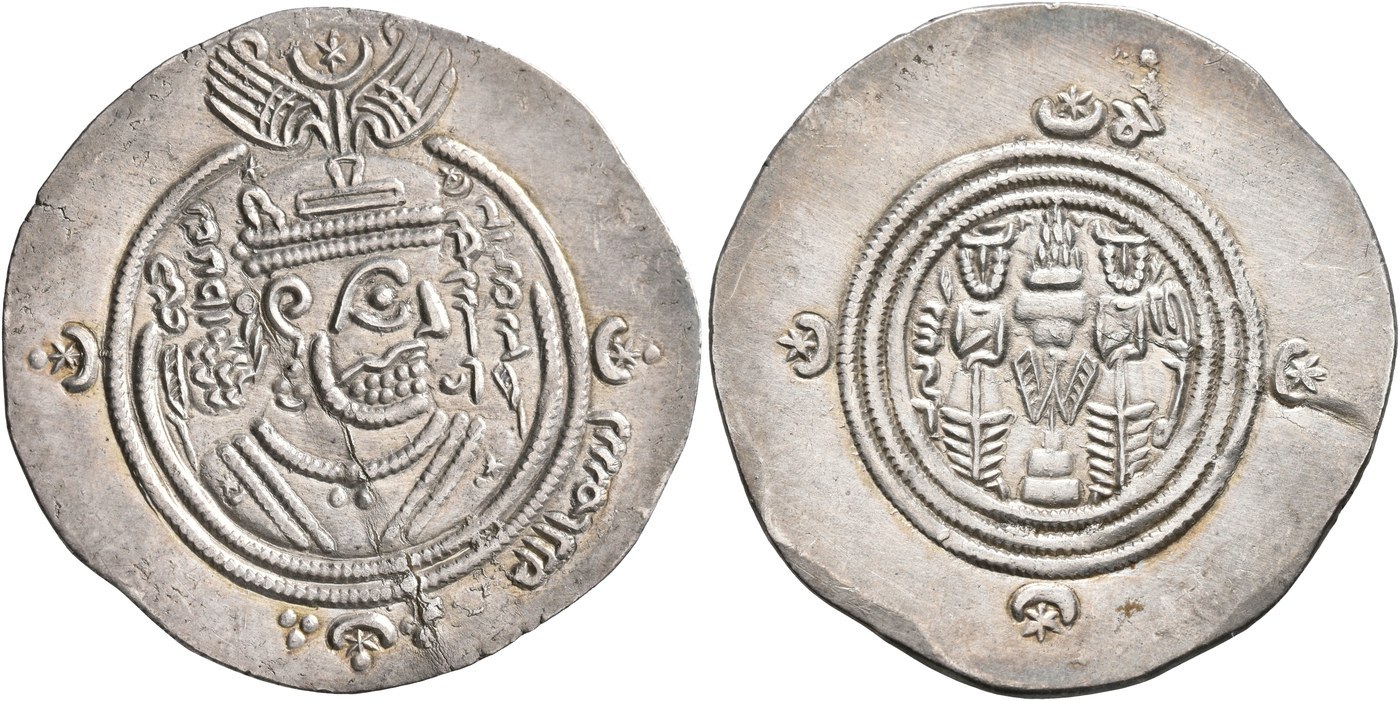
Dirham of Samura ibn Jundab
An Arab-Sassanian silver dirham struck in the name of the early governor Samura ibn Jundab, keeping the Persian Shah bust and fire-altar design with added Arabic.
- Country
- Islamic Caliphate
- Denomination
- Dirham
- Metal
- Silver
Got a coin like this?
Identify any coin from a photo, free.
Overview
The Dirham of Samura ibn Jundab is an Arab-Sassanian silver coin, a type struck in the decades after the Arab conquest of the Sassanian Persian Empire. Rather than inventing a new design, the early Islamic administration continued the well-established Sassanian silver drachm, keeping its Persian-style royal bust and its fire-altar reverse while adding short Arabic inscriptions in the margins. The example here carries this Sassanian-style bust with a decorative border on the obverse and the symmetrical altar-and-attendants composition with calligraphic elements on the reverse, dated to about 672-673 CE.
What sets this coin apart from an ordinary Sassanian drachm is the governor's name placed in the field beside the bust. Here that name is Samura ibn Jundab, an early Muslim figure associated with the governance of Basra in the mid-seventh century. Coins of this kind name the ruling authority who issued them rather than a Persian king, even though the imagery remains Persian.
These transitional dirhams are a snapshot of a caliphate that had taken over a functioning Persian monetary system and kept it running with only light modification, decades before the fully Arabic, image-free reform coinage appeared under Abd al-Malik at the end of the century.
History & Background
After the fall of the Sassanian Empire in the mid-seventh century, the expanding Arab caliphate inherited a mature silver coinage based on the drachm of the late Sassanian kings, especially the widely circulated types of Khusrau II. Local mints continued to strike these coins for the new rulers, who found it easier to maintain a trusted currency than to replace it outright. Governors of the eastern provinces issued silver in their own names using these Persian dies, adding brief Arabic phrases such as pious invocations in the margin.
Samura ibn Jundab was an early Muslim of the first generation who is recorded as having authority over Basra in Iraq during the governorship period of Ziyad ibn Abihi under the Umayyad caliph Mu'awiya. He is named as acting or deputy governor of Basra around the early 670s CE, and dirhams bearing his name belong to this window, consistent with the 672-673 CE date associated with the coin shown here.
The coin therefore sits in the Arab-Sassanian series, the bridge between purely Sassanian coinage and the reformed Islamic dirham. Dating on these pieces can follow the Yazdgerd era of the old Persian calendar or the Hijri era, and the year together with the mint signature in the reverse margin is what fixes an individual coin in time and place.
How to Identify
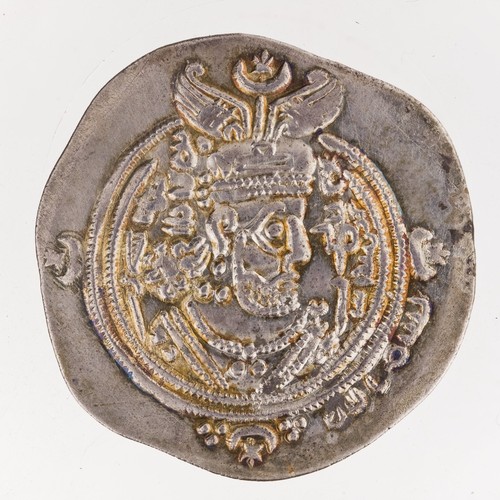
This is a thin, broad silver coin in the Sassanian drachm tradition, typically around 30-33 mm in diameter but only lightly struck on a spread flan, with a weight in the region of roughly 3.5-4.1 grams. The obverse shows a stylised royal bust facing right, wearing an elaborate Sassanian crown with wings and a globe, enclosed by one or more beaded circles and a decorative margin. This Persian imagery is retained wholesale from the pre-Islamic prototype.
The reverse carries the classic Sassanian fire altar flanked by two standing attendants, a strongly symmetrical composition, again surrounded by beaded borders with legends and symbols in the outer margins. What identifies the coin as an Islamic governor's issue rather than a purely Sassanian one is the added Arabic: short marginal phrases in Arabic script alongside the Pahlavi legends, and the governor's name in the obverse field. Reading Samura ibn Jundab's name is the key attribution point.
The surrounding Pahlavi (Middle Persian) inscriptions record the mint abbreviation and the year, usually placed in the reverse margin. Because the design language is Persian and the additions are Arabic, the coin looks at first glance like a Sassanian drachm; the presence of Arabic marginal script and an Arab governor's name in the field is the decisive difference.
Value & Collectibility
Arab-Sassanian dirhams occupy a specialist niche in the market. As a group they are more affordable than the earliest gold reform dinars, but named governor's issues in the name of a specific early figure such as Samura ibn Jundab are scarcer and more sought after than anonymous continuation drachms, and they draw interest from collectors of both Sassanian and early Islamic coinage.
Value is driven above all by the clarity of the crucial details: a legible governor's name in the field, a readable mint signature and year in the margin, sharp Sassanian portraiture, and an unbroken, uncracked flan. Because these coins were struck thin on large blanks, edge splits, weak strikes, and corrosion are common and pull value down, while a well-centred, fully legible example commands a strong premium within the series.
Exact prices vary widely with attribution, condition, and the specific mint and date, so the figures here are context rather than fixed quotes. For a coin like this, a confirmed reading of the governor's name and the mint-and-year is the single biggest factor separating a common Arab-Sassanian drachm from a desirable named issue.
Frequently asked questions
Who was Samura ibn Jundab?
He was an early Muslim of the first generation who held authority over Basra in Iraq in the early 670s CE, during the Umayyad period. Silver dirhams struck in his name belong to this governorship, consistent with the 672-673 CE date of the coin shown.
Why does an Islamic coin have a Persian king's portrait on it?
After the Arab conquest of Persia, the caliphate kept the familiar Sassanian silver drachm rather than replacing it. Governors struck coins using the old Persian bust and fire-altar design, adding only short Arabic phrases and their own name, until fully Arabic reform coinage appeared later.
What is on the reverse of the coin?
The reverse shows the Sassanian fire altar with two standing attendants, a symmetrical composition inherited from Persian coinage, surrounded by beaded borders with marginal inscriptions including the mint and year.
Is this coin made of real silver?
Yes. Arab-Sassanian dirhams continued the Sassanian silver drachm standard, so they are essentially silver coins, struck thin and broad, typically weighing in the region of about four grams.
How is the date of the coin known?
These coins carry a year in their margin, written in Pahlavi (Middle Persian) and dated either in the Persian Yazdgerd era or the Islamic Hijri era, alongside a mint abbreviation. The 672-673 CE range reflects the reading of that year together with the governor's tenure.
Dirham of Samura ibn Jundab guides
In-depth guides for identifying, valuing, and collecting Dirham of Samura ibn Jundab.
Other coins you may enjoy
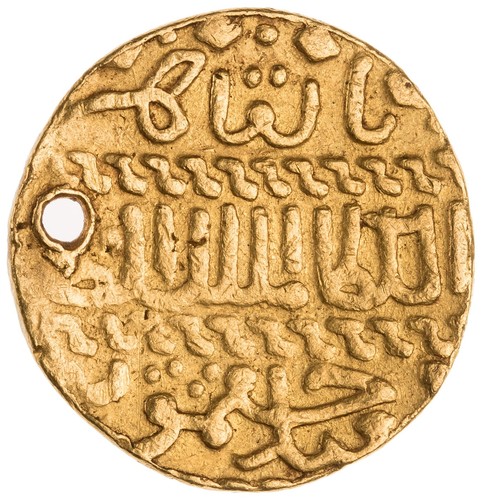
Gold Dinar of Jaqmaq
1438-1453 CE
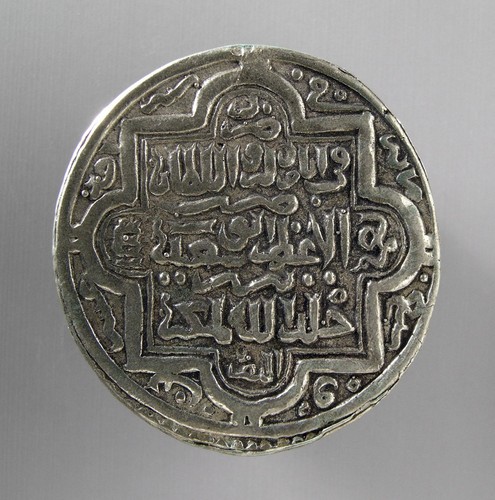
Ilkhanid Dirham
13th–14th century (Ilkhanate, c. 1256–1335 CE)
Ilkhanid Dirham of Ghazan
14th century (c. 1295-1304 CE)
Gold Dinar of al-Muqtadi
c. 467-475 AH (1074-1082 CE)
Gold Dinar of al-Hafiz li-Din Allah
AH 544 (AD 1149–1150)
Samanid Dirham
9th–10th century CE (roughly AH 3rd–4th century)
Copper Fals of Barquq
1382–1389 CE (first reign of Barquq)
Copper Fals of as-Salih Salih
Mid-14th century CE (reign of as-Salih Salih, AH 752–755 / 1351–1354 CE)
Gold Dinar of Malik Shah I
AH 465–485 (1072–1092 CE)
Ilkhanid Dirham of Abu Said
c. 1316-1335 CE (AH 716-736)
Silver Dirham of Salm ibn Ziyad
c. 682-683 CE
Silver Dirham (LACMA M.2002.1.437)
8th century CE (roughly AH 80s–190s)