
How to Identify the Dirham of Samura ibn Jundab
A collector's guide to spotting an Arab-Sassanian dirham of Samura ibn Jundab: the Persian bust, Arabic additions, mint-and-year margin, and fakes to watch.
Read the full Dirham of Samura ibn Jundab encyclopedia entry →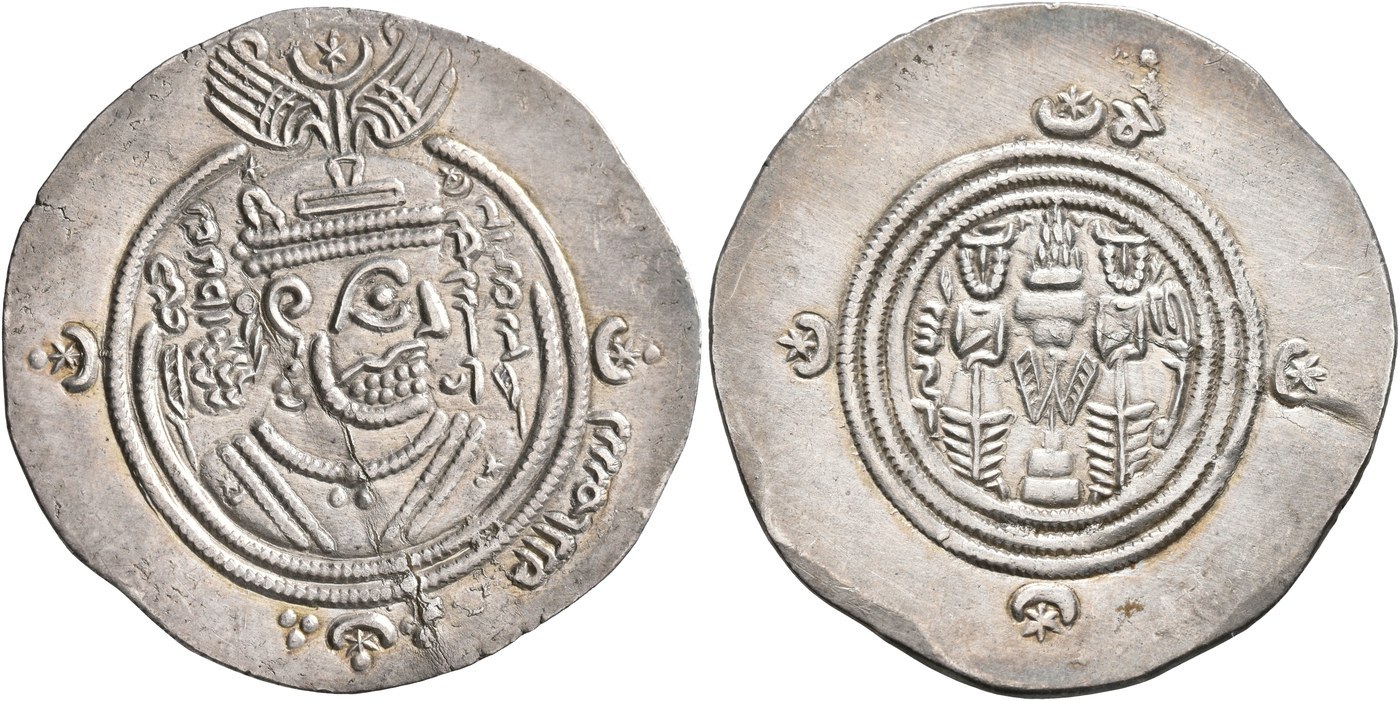
Begin with the fabric and format. This is an Arab-Sassanian silver dirham, so expect a thin, broad, slightly irregular flan roughly 30-33 mm across but weighing only about 3.5-4.1 grams, far lighter than its size suggests. A coin that is thick, heavy, magnetic, or obviously base metal is not this type. The overall look is that of a late Sassanian drachm, and at arm's length it is easy to mistake for a purely Persian coin, which is exactly why the details matter.
Read the obverse. You should see a right-facing royal bust in an ornate winged Sassanian crown, enclosed by beaded circles and a decorative margin. The identifying feature is not the portrait but the Arabic in the field and margin: a governor's name and short pious phrases in Arabic script sit alongside the Pahlavi legends. Confirming the name Samura ibn Jundab in the obverse field is the single most important attribution step, since the same Persian bust was used for many different issuers.
Check the reverse for the mint and year. The reverse carries the symmetrical fire altar with two attendants, and its outer margin holds the mint abbreviation and the date, written in Pahlavi. The year may be reckoned in the old Persian Yazdgerd era or in the Hijri era, so the same coin can appear under different date conventions in references. A correct reading of the mint signature and year, together with the governor's name, is what fixes the coin firmly in the series and distinguishes it from an anonymous continuation drachm.
Separate it from look-alikes. Genuine Sassanian drachms of Khusrau II share the same imagery but lack the added Arabic and the Arab governor's name. Anonymous Arab-Sassanian coins carry Arabic marginal phrases but no personal name. Only issues that actually name Samura ibn Jundab belong to this specific type, so never assume a Sassanian-looking silver coin is his without reading the field legend.
Finally, weigh authentication carefully. These coins are struck, not cast, so casting seams, surface bubbles, a soft mushy relief, or a mould line around the rim are warning signs. Modern forgeries and tooled or re-engraved legends exist, and because the value hinges on a named governor, a faked or altered name is a real risk. Weigh and measure the coin, photograph both faces sharply, and have the Pahlavi and Arabic legends checked against standard Arab-Sassanian references or by a specialist before treating it as a genuine named issue.
Frequently asked questions
How do I tell this coin apart from an ordinary Sassanian drachm?
Look for the added Arabic. A pure Sassanian drachm has only Pahlavi legends, while this type adds short Arabic phrases in the margin and an Arab governor's name in the obverse field. Confirming the name Samura ibn Jundab is the decisive test.
Where are the mint and date on the coin?
They are in the reverse margin, written in Pahlavi around the fire altar. The mint appears as an abbreviation and the year may be given in the Persian Yazdgerd era or the Islamic Hijri era, which is why dates can be quoted differently in references.
Why is my coin so thin and often cracked at the edge?
That is normal for Arab-Sassanian dirhams. They were struck thin and broad on wide silver blanks, so edge splits, weak areas, and slightly off-centre strikes are common and are not by themselves signs of a fake.
How can I check that it is authentic?
Genuine coins are struck, so watch for casting seams, bubbles, or a soft grainy surface that suggest a cast copy. Verify the weight and diameter, and because value depends on the named governor, have the field legend read by someone familiar with Arab-Sassanian coinage to rule out an altered or forged name.