
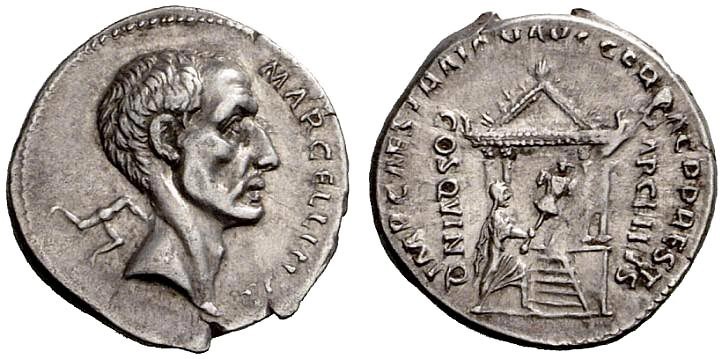
Denarius of Trajan
Silver denarius of the emperor Trajan (98–117 AD), showing his laureate bust and, on this piece, Libertas standing with patera and rod.
- Country
- Roman Empire
- Denomination
- Denarius
- Metal
- Silver
Got a coin like this?
Identify any coin from a photo, free.
Overview
The denarius was the standard silver coin of the Roman Empire, and this example was struck during the reign of Trajan (Marcus Ulpius Traianus), who ruled from 98 to 117 AD. It is a small, hand-struck silver piece bearing a portrait of the emperor on the obverse and a personification of a Roman virtue or deity on the reverse.
The coin shown here has the laureate bust of Trajan facing right, surrounded by an abbreviated Latin legend giving his names and titles. The reverse depicts Libertas, the personification of liberty, standing to the left and holding a patera (a shallow offering dish) in one hand and a rod or scepter in the other. Denarii like this circulated widely across the empire and are among the most commonly collected Roman imperial coins today.
History & Background
Trajan was the second of the so-called Five Good Emperors and is remembered for expanding the Roman Empire to its greatest territorial extent, including the conquest of Dacia and campaigns in the East. His long reign produced an enormous and varied coinage struck primarily at the mint of Rome, funded in part by the spoils of the Dacian Wars.
The denarius had by Trajan's time been the backbone of Roman silver currency for over two centuries. Reverse types under Trajan celebrated military victories, public works, the emperor's titles, and personified virtues such as Liberty, Victory, Fortune, and Peace. The Libertas reverse seen here reflects the standard imperial practice of using coinage to broadcast the emperor's image and the values associated with his rule.
Because Trajan reigned for nearly two decades and minted heavily, his denarii survive in large numbers and are frequently found in hoards and on the ancient-coin market. His obverse legends and titles changed over the reign, which allows many of his coins to be dated to narrower periods within the 98–117 AD span.
How to Identify
This is a small silver coin roughly 17–20 mm across and typically weighing in the neighborhood of 3 to 3.5 grams, struck by hand so that flans are often slightly irregular and off-center. Genuine examples show the toning, wear, and minor flan flaws expected of a hand-struck ancient coin nearly two thousand years old.
The obverse carries a right-facing laureate bust of Trajan wrapped by an abbreviated Latin legend; his titles commonly include forms such as IMP TRAIANO AVG GER DAC and PM TR P, along with COS and PP. The reverse of this piece shows Libertas standing left, holding a patera and a rod, with a surrounding legend that names the emperor's offices and honors. Read the legends carefully, as the reverse figure and its attributes (here the dish and rod) are essential for pinning down the exact type.
Mint marks in the modern sense are absent; Trajan's denarii were struck chiefly at Rome, and attribution relies on the combination of portrait style, legend, and reverse type rather than a mint letter. Reference works such as RIC (Roman Imperial Coinage) catalog the many varieties by these details.
Value & Collectibility
Trajan denarii are among the more affordable Roman imperial silver coins because they were produced in great quantity and survive widely. Worn but identifiable examples commonly trade in the modest range of a few tens of dollars, while attractive pieces with clear portraits and legends bring more.
Condition is the main value driver. Coins with sharp detail, good centering, pleasant toning, and full legends command higher prices, and especially well-preserved or scarce reverse types can reach into the hundreds of dollars. Rare varieties, exceptional strikes, or coins with notable provenance sit at the top of the range.
Values given here are general context, not a quotation for any specific coin. Actual worth depends on grade, eye appeal, the particular reverse type, and authentication, and buyers should seek examples that are clearly genuine and, where possible, attributed to a catalog reference.
Frequently asked questions
Is a denarius of Trajan real silver?
Yes. The denarius of Trajan's era was struck in silver, though the imperial silver standard was not pure and alloys varied. These coins are genuinely silver, not silver-plated base metal.
How old is a Trajan denarius?
Trajan reigned from 98 to 117 AD, so his denarii are roughly 1,900 years old. Many can be dated to a narrower window within that span based on the emperor's titles in the legend.
Who is the figure on the reverse of this coin?
This example shows Libertas, the Roman personification of liberty, standing left and holding a patera (offering dish) and a rod. Trajan used many different reverse figures across his coinage.
Are Trajan denarii valuable?
They are among the more affordable ancient Roman silver coins because they are common. Worn pieces are modestly priced, while well-preserved coins with sharp detail and full legends bring higher premiums.
Where were these coins made?
Trajan's denarii were struck mainly at the mint of Rome. They carry no modern mint mark, so attribution relies on portrait style, legend, and reverse type rather than a mint letter.
Denarius of Trajan guides
In-depth guides for identifying, valuing, and collecting Denarius of Trajan.
Other coins you may enjoy
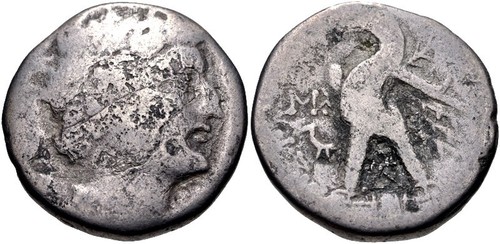
Tetradrachm of Ptolemy XII
80-51 BC
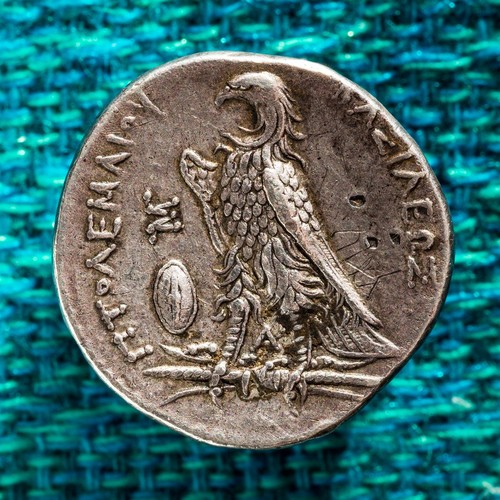
Tetradrachm of Ptolemy I
305-283 BC
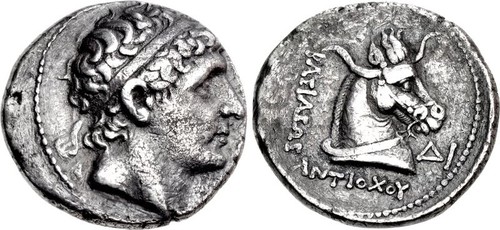
Tetradrachm of Antiochos I Soter
281-261 BC
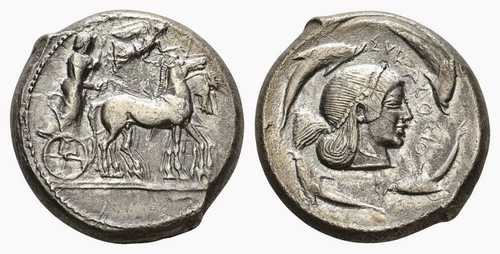
Syracuse Tetradrachm
c. 5th-4th century BC (Classical period)
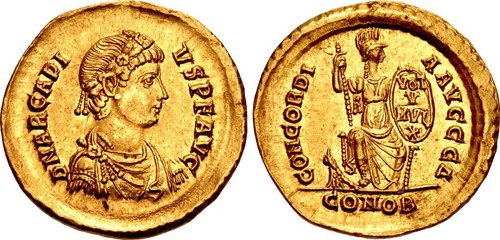
Solidus of Arcadius
AD 395-402
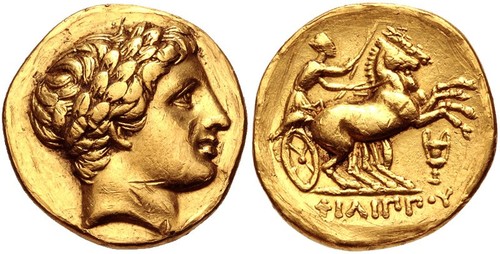
Philip III Gold Stater
323-317 BC
Siliqua of Gratian
AD 367-383
Sestertius of Maximinus Thrax
235-238 AD
Solidus of Valentinian III
AD 425-455
Seleucus I Nicator Tetradrachm
Late 4th-3rd century BC
Nummus of Magnentius
AD 350-353
Follis of Galerius
AD 308-310