
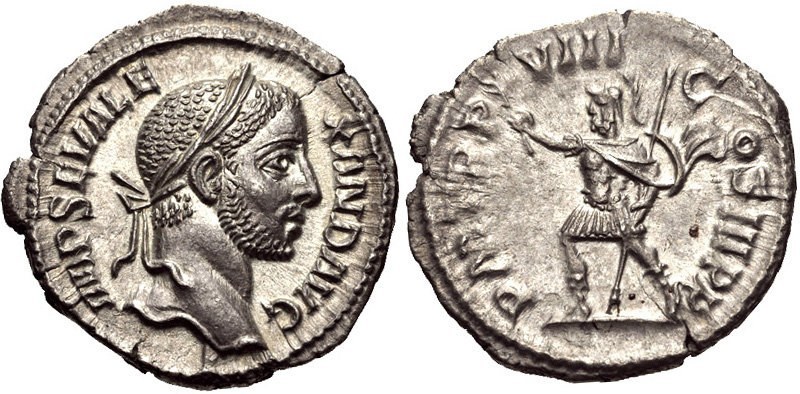
Denarius of Severus Alexander
Silver denarius of the emperor Severus Alexander (AD 222–235), with his laureate portrait and a Mars reverse dated to about AD 229.
- Country
- Roman Empire
- Denomination
- Denarius
- Metal
- Silver
Got a coin like this?
Identify any coin from a photo, free.
Overview
The Denarius of Severus Alexander is a silver coin struck during the reign of the emperor Severus Alexander (AD 222–235), the last ruler of the Severan dynasty. This example shows the standard imperial format of the period: a laureate bust of the emperor facing right on the obverse and, on the reverse, the war god Mars standing left holding a spear and shield.
Denarii of Severus Alexander are among the more common surviving silver coins of the third century AD, as the mint at Rome produced them in quantity across his long reign. The reverse type seen here, dated to about AD 229, belongs to a family of military and virtue themes that were used repeatedly on his coinage.
History & Background
Severus Alexander became emperor as a teenager in AD 222 after the murder of his cousin Elagabalus, and his government was heavily guided by his mother, Julia Mamaea, and a council of advisers. His reign is generally remembered as a period of comparative moderation before the instability of the mid-third century, and it produced a large and varied coinage from the mint of Rome.
The denarius had been the backbone of Roman silver coinage for centuries, but by the 220s AD its silver content had declined substantially from earlier standards as successive emperors reduced its fineness. Under Severus Alexander the denarius continued to circulate alongside the larger double-denarius (antoninianus), which had been introduced a few years earlier.
Severus Alexander was killed by his own troops in AD 235 during a campaign on the Rhine frontier, an event that ended the Severan dynasty and opened the decades of turmoil known as the Crisis of the Third Century. His denarii were struck throughout the roughly thirteen years of his rule.
How to Identify
The obverse shows the laureate head or bust of Severus Alexander facing right, surrounded by a Latin legend naming him, commonly a form such as IMP SEV ALEXAND AVG or IMP C M AVR SEV ALEXAND AVG. The reverse of this type depicts Mars standing and facing left, holding a spear and resting on or holding a shield, with a reverse legend that on dated issues records his titles and regnal year; a legend such as P M TR P VIII COS III P P points to about AD 229.
A denarius of this period is a small silver coin, typically around 18–20 mm across and roughly 2.5–3.3 grams, struck on a hand-made flan so that the shape is slightly irregular and the strike is often off-center. The metal has a pale silver appearance but is noticeably debased compared with earlier Roman denarii.
The key distinction to watch is the crown: a denarius carries a laureate portrait (a wreath), whereas the contemporary antoninianus of Severus Alexander shows the emperor wearing a radiate (spiked) crown and is a slightly larger coin.
Value & Collectibility
Denarii of Severus Alexander are relatively common and are among the more affordable authentic ancient Roman silver coins. Well-worn but identifiable examples frequently trade in the low tens of dollars, while attractive, well-centered, sharply struck pieces command more.
Value is driven mainly by condition (wear, strike quality, centering, and surfaces), the clarity of the portrait and reverse figure, and eye appeal such as pleasant toning. Common Mars and virtue reverse types are less scarce than rarer commemorative or personified types, which can carry a premium.
Because exact prices depend heavily on grade and the individual coin, treat any single figure as a range rather than a fixed number, and compare recent sales of similar examples before buying or selling.
Frequently asked questions
Is a denarius of Severus Alexander made of real silver?
Yes, it is a silver coin, but by the 220s AD the denarius was significantly debased and contained less silver than earlier Roman denarii, so the metal looks pale and grayish rather than bright white.
What does the Mars reverse mean?
Mars was the Roman god of war, and showing him with a spear and shield advertised military strength and protection of the state. It was a common propaganda theme on imperial coinage and does not necessarily commemorate a specific battle.
How can I date this coin to around AD 229?
Roman reverse legends often record the emperor's tribunician power and consulships, which increased over time. A legend indicating his eighth tribunician year and third consulship (TR P VIII COS III) corresponds to roughly AD 229.
Is this a rare coin?
No. Severus Alexander reigned for over a decade and the mint of Rome produced denarii in large numbers, so common reverse types like this survive in quantity and are widely available to collectors.
Denarius of Severus Alexander guides
In-depth guides for identifying, valuing, and collecting Denarius of Severus Alexander.
Other coins you may enjoy
Tetradrachm of Ptolemy XII
80-51 BC
Tetradrachm of Ptolemy I
305-283 BC
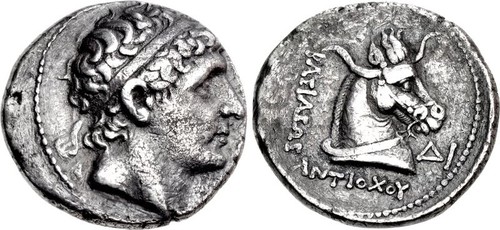
Tetradrachm of Antiochos I Soter
281-261 BC
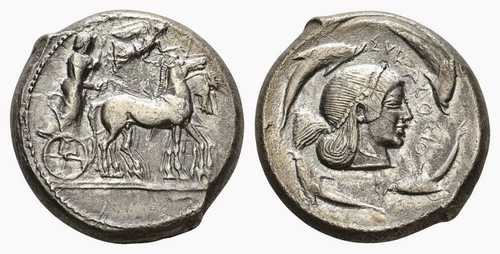
Syracuse Tetradrachm
c. 5th-4th century BC (Classical period)
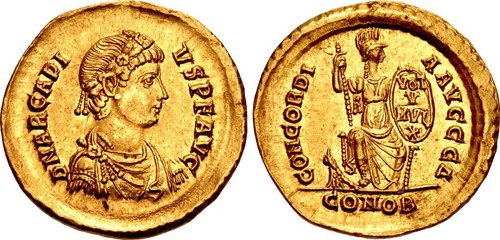
Solidus of Arcadius
AD 395-402
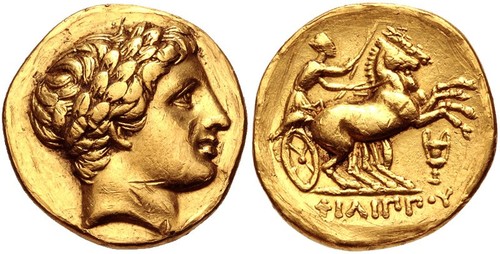
Philip III Gold Stater
323-317 BC
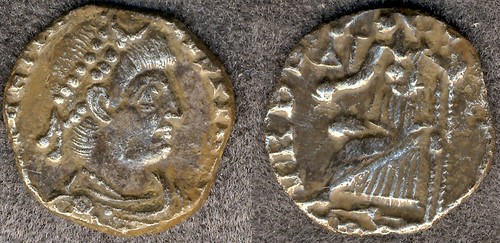
Siliqua of Gratian
AD 367-383
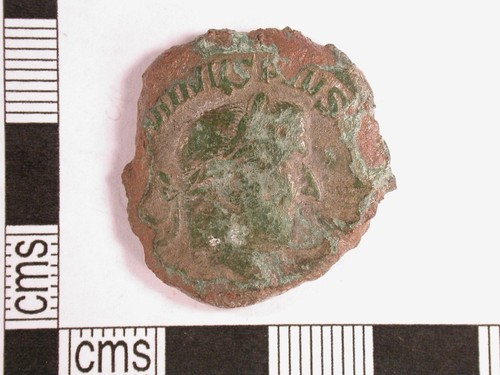
Sestertius of Maximinus Thrax
235-238 AD
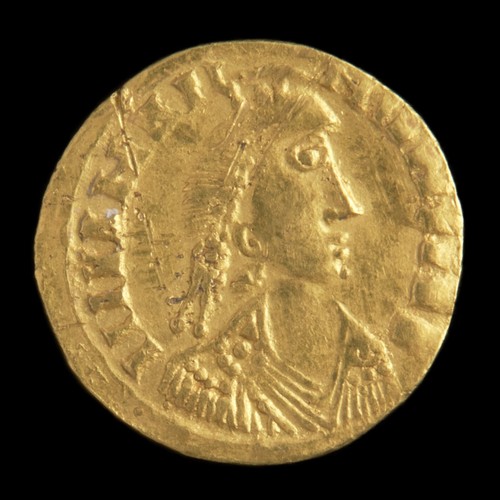
Solidus of Valentinian III
AD 425-455
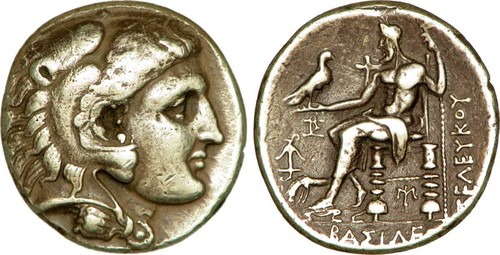
Seleucus I Nicator Tetradrachm
Late 4th-3rd century BC
Nummus of Magnentius
AD 350-353
Follis of Galerius
AD 308-310