
How to Identify the Denarius of Severus Alexander
A collector's guide to recognizing a silver denarius of Severus Alexander by its laureate portrait, Mars reverse, size, and legends.
Read the full Denarius of Severus Alexander encyclopedia entry →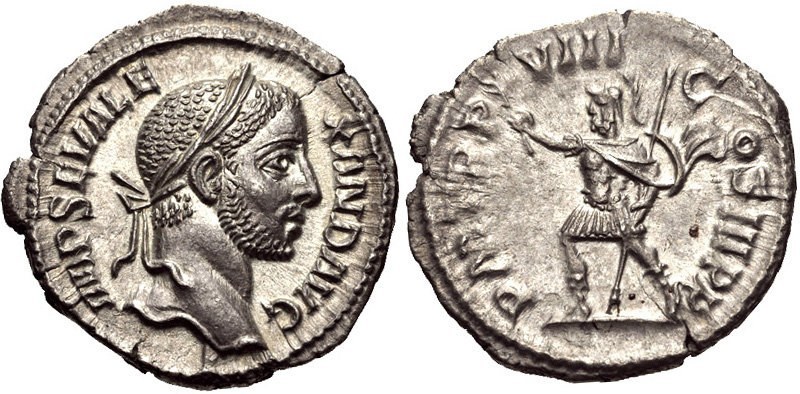
Start with the portrait. A denarius of Severus Alexander shows a youthful-to-mature male head facing right wearing a laurel wreath, not a spiked radiate crown. The laurel wreath is the single most important diagnostic separating a denarius from the larger antoninianus (double denarius) of the same emperor, which uses a radiate crown. Read the surrounding obverse legend for the name ALEXAND or ALEXANDER to confirm the ruler.
Check the reverse figure and legend. This type shows Mars standing and facing left with a spear and a shield; the god is typically nude or in a military cloak. The reverse legend records imperial titles and can date the coin: forms containing TR P followed by a numeral and COS with a numeral pin down the regnal year, with TR P VIII COS III corresponding to about AD 229. Even when a legend is partly worn, the standing warrior with spear and shield is a recognizable Mars type.
Confirm the physical characteristics. Expect a small hand-struck silver coin roughly 18–20 mm in diameter and about 2.5–3.3 grams, with an irregular flan and often an off-center strike. The silver is debased for this era, so a somewhat dull, grayish tone is normal and does not by itself indicate a fake. A suspiciously bright, perfectly round, seam-edged, or lightweight piece deserves scrutiny.
Distinguish look-alikes. The most common confusion is with the antoninianus of Severus Alexander (radiate crown, larger and heavier) and with denarii of other Severan rulers such as Caracalla, Elagabalus, or Julia Mamaea, which use similar Mars and virtue reverses; always let the obverse name and portrait decide. Cast copies and modern tourist fakes exist: watch for soft mushy detail, casting bubbles or seams, granular surfaces, and unnatural weight.
For authentication, favor coins with provenance or a reputable dealer's attribution, and cross-reference the exact legend against a standard reference such as RIC (Roman Imperial Coinage). When in doubt, seek an opinion from an experienced ancient-coin specialist before paying a premium, since surfaces, tooling, and edge details are hard to judge from photographs alone.
Frequently asked questions
How do I tell a denarius from an antoninianus of Severus Alexander?
Look at the crown. The denarius has a laureate (laurel-wreath) portrait and is smaller and lighter, while the antoninianus has a radiate (spiked) crown and is a larger, heavier double denarius.
The legend is worn — can I still identify it?
Often yes. The right-facing laureate male portrait plus a standing figure holding a spear and shield strongly suggests a Mars-reverse denarius of this era; any surviving letters like ALEXAND on the obverse confirm the emperor.
What are common signs of a fake?
Casting seams on the edge, surface bubbles or pitting, mushy or overly soft detail, a perfectly round flan, and weight far outside the roughly 2.5–3.3 gram range are all warning signs. Buy from reputable sources when possible.