
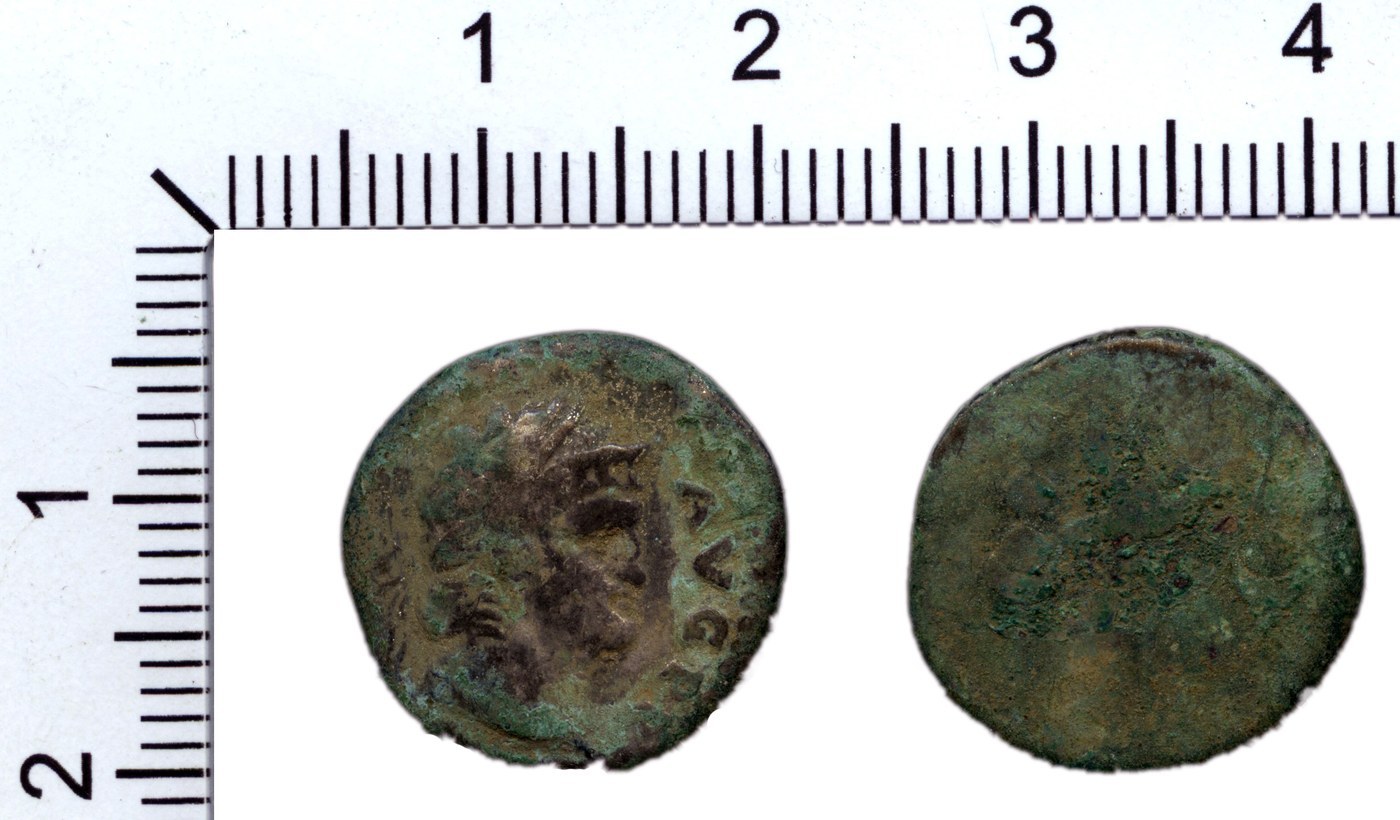
Denarius of Nero
Silver denarius of the emperor Nero (AD 54-68), the last Julio-Claudian ruler, shown with a laureate portrait and a military-standards reverse.
- Country
- Roman Empire
- Denomination
- Denarius
- Metal
- Silver
Got a coin like this?
Identify any coin from a photo, free.
Overview
The Denarius of Nero is a Roman silver coin struck during the reign of Nero Claudius Caesar Augustus Germanicus, who ruled from AD 54 to 68 as the last emperor of the Julio-Claudian dynasty. The denarius was the standard silver denomination of the early Roman Empire, a small hand-struck disc that circulated across the Mediterranean world.
The example shown has a laureate head of Nero facing right on the obverse, surrounded by a Latin legend naming and titling him (laureate reformed issues typically read NERO CAESAR AVGVSTVS). The reverse presents military standards (signa) — the legionary and vexillum standards that symbolized the army and the loyalty of the troops to the emperor.
Nero is one of the most famous — and infamous — figures of the ancient world, which makes coins bearing his portrait perennially popular with collectors of the "Twelve Caesars" and of Julio-Claudian silver.
History & Background
Nero succeeded his adoptive father Claudius in AD 54 at the age of sixteen and reigned until his death in AD 68, when revolt and abandonment by the Senate and army drove him to suicide, ending the Julio-Claudian line and opening the Year of the Four Emperors. His portrait coinage traces his changing image, from a youthful early likeness (sometimes paired with his mother Agrippina) to the fuller, thick-necked adult profile of his later years.
A pivotal event for the coinage was Nero's monetary reform around AD 64, which reduced the weight of both the gold aureus and the silver denarius and lowered the silver fineness of the denarius. Earlier denarii of the reign follow the older, heavier Julio-Claudian standard, while the laureate portraits belong mainly to the reformed coinage of roughly AD 64-68; before the reform, imperial portraits were more often bare-headed.
Nero's denarii were struck principally at the mint of Rome, with some early imperial silver associated with a mint at Lugdunum (Lyon). Reverse types across the reign include deities and personifications such as Jupiter, Roma, Salus, Ceres, Vesta, Virtus and Concordia, as well as military standards, each carrying its own legend and each catalogued as a distinct issue.
How to Identify
Start with the portrait and obverse legend. The coin shows a laureate male head facing right — wearing a laurel wreath rather than a radiate crown — with the broad face, full neck and forward-combed hair characteristic of the mature Nero. The surrounding legend must name him; reformed laureate denarii commonly read NERO CAESAR AVGVSTVS, while earlier issues use longer titulatures such as NERO CLAVD CAESAR AVG GERM. Confirming the name NERO in the legend is the decisive step.
This is a small silver coin, roughly 17-19 mm in diameter. Weight depends on when it was struck: pre-reform denarii run near 3.8-3.9 g, while the post-reform laureate coinage of about AD 64-68 is lighter, around 3.2-3.5 g, and of somewhat reduced silver fineness. The flan is slightly irregular and often a little off-center, as expected of a hand-struck ancient coin.
The reverse of the illustrated coin shows military standards (signa) — upright legionary standards and a vexillum banner. Because Nero used many reverse designs, identification of the exact issue rests on reading the reverse type and its Latin legend together with the obverse NERO legend, then matching the combination to a reference such as RIC (Roman Imperial Coinage).
Value & Collectibility
Denarii of Nero are in steady demand because of his fame, but they are not among the rarest Roman silver coins — he reigned fourteen years and minted extensively. Well-worn but clearly identifiable examples with a readable portrait and legend often trade from roughly the low hundreds of US dollars, while attractive, well-centered pieces with a sharp portrait typically bring several hundred to over a thousand dollars.
Value is driven by portrait quality, centering, surface, and the desirability of the reverse type. Collectors buy Nero chiefly for the face, so a strong, well-struck likeness commands a premium, while corroded, holed, cleaned, or heavily worn coins sell for less. Rarer reverse types and exceptional high-grade examples reach substantially higher figures at auction.
These are broad ranges rather than fixed prices, and because Nero is a high-demand, frequently faked emperor, values are meaningful only for a coin whose authenticity is established. Pieces with documented provenance or third-party certification generally realize stronger results.
Frequently asked questions
Who was Nero?
Nero Claudius Caesar Augustus Germanicus was Roman emperor from AD 54 to 68 and the last ruler of the Julio-Claudian dynasty. He is one of the most notorious emperors, and his death by suicide in AD 68 ended the line and triggered the Year of the Four Emperors.
Is a denarius of Nero real silver?
Yes. The denarius was the standard Roman silver coin. Nero's monetary reform around AD 64 reduced both its weight and its silver fineness, so later laureate denarii are lighter and slightly less pure than earlier ones, but they remain silver coins of about 3.2 to 3.9 grams.
How old is a Nero denarius?
It dates to Nero's reign, AD 54 to 68, making surviving examples roughly 1,960 years old.
What do the military standards on the reverse mean?
The signa are the standards carried by Roman legions, together with a vexillum banner. As a coin type they advertised the loyalty and strength of the army and the emperor's bond with his troops, a common message on imperial coinage.
Why is the portrait laureate rather than bare-headed?
Nero's earliest imperial portraits are often bare-headed, while the laurel-wreathed (laureate) portraits belong mainly to the reformed coinage of about AD 64 to 68. A laureate head therefore points to a later issue of the reign.
Denarius of Nero guides
In-depth guides for identifying, valuing, and collecting Denarius of Nero.
Other coins you may enjoy
Tetradrachm of Ptolemy XII
80-51 BC
Tetradrachm of Ptolemy I
305-283 BC
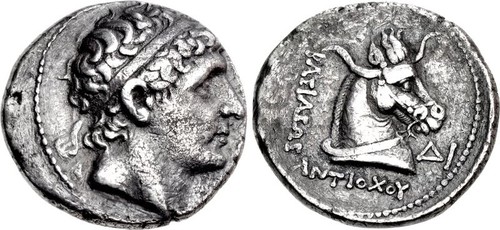
Tetradrachm of Antiochos I Soter
281-261 BC
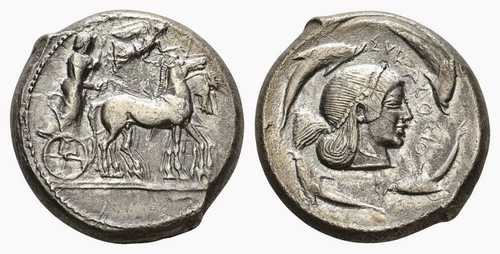
Syracuse Tetradrachm
c. 5th-4th century BC (Classical period)
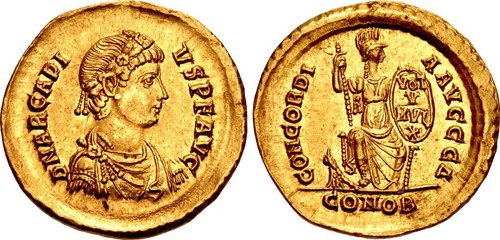
Solidus of Arcadius
AD 395-402
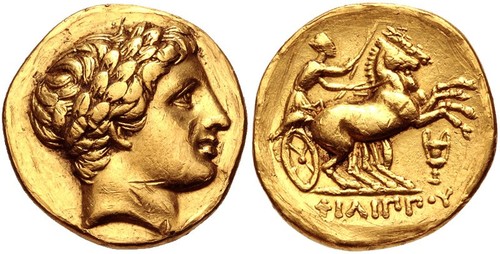
Philip III Gold Stater
323-317 BC
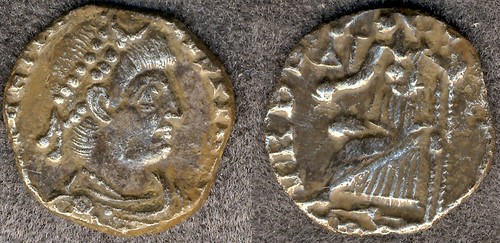
Siliqua of Gratian
AD 367-383
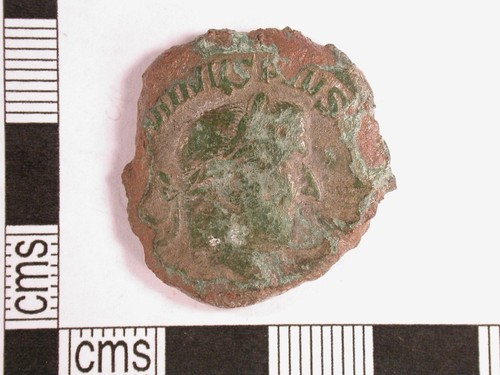
Sestertius of Maximinus Thrax
235-238 AD
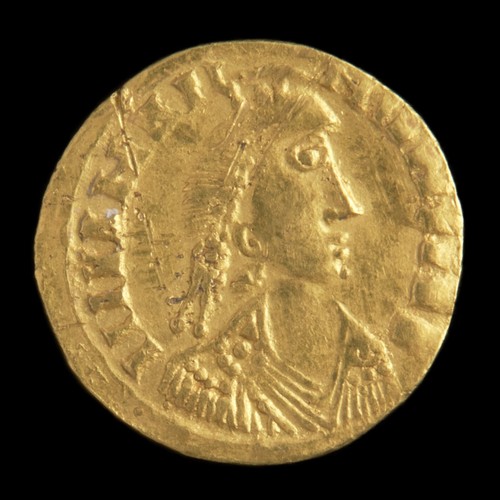
Solidus of Valentinian III
AD 425-455
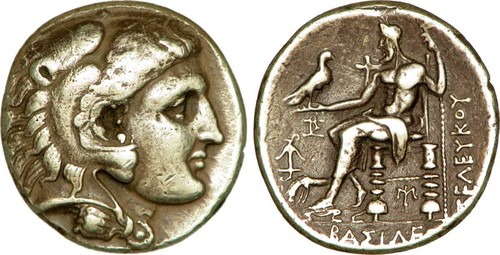
Seleucus I Nicator Tetradrachm
Late 4th-3rd century BC
Nummus of Magnentius
AD 350-353
Follis of Galerius
AD 308-310