
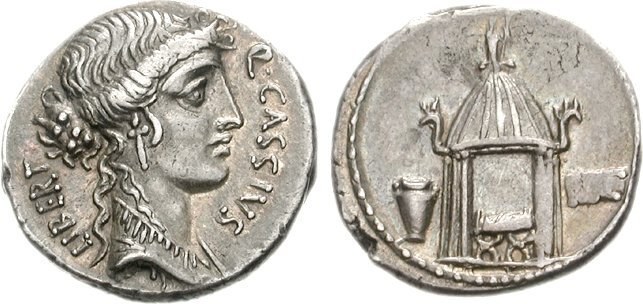
Denarius of Cassius Longinus
Silver denarius struck in 42 BC by Gaius Cassius Longinus, one of Caesar's assassins, to pay his legions before the Battle of Philippi.
- Country
- Roman Republic
- Denomination
- Denarius
- Metal
- Silver
Got a coin like this?
Identify any coin from a photo, free.
Overview
The Denarius of Cassius Longinus is a silver coin issued in 42 BC by Gaius Cassius Longinus, the Roman general who, with Marcus Brutus, led the conspiracy that assassinated Julius Caesar. It belongs to the so-called Liberators' coinage: military money struck in the eastern provinces to fund the armies that would meet the forces of Octavian and Mark Antony.
The coin follows the standard late-Republican pattern of a deity's head in right profile on the obverse and an emblem on the reverse. On this series the obverse carries the head of Libertas (the personification of Liberty), the political watchword of Caesar's assassins, while the reverse bears a naval or military emblem — characteristically an aplustre, the ornamented stern-piece of a warship — alluding to Cassius' command at sea. Both sides carry Latin legends naming Cassius as IMP (Imperator) alongside one of his subordinate officers.
History & Background
By 42 BC the Roman world had split into open civil war. After Caesar's murder in 44 BC, Cassius and Brutus withdrew to the East, where they raised legions and gathered money and ships for the coming struggle against the Second Triumvirate of Octavian, Mark Antony, and Lepidus. Coinage like this denarius was struck by a travelling military mint — associated with Cassius' base in Asia Minor — to pay and reward those troops.
The imagery is frankly propagandistic. Libertas on the obverse declared the assassins' claim to have freed Rome from a would-be king, while Cassius' title IMP (Imperator) asserted his standing as a victorious commander. The reverse naval emblem points to his operations at sea, including his campaign against Rhodes, whose fleet he defeated and whose wealth helped bankroll his army.
The political cause behind the coin failed within months. At the twin battles of Philippi in late 42 BC, the armies of Brutus and Cassius were broken; Cassius took his own life after the first engagement, and Brutus followed after the second. Coins such as this were struck on the eve of that defeat, which is a large part of what makes them so evocative to collectors today.
How to Identify
Look first for the combination that defines the type: a deity's head in right profile on the obverse paired with a naval or military emblem on the reverse, and a Latin legend naming CASSI (Cassius) with the title IMP. The reverse is typically an aplustre — a fan-shaped, curling ornament representing the decorated stern of a galley — though on related dies the emblem can be a jug and lituus (priestly implements) or other symbols.
The obverse head represents Libertas, shown wreathed or diademed and facing right; the surrounding legend reads a form of C·CASSI·IMP. The reverse legend usually adds the name of a subordinate officer, such as M·SERVILIVS·LEG (the legate Marcus Servilius) or LENTVLVS·SPINT, which helps pin down the exact variety.
Physically it is a standard Roman Republican silver denarius: roughly 17–20 mm in diameter and about 3.5–4 grams, hand-struck on a slightly irregular flan. Genuine silver shows a bright to grey-toned white metal, never a yellow or brassy cast. Because it was struck by hand from individual dies, expect minor off-centering, flan cracks, and variation from coin to coin — features that are normal for the period, not defects.
Value & Collectibility
As authentic silver coinage tied directly to one of history's most famous assassins, the Denarius of Cassius Longinus is a desirable and historically significant type that trades well above the value of ordinary Republican denarii. Precise prices vary widely by variety, style, and condition, so this coin is best valued against recent auction results for the same Crawford variety and grade rather than a single figure.
As a rough guide, worn but genuine examples generally reach the mid hundreds of dollars, attractive well-centered pieces the high hundreds to low thousands, and exceptional or rare varieties considerably more. Strong strike, complete legends, clear portrait detail, and pleasant original toning all add a premium, while cleaning, corrosion, or crude flans reduce value.
Because the type is prized and frequently reproduced, certification from a reputable ancient-coin grading service or dealer is strongly recommended before paying a serious sum. A slabbed or professionally attributed example both confirms authenticity and makes it far easier to compare against market records.
Frequently asked questions
Who was the Cassius Longinus who issued this coin?
Gaius Cassius Longinus was a Roman general and senator who, with Marcus Brutus, led the conspiracy that assassinated Julius Caesar in 44 BC. He struck this denarius in 42 BC to pay the armies he raised in the East before the Battle of Philippi.
What do the designs on the coin mean?
The obverse head represents Libertas, the personification of Liberty and the political slogan of Caesar's assassins. The reverse naval emblem — typically an aplustre, the ornamented stern of a warship — refers to Cassius' command at sea, including his campaign against Rhodes.
Is this coin real silver?
Yes. It is a standard Roman Republican silver denarius, about 17–20 mm across and roughly 3.5–4 grams. Genuine examples show bright or grey-toned white silver on an irregular, hand-struck flan, not a yellow base-metal color.
Why is this denarius considered historically important?
It was struck by one of Caesar's assassins on the eve of the Battle of Philippi, where Cassius and Brutus were defeated and Cassius died. Coins connecting directly to that moment are among the most sought-after issues of the Roman Republic.
How much is a Denarius of Cassius Longinus worth?
Value depends heavily on variety and condition, but genuine examples typically range from the mid hundreds of dollars for worn pieces to the low thousands or more for sharp, well-centered coins. Compare against recent auction results and seek certification before buying.
Denarius of Cassius Longinus guides
In-depth guides for identifying, valuing, and collecting Denarius of Cassius Longinus.
Other coins you may enjoy
Tetradrachm of Ptolemy XII
80-51 BC
Tetradrachm of Ptolemy I
305-283 BC
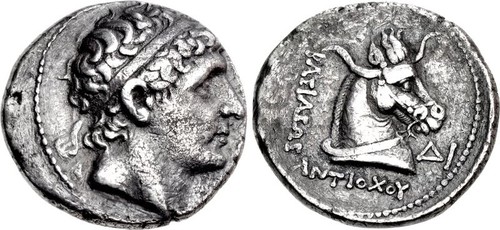
Tetradrachm of Antiochos I Soter
281-261 BC
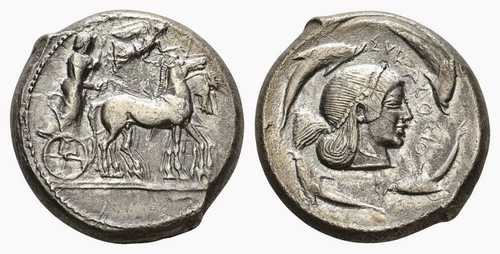
Syracuse Tetradrachm
c. 5th-4th century BC (Classical period)
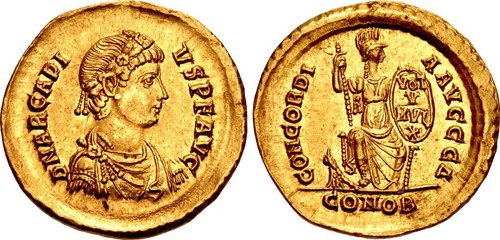
Solidus of Arcadius
AD 395-402
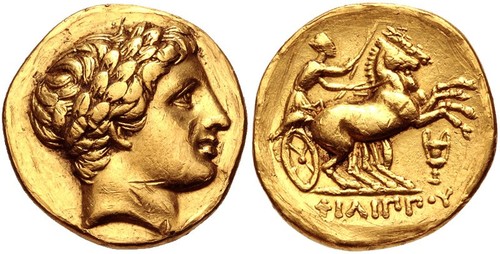
Philip III Gold Stater
323-317 BC
Siliqua of Gratian
AD 367-383
Sestertius of Maximinus Thrax
235-238 AD
Solidus of Valentinian III
AD 425-455
Seleucus I Nicator Tetradrachm
Late 4th-3rd century BC
Nummus of Magnentius
AD 350-353
Follis of Galerius
AD 308-310