
How to Identify the Denarius of Cassius Longinus
A collector's guide to confirming Cassius' 42 BC silver denarius by its Libertas head, naval emblem, CASSI IMP legend, and size.
Read the full Denarius of Cassius Longinus encyclopedia entry →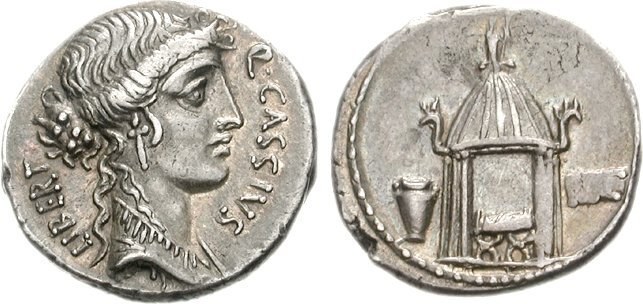
Begin with the legend, which is the surest way to attribute the coin. Genuine examples name Cassius with a form of C·CASSI·IMP and usually add the name of a subordinate officer on the reverse — for instance M·SERVILIVS·LEG or LENTVLVS·SPINT. Reading even part of these inscriptions separates this issue from the many other late-Republican denarii that share its general layout.
Study the two sides together. The obverse should show a wreathed or diademed head of Libertas in right profile — a calm, idealized classical head, not a realistic portrait. The reverse should carry a naval or military emblem, most often an aplustre (the fan-shaped, curling stern-ornament of a galley); some dies instead show a jug and a lituus (a curved priestly staff). The specific reverse emblem plus the officer's name together identify the exact Crawford variety.
Check the physical specifications. This is a Roman Republican silver denarius: about 17–20 mm in diameter, roughly 3.5–4 grams, and hand-struck, so a slightly oval, irregular flan with minor off-centering or a flan crack is normal and even reassuring. The metal should read as silver — bright white to softly grey-toned — and the coin should not be attracted to a magnet.
Be alert to look-alikes and reproductions. Many modern replicas and museum copies of Cassius' denarii exist, and they are often sold openly; watch for a too-perfect round flan, a seam around the edge (a sign of casting), mushy or doubled lettering, and unnaturally uniform surfaces. The type is also related to other Liberators' issues — including coins of Brutus — so confirm the CASSI legend specifically rather than assuming any Libertas-head denarius is Cassius'.
Finally, exercise authentication caution proportional to the price. Because genuine examples are valuable, high-quality forgeries and tooled or repaired coins are a real risk. For any significant purchase, rely on third-party certification or a reputable ancient-coin specialist, and compare the portrait style, legend arrangement, and reverse emblem against verified reference images and Crawford's catalogue.
Frequently asked questions
What is the fastest way to confirm this is a Cassius denarius?
Read the legend for a form of C·CASSI·IMP, and look for an accompanying officer's name such as M·SERVILIVS·LEG or LENTVLVS·SPINT. That inscription, with a Libertas head and a naval or priestly emblem, identifies the type.
What size and weight should a genuine example be?
Expect a Roman Republican silver denarius about 17–20 mm in diameter and roughly 3.5–4 grams, struck by hand on a slightly irregular flan. A perfectly round, seamed, or magnetic piece points to a cast copy or replica.
How do I tell it apart from a coin of Brutus?
Both belong to the Liberators' coinage and can share a Libertas head, so rely on the legend. A Cassius denarius names CASSI and his officers, while Brutus' coins name BRVTVS (or Q·CAEPIO·BRVTVS). Never assume from the portrait alone.
Should I have the coin authenticated before buying?
Yes. Genuine Cassius denarii are valuable and widely reproduced, so for any serious purchase seek third-party certification or a trusted ancient-coin specialist and compare the coin against verified reference images and catalogue descriptions.