
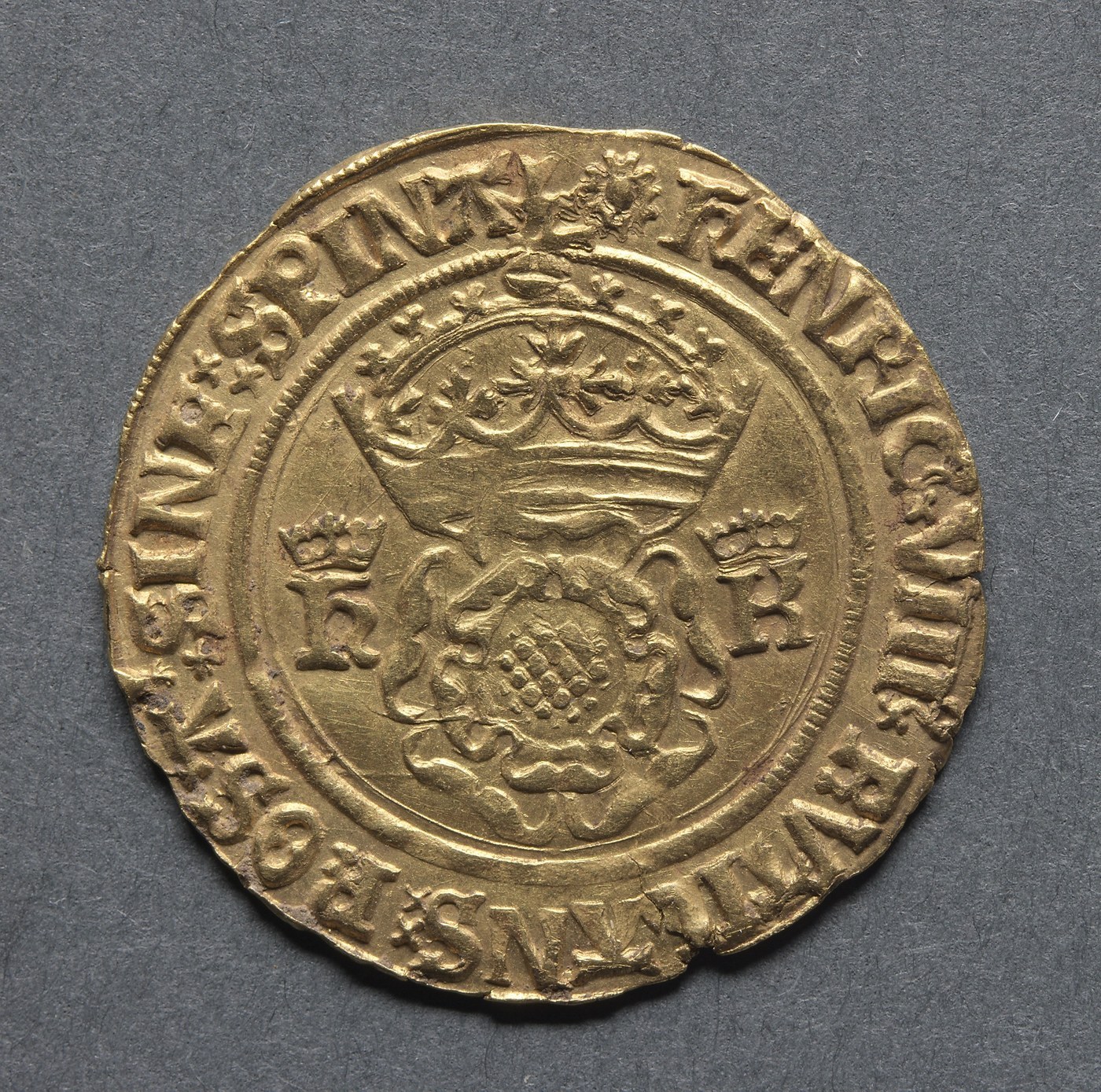
Crown of the Double Rose
A hammered Tudor gold crown of Henry VIII, valued at five shillings and named for the crowned double Tudor rose that defines its design.
- Country
- England
- Denomination
- 1 Crown
- Metal
- Gold
Got a coin like this?
Identify any coin from a photo, free.
Overview
The Crown of the Double Rose is a hammered gold coin of Henry VIII of England, valued at one crown (five shillings). It takes its name from the crowned double Tudor rose that appears as the coin's central device, a badge that fused the red rose of Lancaster and white rose of York into a single dynastic emblem.
Unlike the milled coins of later centuries, the crown was struck by hand between two dies, giving each surviving example a slightly irregular flan and individual character. It circulated as a substantial gold piece within the reformed English coinage, sitting below the larger sovereign and angel denominations.
Surviving examples are hand-struck, roughly the diameter of a modern small coin, and are prized by collectors both for their Tudor iconography and for their association with one of England's most famous reigns.
History & Background
The crown as an English gold denomination emerged in the 1520s during the reign of Henry VIII, part of a wider reform of the coinage. An earlier short-lived Crown of the Rose was quickly succeeded by the Crown of the Double Rose, which became the settled design for the denomination through the remainder of Henry's reign, ending with his death in 1547.
The coin was struck in a lower-fineness gold standard than the traditional English gold pieces, reflecting Henry's efforts to make the coinage more practical and, later, more profitable to the Crown. Because Henry married repeatedly, issues of the Double Rose crown were produced under successive queens, and the crowned initials flanking the rose were changed to reflect the reigning consort.
All examples were produced at the Tower and other royal mints of the period by hammering, before mechanized minting existed in England. The denomination continued in later reigns, but the Double Rose type is specifically tied to Henry VIII's Tudor coinage.
How to Identify
The defining feature is the crowned double Tudor rose at the center of one side, typically enclosed within an ornate beaded or inner circle and surrounded by a Latin legend. Flanking the rose are crowned initials representing the king and his queen (for example, paired letters that changed with each consort), a diagnostic detail collectors use to attribute the piece to a specific period of the reign.
The opposite side carries a crowned heraldic shield bearing the royal arms, quartering the lions of England, set within an ornate circular border with a surrounding legend. In the photographed example the crowned, shield-bearing side with its lion charges and cross-topped crown is visible, while the double-rose side is not shown.
The coin is small, hand-hammered gold with a slightly uneven flan and hand-cut lettering. Genuine strikes show the soft, slightly doubled detail typical of hammered work rather than the crisp uniform edges of machine-made coins. Mint marks (small symbols in the legend) help pinpoint the issuing period.
Value & Collectibility
As a genuine Tudor hammered gold coin roughly five centuries old, the Crown of the Double Rose is a scarce and desirable piece that trades well above its bullion content. Values are driven by grade, strength of strike, which queen's initials appear, and overall eye appeal rather than any single fixed price.
Worn but authentic examples generally command strong four-figure sums, while sharp, well-centered, and rarer consort issues can reach into the higher four figures or beyond at specialist auction. Because the type is old, hand-struck, and frequently faked or clipped, condition and verified provenance heavily influence what a given coin realizes.
Anyone valuing a specific piece should rely on recent auction records for the matching consort issue and mint mark, and treat any single quoted figure as context rather than a guaranteed price.
Frequently asked questions
Why is it called the Crown of the Double Rose?
It is named for its central design: a crowned double Tudor rose, the emblem combining the Lancastrian red rose and Yorkist white rose. This distinguishes it from the earlier, short-lived Crown of the Rose.
What was the coin worth when it was in use?
It was valued at one crown, equal to five shillings, within Henry VIII's English coinage. It was a substantial gold denomination but ranked below the larger sovereign and angel.
Why do the initials next to the rose change?
The crowned initials flank the rose to represent the king and his queen consort. Because Henry VIII married several times, different issues carry different paired initials, which collectors use to date the coin.
Is it made of pure gold?
No. It is a gold coin but struck to a lower fineness than earlier English gold pieces, part of Henry VIII's reform of the coinage. It is still solid gold, just alloyed.
Crown of the Double Rose guides
In-depth guides for identifying, valuing, and collecting Crown of the Double Rose.
Other coins you may enjoy
English Sixpence
Early 1600s (James I, 1603-1625)
Sixpence of James I
1603-1625
Thistle Merk
1567–1625
James VI Ryal
1567–1571
Quarter Merk
c. 1580–1691
Sixpence of Elizabeth I
1560–1603
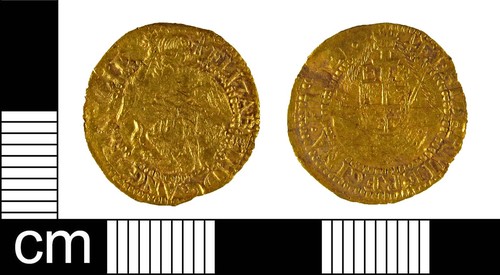
Quarter Angel of Elizabeth I
1581-1583
Laurel
1619-1625
Mary I Groat
1553-1558
Medieval Coin
c. 500–1500 (Medieval)
Half Thistle Merk
1567-1625
Irish Pistole
1640s (17th century)