
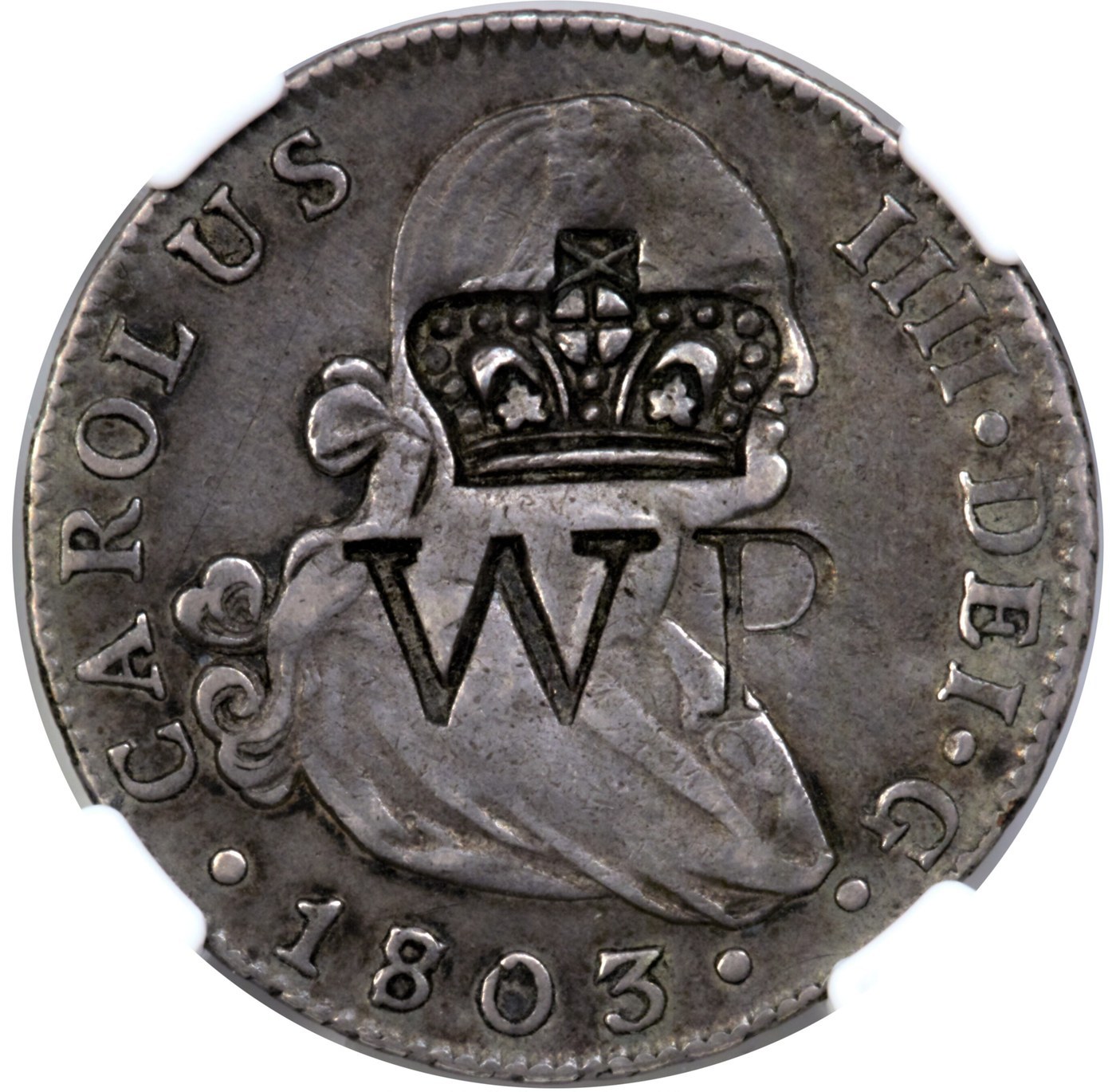
Counterstamped 2 Reales
A Spanish silver 2 reales dated 1803 that was later punched with a WR-and-crown counterstamp, giving it a second, borrowed life as legal tender.
- Country
- Spain
- Denomination
- 2 Reales
- Metal
- Silver
Got a coin like this?
Identify any coin from a photo, free.
Overview
This is a Spanish silver 2 reales dated 1803 that carries a later WR counterstamp topped by a crown punched into its surface. The underlying coin is an ordinary circulating 2 reales; the counterstamp is a secondary mark added by a different authority after the coin left the mint, a common practice used to authorize foreign silver for local circulation.
Counterstamped coins like this one are collected as two artifacts in one: the original Spanish 2 reales, and the punch that revalidated it. The example shown pairs a readable 1803 date and a Spanish heraldic shield reverse with a crowned 'WR' countermark, so it sits at the intersection of Spanish colonial coinage and the wider world of countermarked money.
Because the host coin and the counterstamp come from two separate events, value and interest depend on both. The 2 reales itself is a modest, widely produced silver denomination, while the counterstamp can add historical significance depending on who applied it and why.
History & Background
Spain struck the 2 reales as a mainstay silver denomination for both its home territories and its vast colonial empire, and coins of this type circulated widely across the Atlantic world in the late 18th and early 19th centuries. A piece dated 1803 belongs to this late-colonial era, when Spanish silver was effectively an international trade currency.
Counterstamping was a standard tool of the period. When Spanish coins flowed into regions with their own coin shortages or trade rules, local governments, colonies, and even private merchants would punch an official mark onto them to authorize their use, revalue them, or certify their weight. The WR-with-crown mark on this coin is one such authorizing device, applied after the coin was already in circulation.
These secondary marks turn an otherwise routine trade coin into evidence of a specific monetary need, and they are studied as their own field. Because counterstamps were applied piecemeal by many different issuers, they vary enormously in style, letters, and purpose, and attributing a given mark to a specific authority is a core part of the coin's history.
How to Identify
Start with the host coin. It is a silver 2 reales roughly 26–27 mm across, showing a Spanish heraldic shield on the reverse and a readable date of 1803. On coins of this type the design typically pairs a portrait or arms with a crowned shield flanked by supporting elements, plus a denomination mark reading '2 R' and mint and assayer letters in the legend.
The defining feature is the counterstamp: a crowned 'WR' punched into the field, standing proud of or sunk into the original design. A genuine counterstamp will disturb the underlying coin, flattening or displacing the metal beneath it, and its style (letter forms, the shape of the crown, the depth of the punch) should be consistent throughout. The host date of 1803 sets the earliest possible date for the mark; the counterstamp itself is necessarily later.
To attribute the piece, record three things separately: the host coin (denomination, date, mint and assayer marks), the counterstamp legend and device (here, WR beneath a crown), and how the two relate physically. Weigh and measure the coin, note the silver color and any test cuts or edge damage, and photograph the counterstamp straight-on so its exact letter forms can be compared against published countermark references.
Value & Collectibility
Value comes from two sources: the base 2 reales and the counterstamp. A common circulated Spanish 2 reales of this era is an affordable silver coin worth a modest premium over its small silver content, and heavy wear, cleaning, or damage pull it toward the low end.
A counterstamp can raise value substantially, keep it roughly the same, or in some cases even lower it, depending entirely on what the mark is. A well-documented, correctly attributed countermark tied to a known issuing authority can make the coin far more desirable to specialists than the plain host coin, while an unidentified or suspect mark adds little. Because attribution drives the price so heavily, ranges here are wide and case-specific.
Treat any specific figure as an estimate only. Condition of both the host coin and the punch, the rarity of the particular counterstamp, and confidence in the attribution all matter, so comparable auction records and specialist opinion are the best guides to a realistic value.
Frequently asked questions
What is a counterstamped 2 reales?
It is a Spanish silver 2 reales that was later stamped with a secondary punch mark, here a crowned 'WR', by an authority other than the original mint to authorize or revalue the coin for local use.
Does the 1803 date refer to the counterstamp?
No. The 1803 date belongs to the underlying 2 reales host coin. The counterstamp was applied afterward, so 1803 is only the earliest possible date for the mark, not the date it was punched.
What does the 'WR' with a crown mean?
It is a counterstamp: a monogram or initials under a crown punched by an issuing authority. Attributing which authority used a 'WR' crowned mark requires comparing it to published countermark references.
Is a counterstamp damage or added value?
A counterstamp is an intentional official mark, not casual damage, and it is part of the coin's history. Depending on its rarity and attribution it can add significant value, though an unidentifiable mark adds little.
How big is a 2 reales coin?
A silver 2 reales of this era is typically about 26–27 mm in diameter, a mid-size silver coin, smaller than an 8 reales but larger than the 1 real and half real.
Counterstamped 2 Reales guides
In-depth guides for identifying, valuing, and collecting Counterstamped 2 Reales.
Other coins you may enjoy
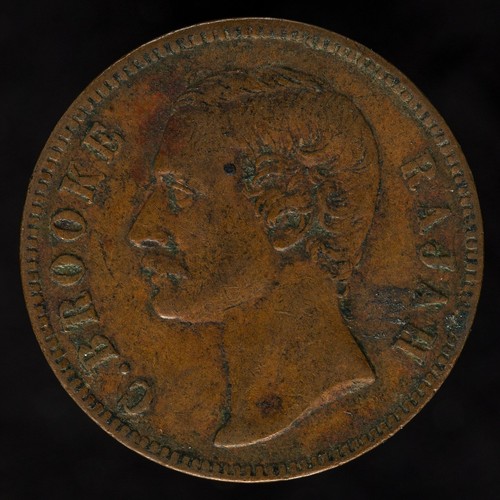
Sarawak One Cent
1870
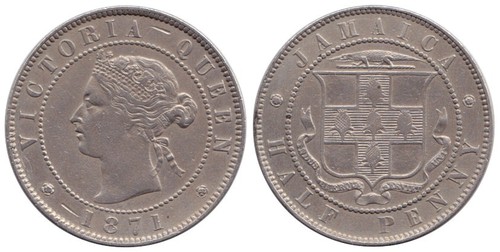
Jamaica Half Penny
1871
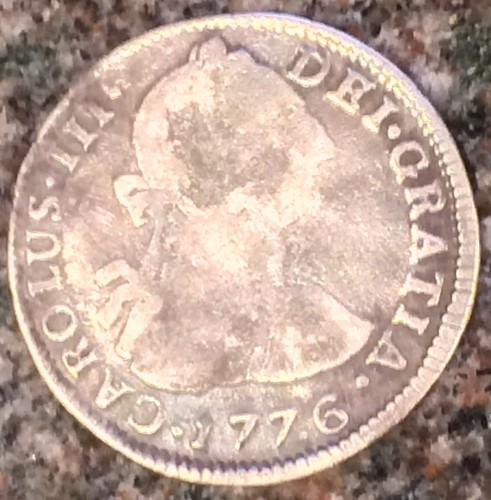
Spanish Colonial 2 Reales (Milled)
1732–1772 (pillar) and 1772–1825 (portrait); example dated 1776
Straits Settlements One Cent
1919–1926 (this type)
British Honduras 10 Cents
1956
Spanish Colonial 1 Real (Bourbon)
1700-1746
Bermuda Half Penny
1909
British North Borneo One Cent
1884–1886
British Honduras One Cent
1885–1894 (Victoria); this example 1889
British North Borneo Half Cent
1885
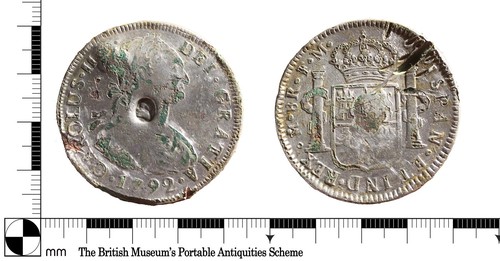
Counterstamped 8 Reales
Charles IV era (1788-1808), host coin; counterstamps and hole added later
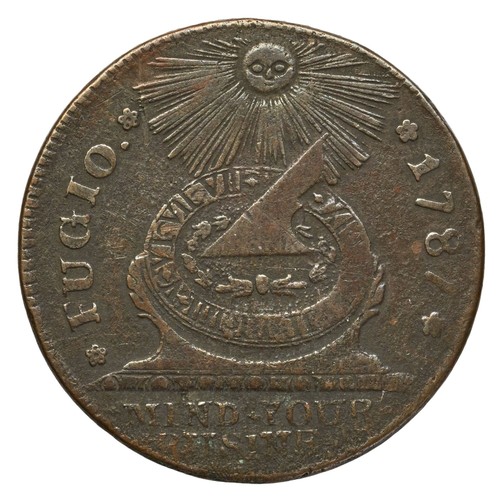
Fugio Cent
1787