
Counterstamped 8 Reales
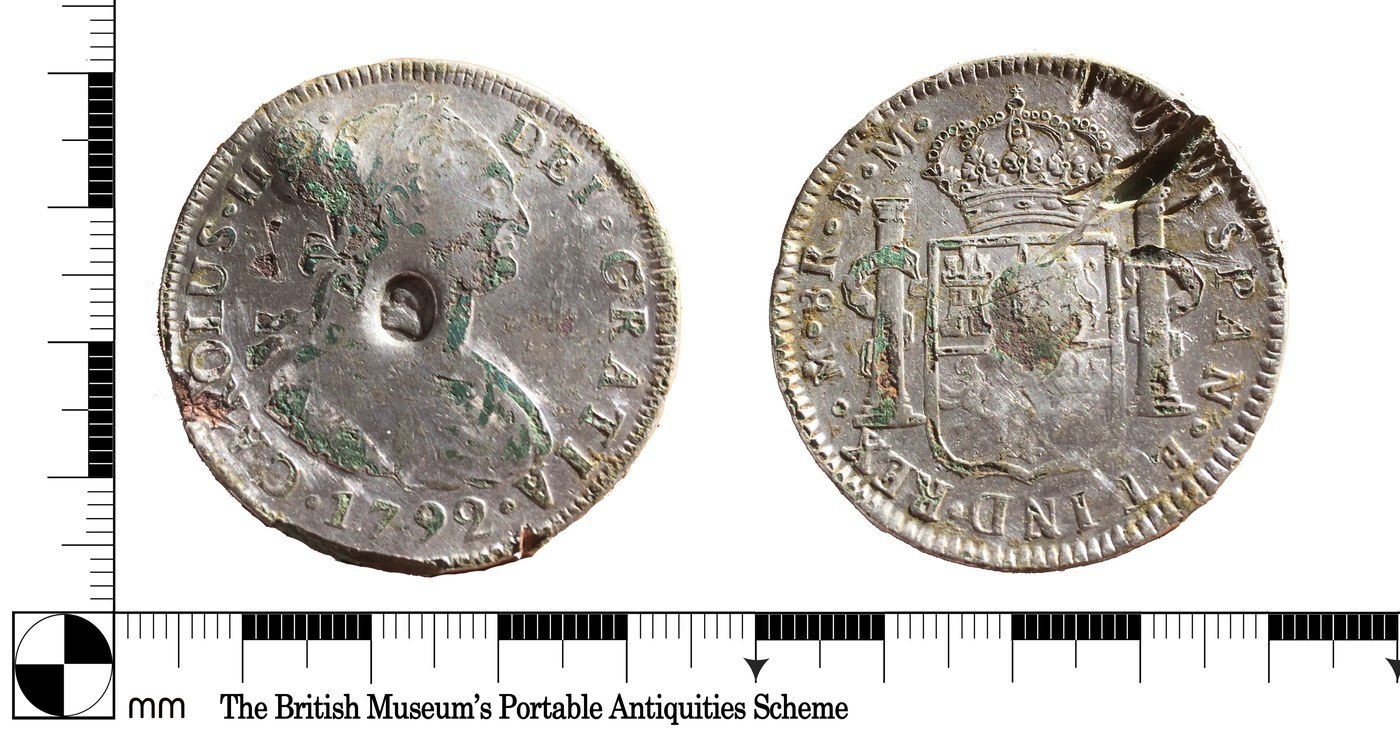
A Charles IV silver 8 reales later punched with counterstamps and pierced with a central hole, layering a second life onto the classic Spanish dollar.
- Country
- Spain
- Denomination
- 8 Reales
- Metal
- Silver
Got a coin like this?
Identify any coin from a photo, free.
Overview
This is a Spanish silver 8 reales of the Charles IV era that was later marked with one or more counterstamps and pierced with a central hole. The underlying coin is the classic 'piece of eight' or Spanish dollar; the punches and the hole are secondary features added after the coin left the mint, each recording a separate chapter in the coin's working life.
The example shown pairs the bust of Charles IV on the obverse with the crowned Spanish coat of arms on the reverse, and both faces carry counterstamps. A hole punched through the center runs through both the portrait and the shield. Coins like this are collected as layered artifacts: the original 8 reales, the counterstamp or counterstamps that revalidated or revalued it, and the piercing that reflects a later use.
Because the host coin, the counterstamps, and the hole come from different events, interest and value depend on all three. The 8 reales itself is a large, historically important silver trade coin, while the counterstamps and hole can add or subtract appeal depending on what they are and why they were made.
History & Background
Spain struck the 8 reales as the flagship silver coin of its empire, and under Charles IV (reigned 1788-1808) enormous quantities poured from the colonial mints of the Americas. These coins became the dominant international trade currency of the age, circulating across the Atlantic, the Caribbean, Asia, and beyond, which is exactly why so many were later altered by other authorities.
Counterstamping was a routine monetary tool. When Spanish dollars entered regions facing coin shortages or different legal-tender rules, governments, colonies, and sometimes private merchants would punch an official mark into them to authorize local use, revalue them, or certify their weight. A single 8 reales could accumulate several such marks as it passed through different hands and jurisdictions, which is why multiple counterstamps on one coin are not unusual.
The central hole reflects a separate practice. Coins were pierced for many reasons: to be worn as jewelry or an amulet, to be strung or sewn onto clothing, to mark them for a specific purpose, or as part of formal 'holey dollar' schemes in which a center plug was cut from a Spanish dollar to create two coins from one. Without documentation, the exact reason a given coin was holed is often uncertain, but the piercing is itself a genuine part of the object's history.
How to Identify
Start with the host coin. It is a large silver 8 reales, typically around 38-40 mm in diameter, showing the draped bust of Charles IV on the obverse with a surrounding Latin legend naming him, and the crowned Spanish royal arms flanked by the Pillars of Hercules on the reverse. The denomination reads '8 R', and mint and assayer letters appear in the legend. On the photographed coin the portrait and the coat of arms are both clearly present beneath the later alterations.
The defining added features are the counterstamps and the central hole. Look for punch marks struck into the fields on both faces: a genuine counterstamp disturbs the metal beneath it, flattening or displacing the original design, and each mark's style should be internally consistent. Record every counterstamp separately, noting its letters, device, shape, and depth. The hole through the center should show its own metal flow and wear, which can differ from the counterstamps if it was made at a different time.
To attribute the piece, treat it as several artifacts at once: the host coin (denomination, ruler, date if legible, mint and assayer marks), each counterstamp (legend and device), and the piercing (size, placement, and how it interacts with the design). Weigh and measure the coin, confirm it reads as silver, and photograph each counterstamp straight-on so its letter forms can be compared against published countermark references.
Value & Collectibility
Value comes from several sources at once: the base 8 reales, the counterstamps, and the hole. A common Charles IV 8 reales is already a substantial silver coin worth a meaningful premium over its silver content, and condition of the underlying portrait and arms sets a baseline before the alterations are considered.
Counterstamps can raise value considerably when they are well documented and correctly attributed to a known issuing authority, since such marks are collected as their own specialty. An unidentified or suspect mark adds little. The central hole generally works the other way: piercing is a form of damage that reduces the value of an otherwise collectible 8 reales, though a hole tied to a documented practice can retain historical interest. Where these effects land depends entirely on the specifics.
Because so many independent factors are in play, any figure should be treated as an estimate only. The condition of the host coin, the rarity and attribution of each counterstamp, and the nature of the piercing all matter, so comparable auction records and specialist opinion are the best guides to a realistic value.
Frequently asked questions
What is a counterstamped 8 reales?
It is a Spanish silver 8 reales, here of the Charles IV era, that was later punched with one or more secondary counterstamps by an authority other than the original mint, typically to authorize or revalue the coin for local use.
Why is there a hole in the middle of the coin?
The central hole was added after the coin was struck. Coins were pierced to be worn as jewelry or amulets, to be strung or sewn onto items, or as part of 'holey dollar' schemes. Without documentation the exact reason for a specific hole is often uncertain.
Who is on the obverse of this coin?
The obverse shows the bust of Charles IV, King of Spain from 1788 to 1808. The surrounding legend names him in Latin, and the reverse carries the crowned Spanish royal arms with the Pillars of Hercules.
Do the counterstamps and hole add value or reduce it?
It depends. A well-attributed counterstamp tied to a known authority can add significant value, while an unidentified mark adds little. The central hole is a form of damage that usually lowers value, though it can retain historical interest.
How big is an 8 reales coin?
A silver 8 reales, the classic 'piece of eight' or Spanish dollar, is a large coin typically about 38-40 mm in diameter, the flagship silver denomination of the Spanish empire.
Counterstamped 8 Reales guides
In-depth guides for identifying, valuing, and collecting Counterstamped 8 Reales.
Other coins you may enjoy
Sarawak One Cent
1870
Jamaica Half Penny
1871
Spanish Colonial 2 Reales (Milled)
1732–1772 (pillar) and 1772–1825 (portrait); example dated 1776
Straits Settlements One Cent
1919–1926 (this type)
British Honduras 10 Cents
1956
Spanish Colonial 1 Real (Bourbon)
1700-1746
Bermuda Half Penny
1909
British North Borneo One Cent
1884–1886
British Honduras One Cent
1885–1894 (Victoria); this example 1889
British North Borneo Half Cent
1885
Fugio Cent
1787
Massachusetts Shilling (1 Shilling 6 Pence)
1779