
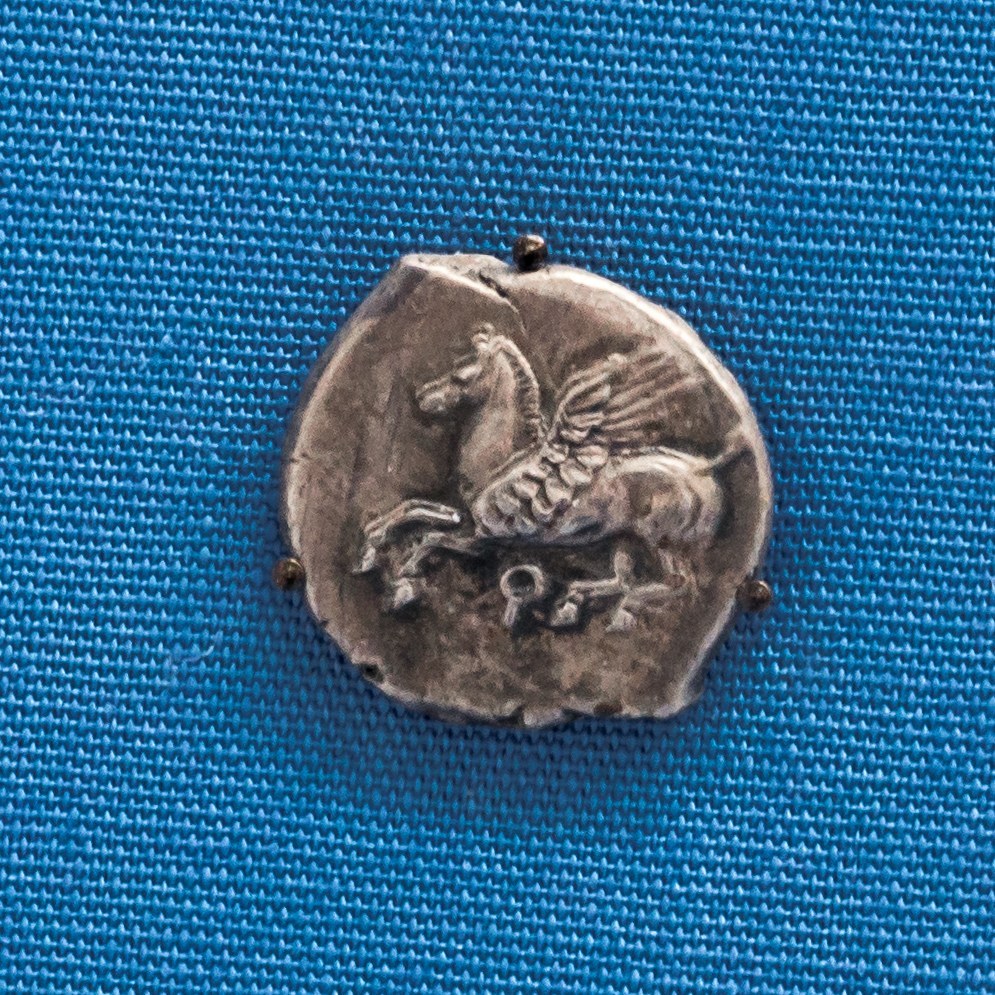
Corinth Pegasos Stater
Classical silver stater of Corinth showing the winged horse Pegasos on the obverse and a helmeted head of Athena on the reverse.
- Country
- Ancient Greece
- Denomination
- Stater
- Metal
- Silver
Got a coin like this?
Identify any coin from a photo, free.
Overview
The Corinth Pegasos stater is a classical Greek silver coin struck by the wealthy trading city of Corinth. Its two constant devices are the winged horse Pegasos, the emblem of Corinth, and the head of the goddess Athena. On this example Pegasos flies to the left on the obverse while Athena's head faces right on the reverse, a pairing dated to around 343 BC.
Coins of this type are known to collectors simply as "Pegasi," and they were among the most widely circulated staters of the ancient Greek world. The horse device gave the coins their popular ancient nickname, and Corinth's role as a maritime and colonial power carried them far beyond the city itself.
Struck on the Corinthian (or "Euboic-Corinthian") weight standard, the stater was divided into drachms and was a substantial unit of silver used in trade across the Greek Mediterranean.
History & Background
Corinth was one of the great commercial hubs of ancient Greece, controlling the narrow isthmus linking the mainland to the Peloponnese and maintaining colonies around the Ionian and Adriatic seas. From the sixth century BC onward the city struck silver staters bearing Pegasos, the winged horse tied to the local myth of the hero Bellerophon and the spring Peirene.
The classical issues of the fourth century BC, including pieces of the 340s such as this one, standardized the design of Pegasos on one side and a helmeted Athena on the other. Because Corinth founded and traded with many colonies, cities such as those in western Greece, Sicily, and Epirus struck their own "Pegasi" on the same standard and types, distinguished mainly by small control symbols. These allied issues made the Corinthian stater a kind of international trade coinage.
The abundance of Corinthian and colonial Pegasi reflects the city's prosperity in the decades before it, like the rest of Greece, came under Macedonian domination in the later fourth century BC.
How to Identify
The defining feature is the winged horse Pegasos, shown in flight; on this coin it moves to the left. Early and archaic issues often place a control letter (the archaic koppa, for Corinth) beneath the horse, while classical fourth-century pieces show Pegasos with a curved wing and refined, naturalistic modeling. The reverse bears the head of Athena wearing a Corinthian helmet, here facing right, typically with small control symbols or letters in the field beside her.
In hand a Corinthian stater is a thick, compact silver coin roughly 20-22 mm across and generally weighing about 8.5 grams on the Corinthian standard. The metal is good silver, and genuine examples show hand-struck relief, often slightly off-center, with the die axis varying from coin to coin.
Because many colonies copied the design, attribution to Corinth itself relies on the style of the devices and the control marks in the reverse field. The pairing of a left-flying Pegasos with a right-facing helmeted Athena, together with fine classical style, is consistent with a Corinth mint stater of the mid-fourth century BC.
Value & Collectibility
Corinthian Pegasi are among the more available classical Greek silver staters, since Corinth and its colonies produced them in large numbers. Worn or off-center examples with clear devices commonly trade in the low hundreds of dollars, while sharply struck, well-centered coins with attractive Athena portraits and good metal can bring the mid hundreds to low thousands.
Value is driven by strike quality, centering, surface preservation, the artistry of the Athena head, and any desirable control symbols that pin the coin to a particular issue or colony. Toning, wear, and eye appeal all matter, and coins securely attributed to Corinth itself are generally preferred over anonymous colonial imitations.
The figures here are broad ranges for context, not appraisals. Condition, exact issue, and provenance can move an individual coin well outside them, and specialist attribution can add a premium.
Frequently asked questions
What are the two designs on a Corinth Pegasos stater?
The obverse shows Pegasos, the winged horse and emblem of Corinth, and the reverse shows the head of the goddess Athena wearing a Corinthian helmet. On this example Pegasos flies left and Athena faces right.
Why is Pegasos on the coins of Corinth?
Pegasos was tied to Corinth's local mythology through the hero Bellerophon and the spring Peirene. The winged horse became the city's badge, and the coins were nicknamed "Pegasi" in antiquity.
How much silver is in the coin and what did it weigh?
It is a good-silver stater struck on the Corinthian standard, typically weighing about 8.5 grams and measuring roughly 20-22 mm across. The stater was divided into smaller drachm denominations.
Did other cities strike the same type?
Yes. Many Corinthian colonies in western Greece, Sicily, and Epirus struck their own Pegasi on the same weight standard and types, distinguished mainly by small control symbols, which is why the coins circulated so widely.
Corinth Pegasos Stater guides
In-depth guides for identifying, valuing, and collecting Corinth Pegasos Stater.
Other coins you may enjoy
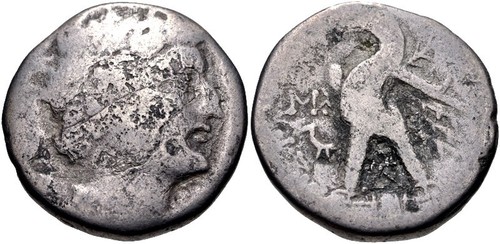
Tetradrachm of Ptolemy XII
80-51 BC
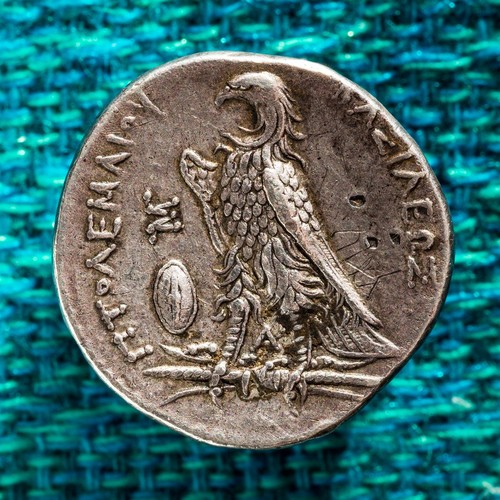
Tetradrachm of Ptolemy I
305-283 BC
Tetradrachm of Antiochos I Soter
281-261 BC
Syracuse Tetradrachm
c. 5th-4th century BC (Classical period)
Solidus of Arcadius
AD 395-402
Philip III Gold Stater
323-317 BC
Siliqua of Gratian
AD 367-383
Sestertius of Maximinus Thrax
235-238 AD
Solidus of Valentinian III
AD 425-455
Seleucus I Nicator Tetradrachm
Late 4th-3rd century BC
Nummus of Magnentius
AD 350-353
Follis of Galerius
AD 308-310