
How to Identify the Corinth Pegasos Stater
A collector's guide to the flying Pegasos, helmeted Athena head, Corinthian weight, and control marks that identify a Corinth stater.
Read the full Corinth Pegasos Stater encyclopedia entry →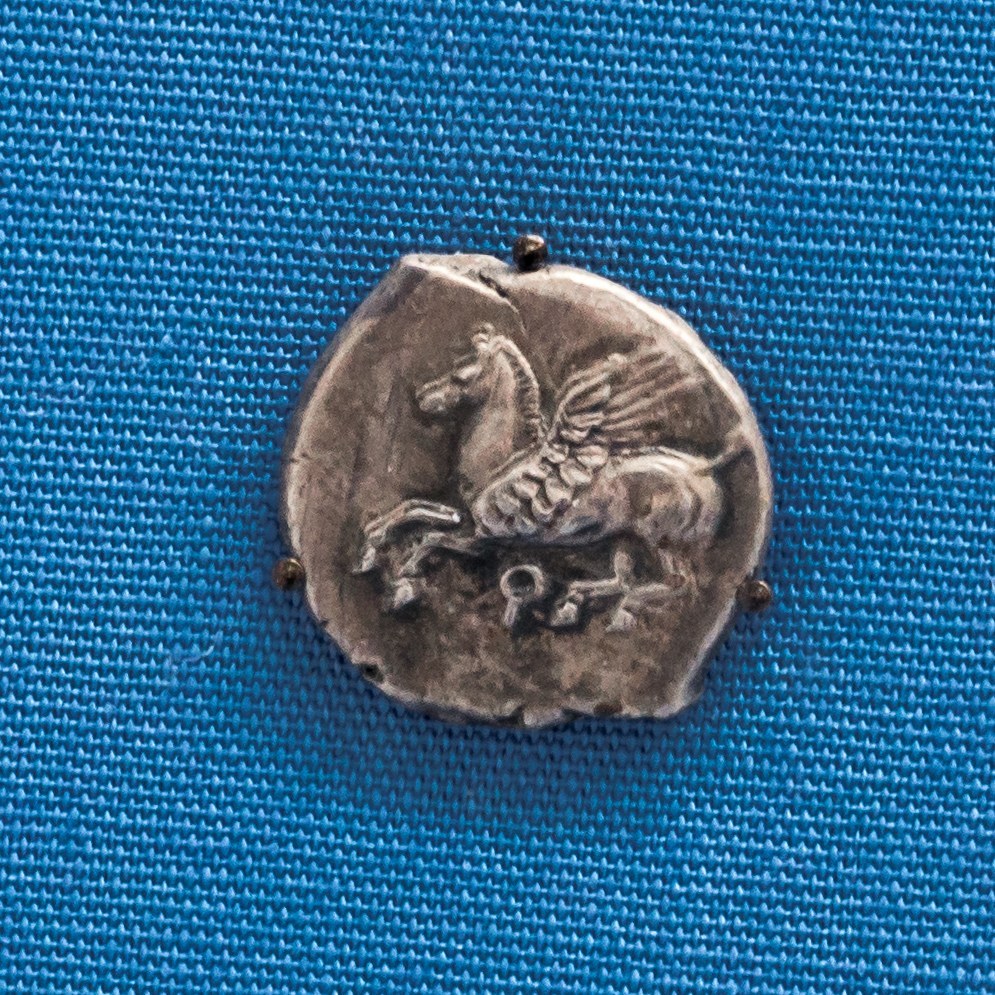
Begin with the two devices, because the pairing is diagnostic. A Corinthian stater always shows the winged horse Pegasos on one side and a helmeted head of Athena on the other. On this coin Pegasos flies to the left and Athena faces to the right; the horse should read as a single leaping, winged figure rather than a chariot or a facing bust. Classical fourth-century style gives Pegasos a gracefully curved wing and naturalistic body, distinct from the stiffer archaic renderings.
Check size, weight, and metal in hand. A genuine stater is a thick, compact silver piece about 20-22 mm across and generally close to 8.5 grams on the Corinthian standard. The silver should look bright or evenly toned, with hand-struck relief and a die axis that varies from coin to coin. Slightly off-center strikes and irregular flan edges are normal for the period and are not by themselves signs of a problem.
Study the control marks. Corinth used the archaic letter koppa (an O with a vertical tail) beneath Pegasos on many issues, and the field beside Athena often carries small letters or symbols such as a wreath, animal, or figure. These marks, together with the style of the Athena head, are how specialists separate a true Corinth mint stater from the many colonial "Pegasi" struck at cities in western Greece, Sicily, and Epirus on the same types and standard.
Be cautious about look-alikes and authenticity. Colonial imitations can be nearly identical apart from their control symbols, so attribution depends on style and marks rather than the devices alone. Modern cast counterfeits and tooled coins exist; warning signs include a visible casting seam, a soft or granular surface, bubbles in the metal, weight well away from the expected range, or lettering that does not match known dies. For a significant purchase, favor coins with clear photographs, published references, or attribution by a specialist in Greek silver.
Frequently asked questions
How do I tell a Corinth stater from a colonial Pegasos coin?
Both share the flying Pegasos and helmeted Athena. Attribution to Corinth itself rests on style and the control marks, such as the koppa under the horse and the letters or symbols beside Athena, rather than the main devices.
What should the coin weigh?
A Corinthian stater is struck on the Corinthian standard and typically weighs close to 8.5 grams, measuring about 20-22 mm in diameter. A weight far outside this range is a reason for caution.
Which way should Pegasos and Athena face?
There are issues in both directions across the series. On this coin Pegasos flies left and Athena faces right; the direction, combined with control marks and style, helps place a coin within a particular issue.
What are the warning signs of a fake?
Look for a casting seam around the edge, a soft or grainy surface, trapped bubbles, incorrect weight, or lettering and style that do not match genuine dies. Provenance or specialist attribution is the safest check for valuable examples.