
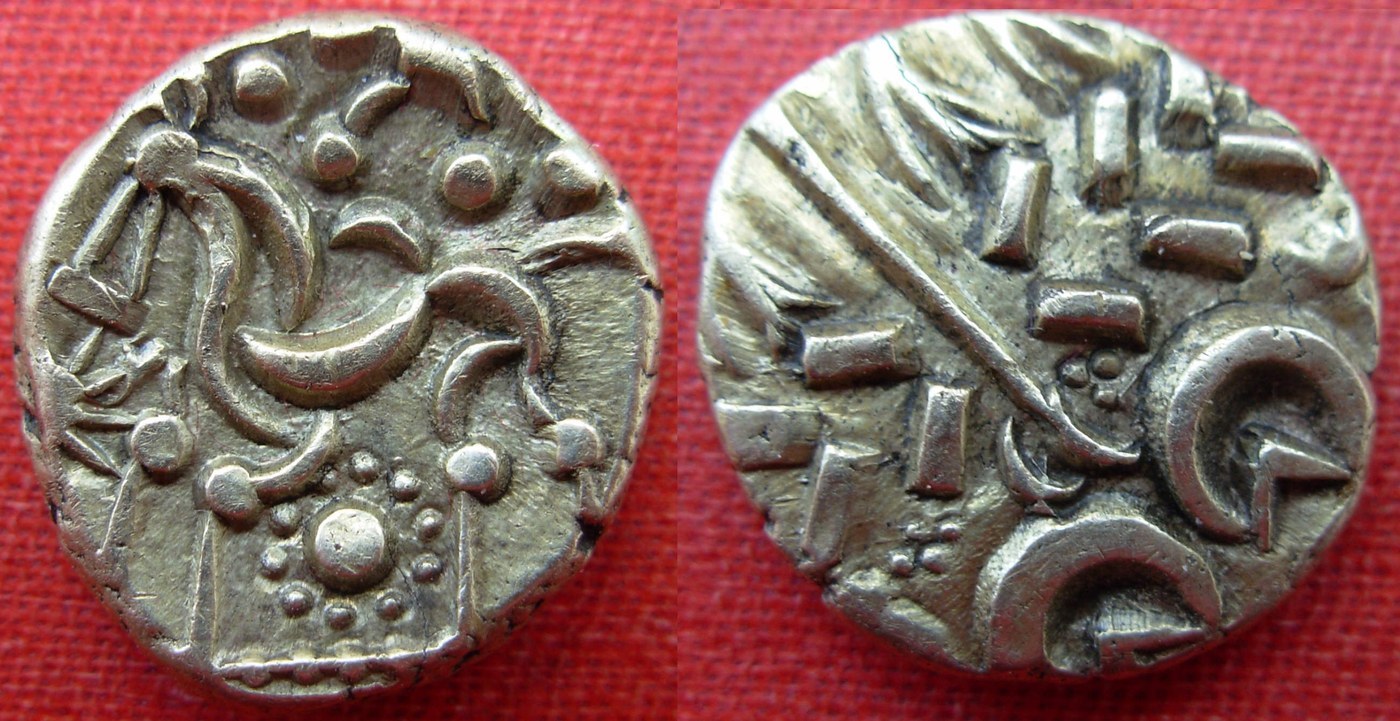
Corieltauvi Stater
A gold stater of the Corieltauvi tribe of Iron Age Britain, with an abstracted head on the obverse and a stylized horse and symbols on the reverse.
- Country
- Ancient Britain
- Denomination
- Stater
- Metal
- Gold
Got a coin like this?
Identify any coin from a photo, free.
Overview
The Corieltauvi stater is a gold coin struck by the Corieltauvi, an Iron Age tribe of what is now the East Midlands of England, chiefly in Lincolnshire and the surrounding region. Like most British Celtic gold, its design descends from the gold stater of Philip II of Macedon, filtered through Gallo-Belgic imports and reworked into a highly abstract native style. The obverse shows a disintegrated laureate head, so stylized that it reads as a pattern of wreath, crescents, and lines rather than a recognizable face, while the reverse carries a stylized horse accompanied by pellets, rings, and other symbolic marks.
The tribe was formerly known in older literature as the Coritani, and coins are still catalogued under both names. Struck in the 1st century BC, these staters are among the classic products of the pre-Roman British coinage and are strongly associated with the well-known uninscribed "South Ferriby" type. Later Corieltauvi issues began to add abbreviated names in the fields, but earlier pieces such as the one shown here are anepigraphic, relying entirely on their abstract imagery.
As a native British gold coin from before the Roman conquest, the Corieltauvi stater is a tangible relic of an era with no local written history. It is collected both as an ancient coin and as an artifact of Iron Age Britain.
History & Background
The Corieltauvi occupied a territory across the modern East Midlands, roughly corresponding to Lincolnshire, Nottinghamshire, Leicestershire and neighboring areas, in the last century before the Roman conquest of Britain in AD 43. Coinage reached Britain through contact with Gaul, where staters imitating Philip II of Macedon's gold had long circulated, and British tribes gradually developed their own regional series. The Corieltauvi were one of several tribes, alongside the Iceni, Catuvellauni, and others, that produced distinctive gold and silver coinages.
The abstraction seen on these coins is the result of generations of copying. The original Macedonian design paired the head of Apollo with a two-horse chariot; as the type passed from hand to hand and mint to mint, the head dissolved into a wreath-and-crescent pattern and the chariot was reduced to a single disjointed horse. This progressive stylization is a hallmark of Celtic coin art rather than a sign of crude workmanship.
Over time the Corieltauvi series moved from anepigraphic issues to inscribed types bearing abbreviated names such as those recorded on later staters, thought to name rulers or moneyers. The coinage came to an end with the Roman conquest, after which the region was absorbed into the province of Britannia. Because the tribe left no written records of its own, the coins are a primary source for its existence and organization.
How to Identify
Begin with the overall look, because a Corieltauvi stater does not resemble a classical portrait coin. The obverse is an abstract design: a laureate head so reduced that it appears as a wreath, curved lines, and crescent shapes, often with much of the field blank. Do not expect a clear face; the abstraction itself is diagnostic of British Celtic gold.
The reverse shows a stylized horse, typically moving to the right or left, formed from pellets and curved lines rather than a naturalistic body. Around and above the horse are symbolic marks, which may include pellets, ring-and-dot motifs, crescents, and small ornaments; on Corieltauvi staters the horse is characteristically angular and the field busy with such symbols. Early pieces carry no legend, while later related types may show a few abbreviated letters.
In hand the coin is small and thick, usually about 15 to 20 mm across and roughly 5 to 6 grams. The metal is gold, though the color varies from bright yellow to a paler, greenish tone where the alloy contains more silver, as is common in later Iron Age British gold. The fabric is hand-struck, so flans are irregular and the design is frequently off-center, leaving parts of the wreath or horse beyond the edge.
Value & Collectibility
Corieltauvi gold staters are collected as genuine pre-Roman British gold and generally command prices well above those of common ancient bronze coins, reflecting both their metal and their scarcity. Worn or off-center examples of common uninscribed types often trade in the mid hundreds of dollars, while sharp, well-centered coins with a clear horse and wreath can reach the high hundreds to low thousands. Rare inscribed types and exceptional examples can bring more.
Value depends heavily on the completeness of the design, the centering of the strike, the color and purity of the gold, and the specific type within the series. Because the coins are abstract, examples where the wreath pattern and the horse with its symbols are both clearly visible are markedly more desirable than those where much of the design has run off the flan.
The figures given here are broad ranges for context, not appraisals. Provenance matters for Iron Age British gold, and in Britain finds may fall under treasure and reporting rules, so documented collecting history can affect both legality and price. Have significant pieces attributed by a specialist in Celtic coinage.
Frequently asked questions
Who were the Corieltauvi?
The Corieltauvi were an Iron Age tribe of the East Midlands of Britain, in and around Lincolnshire, in the last century before the Roman conquest of AD 43. They were formerly known as the Coritani, and their coins appear under both names.
Why does the obverse not look like a face?
The design descends from the head of Apollo on Philip II of Macedon's gold stater, but centuries of copying reduced it to an abstract pattern of wreath, crescents, and lines. This stylization is typical of British Celtic gold, not a defect.
What does the horse on the reverse represent?
It is a stylized survival of the two-horse chariot on the original Macedonian coin, simplified over time to a single angular horse made of pellets and curves, surrounded by symbolic marks whose exact meaning is not known.
Is it made of pure gold?
It is a gold coin, but the alloy varies. Some examples are bright yellow while others are paler and greenish where the gold is mixed with more silver, a common trait of later Iron Age British staters.
Are these coins rare?
They are far scarcer than common Roman coins and are valued accordingly. Uninscribed types are the most frequently encountered, while inscribed and exceptionally well-struck pieces are considerably rarer and more valuable.
Corieltauvi Stater guides
In-depth guides for identifying, valuing, and collecting Corieltauvi Stater.
Other coins you may enjoy
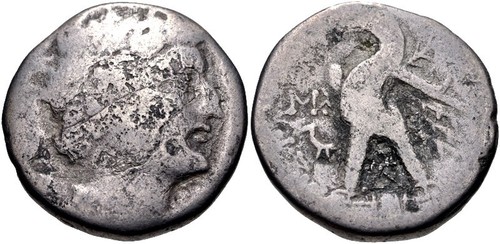
Tetradrachm of Ptolemy XII
80-51 BC
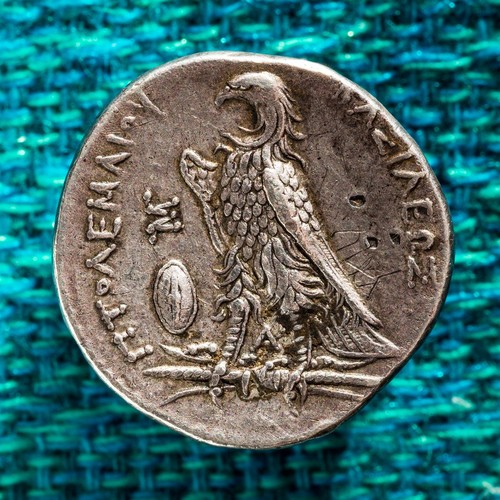
Tetradrachm of Ptolemy I
305-283 BC
Tetradrachm of Antiochos I Soter
281-261 BC
Syracuse Tetradrachm
c. 5th-4th century BC (Classical period)
Solidus of Arcadius
AD 395-402
Philip III Gold Stater
323-317 BC
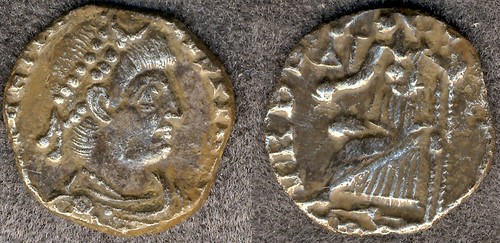
Siliqua of Gratian
AD 367-383
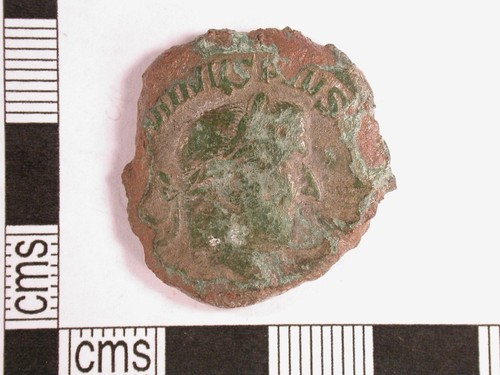
Sestertius of Maximinus Thrax
235-238 AD
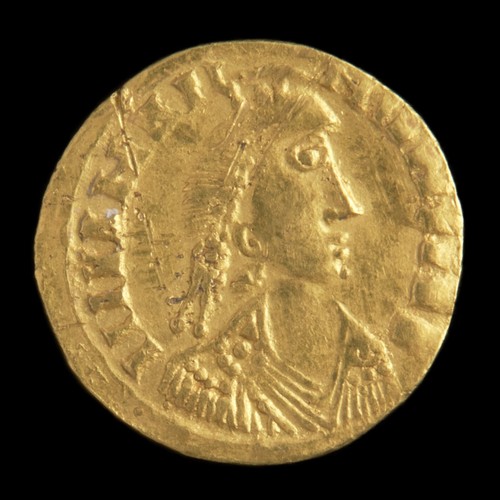
Solidus of Valentinian III
AD 425-455
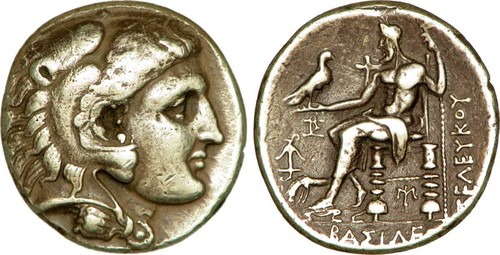
Seleucus I Nicator Tetradrachm
Late 4th-3rd century BC
Nummus of Magnentius
AD 350-353
Follis of Galerius
AD 308-310