
How to Identify the Corieltauvi Stater
A collector's guide to recognizing the abstract wreath obverse, stylized horse reverse, and gold fabric of a Corieltauvi Iron Age stater.
Read the full Corieltauvi Stater encyclopedia entry →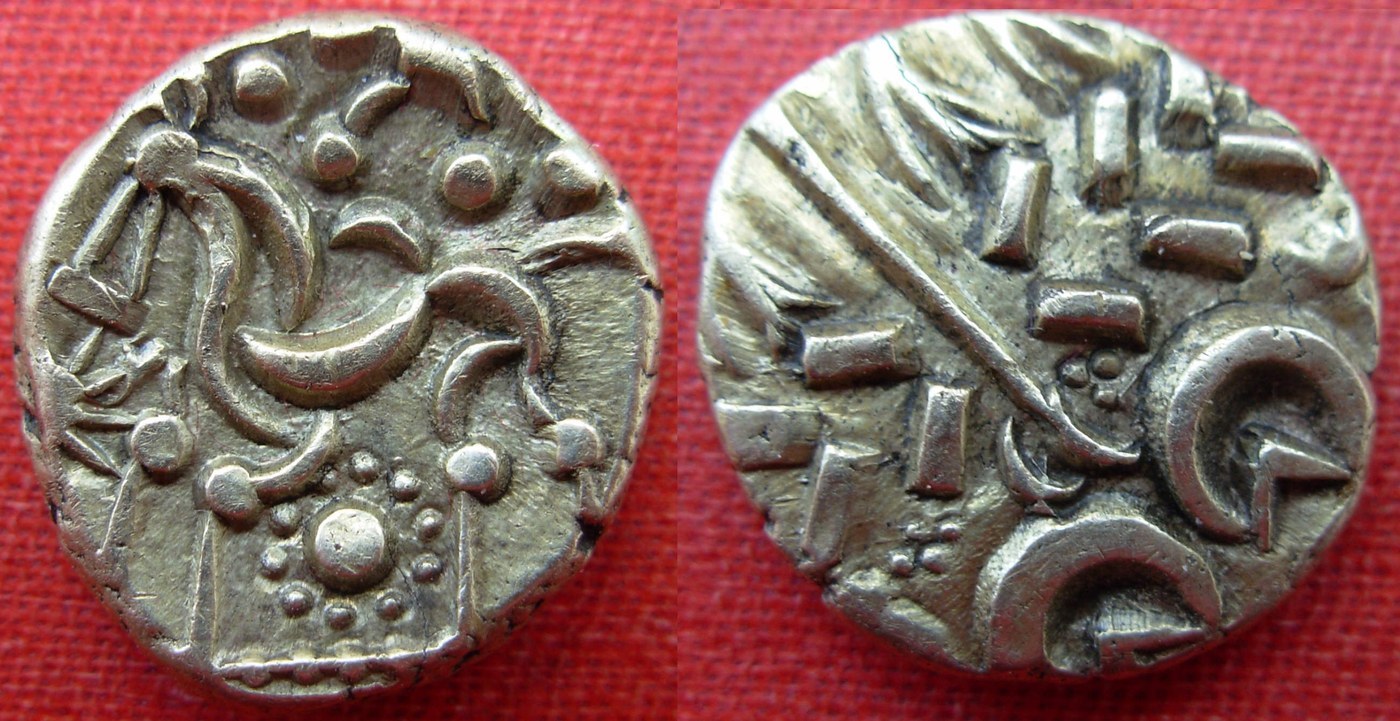
Start by accepting that this coin is meant to be abstract. On a Corieltauvi stater the obverse is a disintegrated laureate head reduced to a wreath, crescents, and curved lines, often over a largely blank field. If you are searching for a lifelike portrait you will miss the type entirely; the wreath-and-crescent pattern, with no clear face, is exactly what confirms a British Celtic gold stater rather than a Greek or Roman coin.
Turn to the reverse and find the horse. Corieltauvi reverses show a stylized horse built from pellets and curved lines, usually in profile, with an angular body and a field filled with symbolic marks such as pellets, ring-and-dot motifs, crescents, and small ornaments above and below the animal. The particular arrangement of these symbols is what distinguishes one type from another, so note them carefully; the uninscribed South Ferriby type is the classic example, while some related issues add a few abbreviated letters that later series expanded into names.
Check size, weight, and metal. A genuine stater is small and chunky, about 15 to 20 mm across and roughly 5 to 6 grams, and struck in gold. Color is a useful clue: bright yellow indicates higher gold content, while a paler, greenish tone signals a more silver-rich alloy, both of which occur in the series. Because the coins were struck by hand on irregular flans, expect off-center strikes, uneven edges, and part of the design running off the flan; a perfectly round, evenly centered piece should invite suspicion.
Separate the Corieltauvi type from its neighbors and imitations. Other British tribes, including the Iceni and the Catuvellauni, struck gold staters from the same Macedonian ancestry, so the specific style of the horse and the pattern of field symbols, rather than the mere presence of a horse, place a coin with the Corieltauvi. Gallo-Belgic imports from the Continent are also similar and can be mistaken for native issues.
Finally, be cautious about authenticity and provenance. Cast forgeries and modern replicas of Celtic gold exist; warning signs include a visible casting seam, a soft or bubbly surface, a weight well outside the normal range, and a color that does not match genuine Iron Age gold. Because these coins are valuable and, in Britain, may be subject to treasure and reporting laws, prefer pieces with documented collecting history and have important examples confirmed by a specialist in Celtic coinage.
Frequently asked questions
How do I tell a Corieltauvi stater from another British tribe's stater?
Focus on the reverse. All descend from the same Macedonian horse, so compare the specific style of the horse and the pattern of surrounding symbols to reference images of Corieltauvi types, rather than relying on the horse alone. The abstract wreath obverse is shared across British gold.
There is no face and no lettering. Is the coin incomplete?
No. The obverse is deliberately abstract, showing a wreath and crescents rather than a face, and early Corieltauvi staters carry no legend at all. A blank-looking field and missing letters are normal for uninscribed types of the 1st century BC.
What size and weight should a genuine example be?
Roughly 15 to 20 mm in diameter and about 5 to 6 grams of gold. A coin far outside that range, especially one that is too light or too large, or that shows a casting seam, should be treated with caution as a possible forgery.
Does the gold color affect identification?
Color reflects the alloy rather than authenticity by itself. Bright yellow indicates more gold, while a paler greenish tone indicates more silver in the mix; both are seen in genuine Corieltauvi staters, so judge the coin on design, fabric, and weight together.