
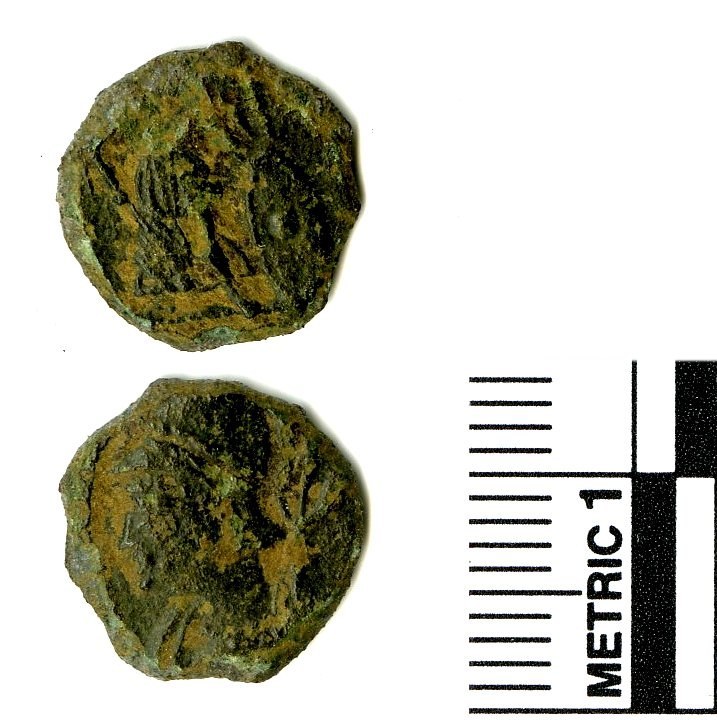
Commemorative Follis of Constantinople
Bronze city-commemorative of Constantine's era (330-340 AD): helmeted Constantinopolis on the obverse, a Victory standing on a ship's prow on the reverse.
- Country
- Roman Empire
- Denomination
- Follis
- Metal
- Bronze
Got a coin like this?
Identify any coin from a photo, free.
Overview
The Commemorative Follis of Constantinople is a small bronze coin struck across the Roman Empire from about 330 AD onward to mark the dedication of Constantine the Great's new capital, Constantinople. It is one of a paired series of "city commemoratives": one type honors Constantinople (legend CONSTANTINOPOLIS) and a companion honors old Rome (legend VRBS ROMA). The coin described here is the Constantinople issue.
The obverse shows a helmeted personification of Constantinople as a female bust, laureate and wearing an imperial mantle, rather than an emperor's portrait. The reverse carries a winged Victory standing on the prow of a ship, holding a scepter and resting a hand on a shield, celebrating the city's naval and imperial power. Because these coins bear no ruler's name, they are dated by their fabric, mint marks, and the period of production, roughly 330-340 AD.
Struck in very large numbers at many mints, these commemoratives are among the most recognizable late Roman bronzes and a popular entry point into collecting the coinage of the Constantinian dynasty.
History & Background
Constantine the Great refounded the Greek city of Byzantium as Constantinople and formally dedicated it as a new imperial capital in 330 AD. To publicize the event, the imperial mints issued a series of small bronze commemoratives that paired the new capital with the ancient one: a CONSTANTINOPOLIS type and a VRBS ROMA type, struck alongside the regular imperial coinage of Constantine and his sons.
These coins belong to the reformed bronze system of the fourth century. The large silver-rich follis of the early tetrarchy had by this date shrunk to a small bronze piece, and the city commemoratives were produced as part of that reduced-module coinage. They were minted throughout the empire, and examples carry mint marks in the exergue identifying workshops at cities such as Constantinople, Trier, Lyon, Arles, Rome, Siscia, Thessalonica, Nicomedia, Antioch, and others.
Production continued through the 330s, and the type circulated widely into the following decade. Because they were struck in enormous quantity and did not name a specific emperor, the commemoratives outlasted the immediate dedication and remain one of the most common surviving coin types of the Constantinian age.
How to Identify
Identify the obverse by its personification rather than an emperor. The Constantinople issue shows a left-facing female bust of the city wearing a crested or laureate helmet and an imperial cloak, sometimes holding a scepter or reed over the shoulder, with the legend CONSTANTINOPOLIS around the edge. The companion Rome type reads VRBS ROMA and shows a helmeted Roma; matching the legend to the bust is the surest way to separate the two.
The reverse is diagnostic: a winged Victory standing on the prow of a ship (galley), usually holding a long scepter or transverse spear and resting the other hand on a shield. On the Rome commemorative the reverse instead shows the she-wolf suckling Romulus and Remus, so the ship's-prow Victory confirms the Constantinople type. Look in the exergue beneath the reverse for a mint mark of letters and symbols.
In hand these are small bronze coins, typically about 16-19 mm in diameter and roughly 1.5-2.5 grams, often with a dark brown or green patina. There is no emperor's name or portrait, which distinguishes commemoratives from the standard bronzes of Constantine and his sons struck in the same years.
Value & Collectibility
City commemoratives of Constantinople are common and generally affordable ancient coins. Worn examples with a legible bust and a recognizable ship's-prow reverse trade at modest prices, while well-centered coins with a sharp helmeted portrait, a clear Victory, full legends, and an attractive patina command a clear premium.
Value is driven mainly by condition, strike, and eye appeal rather than rarity, since the type was produced in huge numbers. Scarcer mints, unusual mint-mark varieties, or coins retaining original silvering can sell above the level of ordinary circulated pieces.
The figures here are general ranges for context, not appraisals. Grade, mint, centering, and surface preservation can move an individual coin well outside them, and specialist attribution to a specific mint and issue can add a premium.
Frequently asked questions
Whose portrait is on this coin?
None. The bust is a personification of the city of Constantinople, shown as a helmeted female figure, not an emperor. That is why the coin carries the city name CONSTANTINOPOLIS rather than a ruler's name.
What does the ship on the reverse mean?
The reverse shows Victory standing on the prow of a ship, a symbol of naval strength and imperial triumph chosen to celebrate Constantine's new capital on the Bosporus.
How is this different from the VRBS ROMA coin?
They are a matched pair. The Constantinople type reads CONSTANTINOPOLIS with a Victory on a ship's prow; the Rome type reads VRBS ROMA with the she-wolf suckling Romulus and Remus.
Are these commemoratives rare?
No. They were struck in very large numbers at many mints during the 330s and are among the most common surviving late Roman bronzes, which keeps most examples inexpensive.
Why is it called a follis if it is so small?
The bronze follis was steadily reduced in size and metal through the early fourth century. By the time of these commemoratives it had become a small, light bronze coin far smaller than the large early-tetrarchic follis.
Commemorative Follis of Constantinople guides
In-depth guides for identifying, valuing, and collecting Commemorative Follis of Constantinople.
Other coins you may enjoy
Tetradrachm of Ptolemy XII
80-51 BC
Tetradrachm of Ptolemy I
305-283 BC
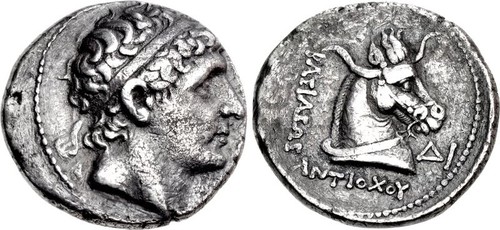
Tetradrachm of Antiochos I Soter
281-261 BC
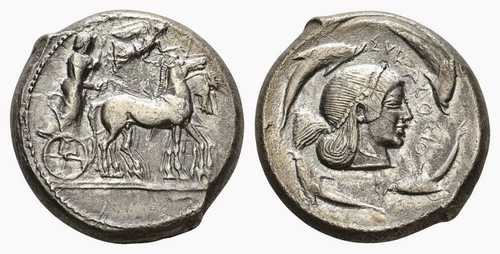
Syracuse Tetradrachm
c. 5th-4th century BC (Classical period)
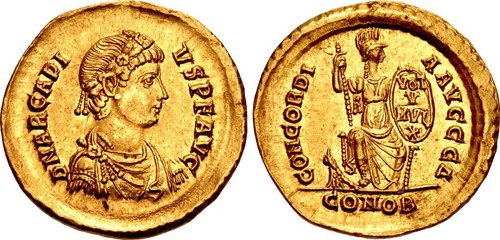
Solidus of Arcadius
AD 395-402
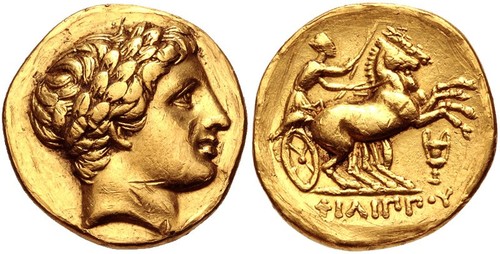
Philip III Gold Stater
323-317 BC
Siliqua of Gratian
AD 367-383
Sestertius of Maximinus Thrax
235-238 AD
Solidus of Valentinian III
AD 425-455
Seleucus I Nicator Tetradrachm
Late 4th-3rd century BC
Nummus of Magnentius
AD 350-353
Follis of Galerius
AD 308-310