
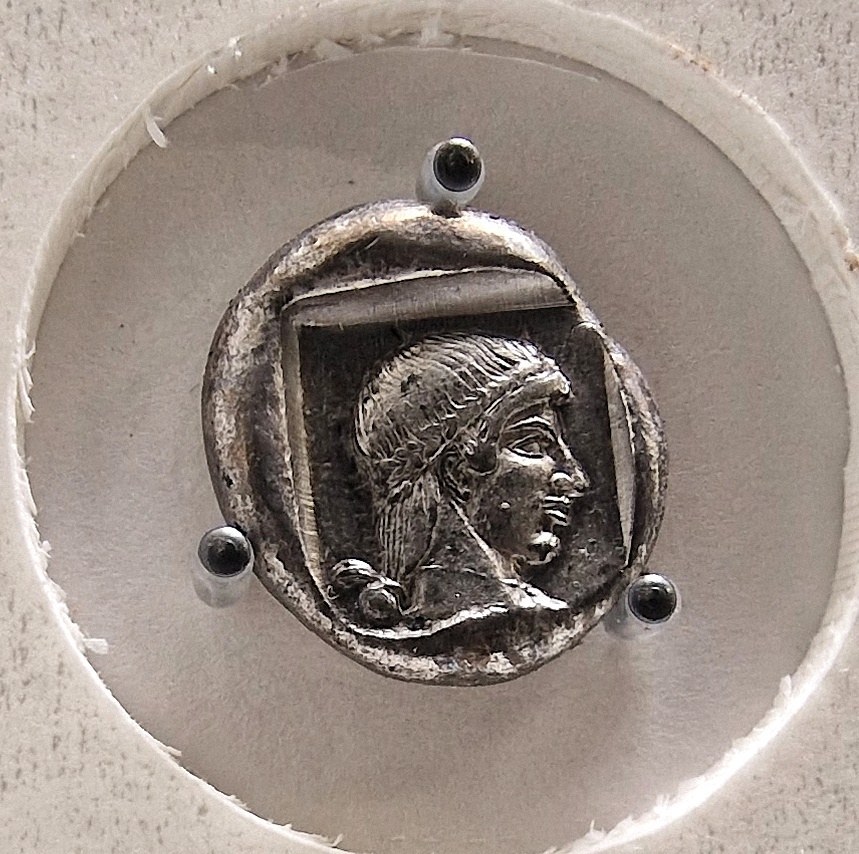
Cnidian Drachm
An archaic hand-struck silver drachm of the Greek city of Cnidus, showing the goddess Aphrodite on one side and an eagle on the other.
- Country
- Ancient Greece
- Denomination
- Drachm
- Metal
- Silver
Got a coin like this?
Identify any coin from a photo, free.
Overview
This is a small hammered silver coin struck by the ancient Greek city of Cnidus (Knidos), a Dorian settlement on the coast of Caria in what is now southwestern Turkey. The example seen here belongs to the archaic period, roughly around 500 BC, with the head of the goddess Aphrodite on the obverse and an eagle on the reverse. Cnidus was one of the most important cult centers of Aphrodite in the Greek world, so her image is a fitting civic emblem for the city's money.
Because the coin was struck by hand from individually engraved dies onto a hand-made blank, no two pieces are identical. The flan is typically thick, slightly irregular, and often off-round, and the design is frequently a little off-center. This is entirely normal for archaic Greek silver and is one of the ways genuine coins are recognized.
As an early Greek city issue, the Cnidian drachm is far scarcer than later mass-produced ancient coins. Surviving examples range from worn, softly struck pieces to well-centered coins with a clear portrait of the goddess and a sharp eagle, and condition strongly affects how each one is regarded by collectors.
History & Background
Cnidus was a wealthy Dorian Greek city built on the trade routes of the eastern Aegean, at the tip of a long peninsula in Caria. Like many Greek cities of Asia Minor, it began striking its own silver coinage in the archaic period, in the decades on either side of 500 BC, using civic emblems to advertise the identity and cults of the city.
The city was famed throughout antiquity for its devotion to Aphrodite, worshipped there as a protector of seafarers and, in later centuries, celebrated through the renowned nude statue of Aphrodite carved by the sculptor Praxiteles. That strong local cult explains why the goddess appears as a coin type. Early Cnidian silver circulated in a region that soon fell under Persian influence and later joined Athenian-led alliances, so its coinage reflects a small independent city asserting itself among much larger powers.
Archaic issues like this one predate the standardized, widely legible Greek coins of the classical age. They were produced in limited quantity by the standards of later antiquity, and the surviving pieces come mainly from old collections and hoards. Over the following centuries Cnidus continued to strike coins, but the early hand-struck drachms remain the most evocative of the city's beginnings as a mint.
How to Identify
Look first at the obverse, which carries the head of Aphrodite. On archaic dies the goddess is rendered in a stylized early style, with formal hair and facial features that look more angular and less naturalistic than the softer classical portraits of later centuries. The reverse shows an eagle, the second civic device, often within a shallow incuse (sunken) area rather than a raised field, which is typical of early Greek striking.
The coin is small and struck in silver. A drachm of this era is generally on the order of roughly 5 to 6 grams and around 15 to 18 mm across, though archaic weights and sizes vary between specimens and standards. Genuine ancient silver usually tones to a soft gray, sometimes with iridescence or darker patina settled in the recesses, rather than the bright white of modern polished metal.
Diagnostic traits of a genuine piece include a thick, slightly irregular hand-made flan, high but individualized relief, and clear evidence of striking rather than casting: no seam around the edge and no trapped air bubbles. Centering is often imperfect, so parts of the design may run off the flan. Lettering, where present on early Cnidian coins, is minimal and abbreviated, so attribution rests mainly on the types themselves and on comparison with published examples.
Value & Collectibility
As an archaic Greek city issue, the Cnidian drachm is considerably scarcer than common later ancient coins, and even modest examples carry a meaningful premium over base-metal antiquities. Values span a wide range driven by the sharpness of the strike, centering, the clarity of Aphrodite's head and the eagle, and the overall preservation of the silver surface.
Worn or softly struck pieces sit at the lower end, while well-centered coins with a crisp goddess and a bold eagle command substantially more, and exceptional archaic specimens can reach into the higher tiers of the ancient-coin market. Provenance from an old collection or a documented sale can also add value and reassurance.
Because exact figures depend on grade, eye appeal, and the current market, treat any single number as context rather than a fixed price. For a coin of this age and importance, independent attribution and authentication by a specialist in ancient Greek coinage is the single biggest factor in establishing a realistic value.
Frequently asked questions
Who is the goddess on the Cnidian drachm?
It is Aphrodite, the Greek goddess of love, who was the principal deity of Cnidus. The city was one of her most famous cult centers, which is why her head appears as the civic type on its coinage.
Where was Cnidus and where were these coins made?
Cnidus (Knidos) was a Dorian Greek city on the coast of Caria, in what is now southwestern Turkey, near the modern Datca peninsula. The coin was struck at the city's own mint in the archaic period, around 500 BC.
Why is the coin thick and not perfectly round?
Archaic Greek coins were struck by hand on individually made blanks, so a thick, slightly irregular, off-center flan is normal and expected. Perfectly round, seamless uniformity would instead be a warning sign of a modern cast copy.
Is the Cnidian drachm solid silver?
Yes, genuine archaic Cnidian drachms are struck in good silver, which typically tones to a soft gray patina over the centuries. It is not a modern coin metal, and it should not look bright and white unless it has been cleaned.
Are these coins rare?
Compared with mass-produced later ancient coins, early Cnidian drachms are genuinely scarce. Survivors come mainly from old collections and hoards, and well-preserved, well-centered examples are especially sought after.
Cnidian Drachm guides
In-depth guides for identifying, valuing, and collecting Cnidian Drachm.
Other coins you may enjoy
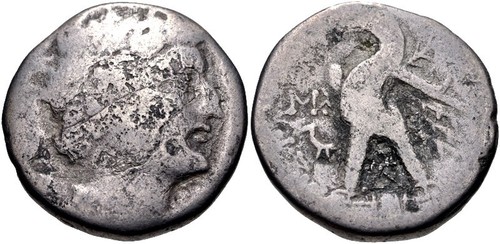
Tetradrachm of Ptolemy XII
80-51 BC
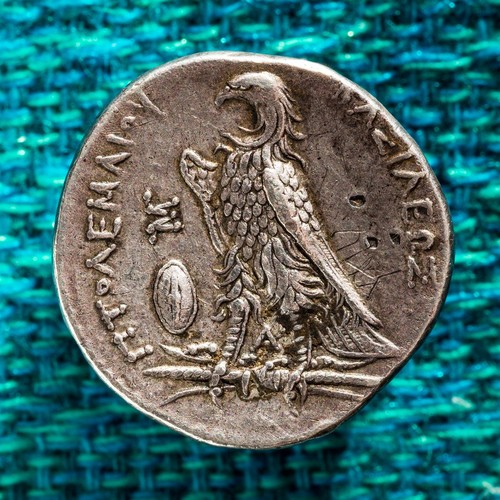
Tetradrachm of Ptolemy I
305-283 BC
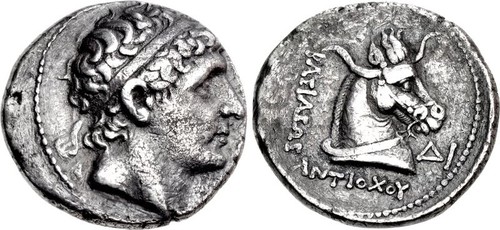
Tetradrachm of Antiochos I Soter
281-261 BC
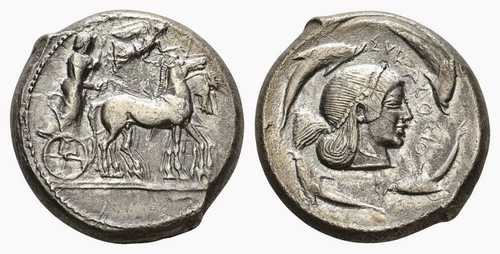
Syracuse Tetradrachm
c. 5th-4th century BC (Classical period)
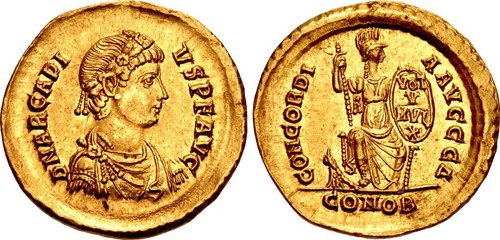
Solidus of Arcadius
AD 395-402
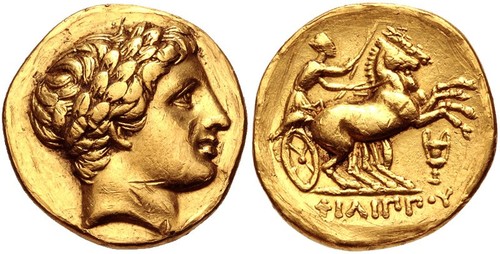
Philip III Gold Stater
323-317 BC
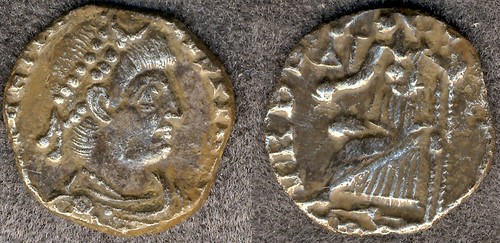
Siliqua of Gratian
AD 367-383
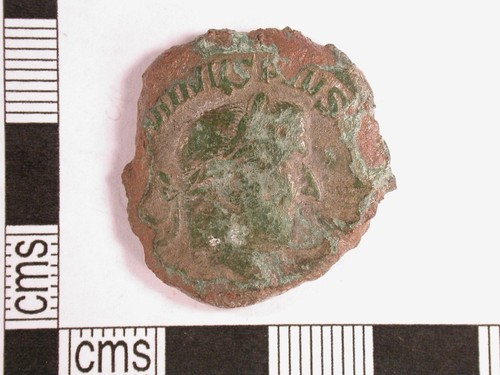
Sestertius of Maximinus Thrax
235-238 AD
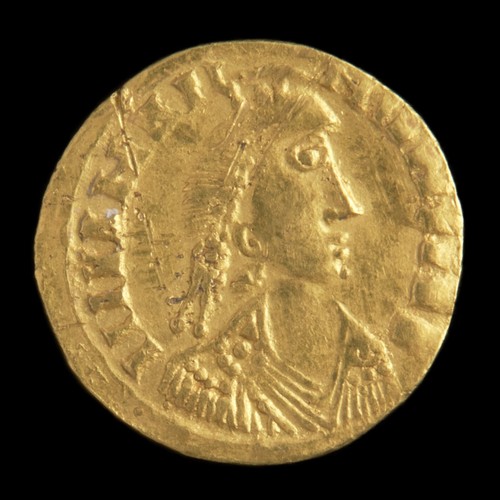
Solidus of Valentinian III
AD 425-455
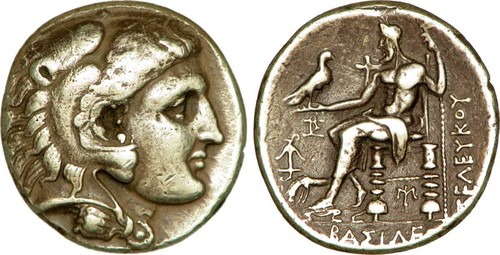
Seleucus I Nicator Tetradrachm
Late 4th-3rd century BC
Nummus of Magnentius
AD 350-353
Follis of Galerius
AD 308-310