
How to Identify the Cnidian Drachm
A collector's guide to recognizing an archaic Cnidian silver drachm by its Aphrodite head, eagle reverse, size and weight, hand-struck flan, and common look-alikes.
Read the full Cnidian Drachm encyclopedia entry →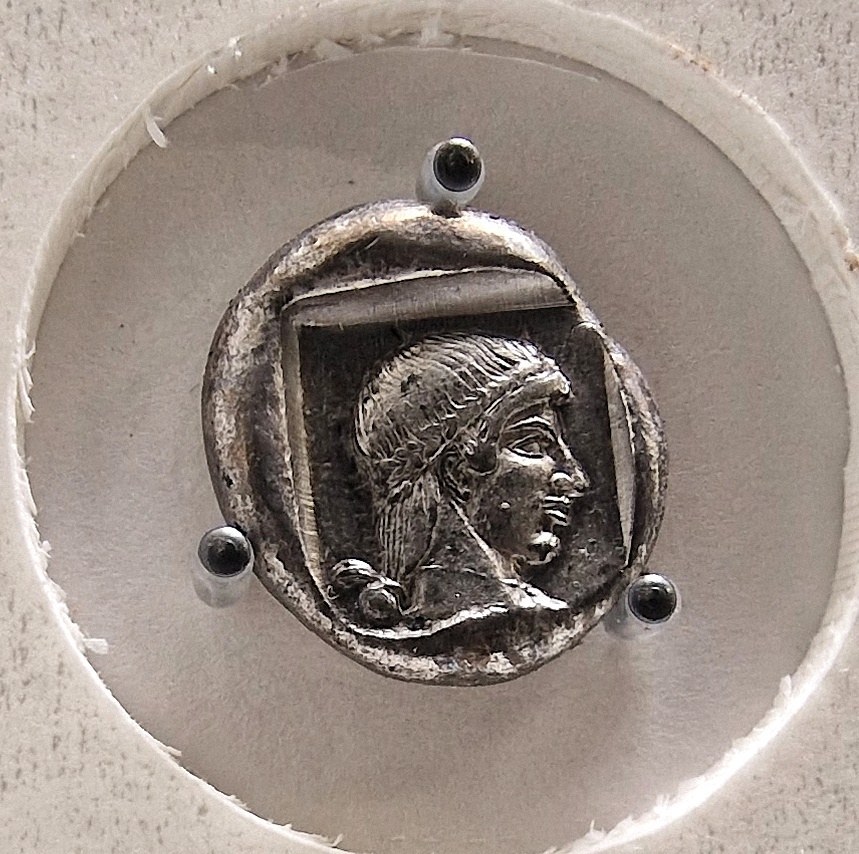
Start With the Two Civic Types
The fastest way to place this coin is to read its two designs together. The obverse carries the head of Aphrodite, the patron goddess of Cnidus, and the reverse carries an eagle. That specific pairing of the goddess and the bird, on a small archaic silver piece, points to Cnidus rather than another Greek mint. Note the direction the head faces and how the eagle is posed, since these details help match a coin to published archaic examples.
Read the Archaic Style
Archaic dies look different from later classical work. Expect a stylized, formal rendering of Aphrodite's hair and features, more angular and less naturalistic than the soft portraits of the 4th century BC. The reverse eagle is often set within a shallow sunken (incuse) area rather than a raised field, a hallmark of early Greek striking. This deliberately old-looking style is a positive sign of an archaic date, not a defect.
Check Size, Weight, and Metal
A drachm of this period is small and struck in silver, generally in the range of roughly 5 to 6 grams and about 15 to 18 mm across, though archaic weights vary by standard and by specimen. Genuine ancient silver tones to a soft gray, sometimes with iridescence or darker tone in the recesses. A coin that is bright white, unusually heavy or light for its size, or clearly base metal under the surface warrants caution.
Confirm It Was Struck, Not Cast
Genuine archaic coins were hammered between hand-engraved dies, so expect a thick, slightly off-round flan, high but individualized relief, and often an off-center strike with part of the design running off the edge. Examine the edge closely: struck coins have no casting seam and no trapped air bubbles. A visible mold seam, a grainy or pitted surface, mushy details, or two coins that are exactly identical are strong signs of a cast reproduction.
Rule Out Look-Alikes and Get a Second Opinion
Early Greek silver is widely reproduced, both as honest tourist replicas and as deceptive forgeries, so be cautious. Other Greek cities also used deities and birds on their coins, so confirm both types and the archaic style before settling on Cnidus. Because scarce archaic coins carry real value, it is worth confirming attribution and authenticity through a reputable ancient-coin dealer or a third-party expert before relying on any identification or price.
Frequently asked questions
What distinguishes a Cnidian drachm from other archaic Greek coins?
The combination of Aphrodite's head with an eagle, on a small hand-struck silver drachm in the archaic style, is the key. Many Greek cities used deities or animals, so it is the specific pairing of these two types together that points to Cnidus.
How can I tell it is genuinely archaic and not later?
Look for the stylized, formal early rendering of the goddess and a reverse design set in a shallow incuse area rather than a raised field. This archaic engraving style, combined with a thick hand-made flan, indicates an early date around 500 BC.
What are the clearest signs of a fake?
A seam around the edge, trapped air bubbles or pitting, a grainy or soapy-smooth surface, blurry details, or two coins that are exactly identical all point to a cast copy. Genuine archaic drachms are hand-struck and show natural, individual variation with no casting seam.
Can a worn example still be identified?
Often yes. Even when detail is soft, the pairing of Aphrodite and the eagle, the archaic style, and the size and weight in silver usually let an experienced collector or dealer place the coin. Heavy wear lowers value but does not necessarily prevent attribution.