
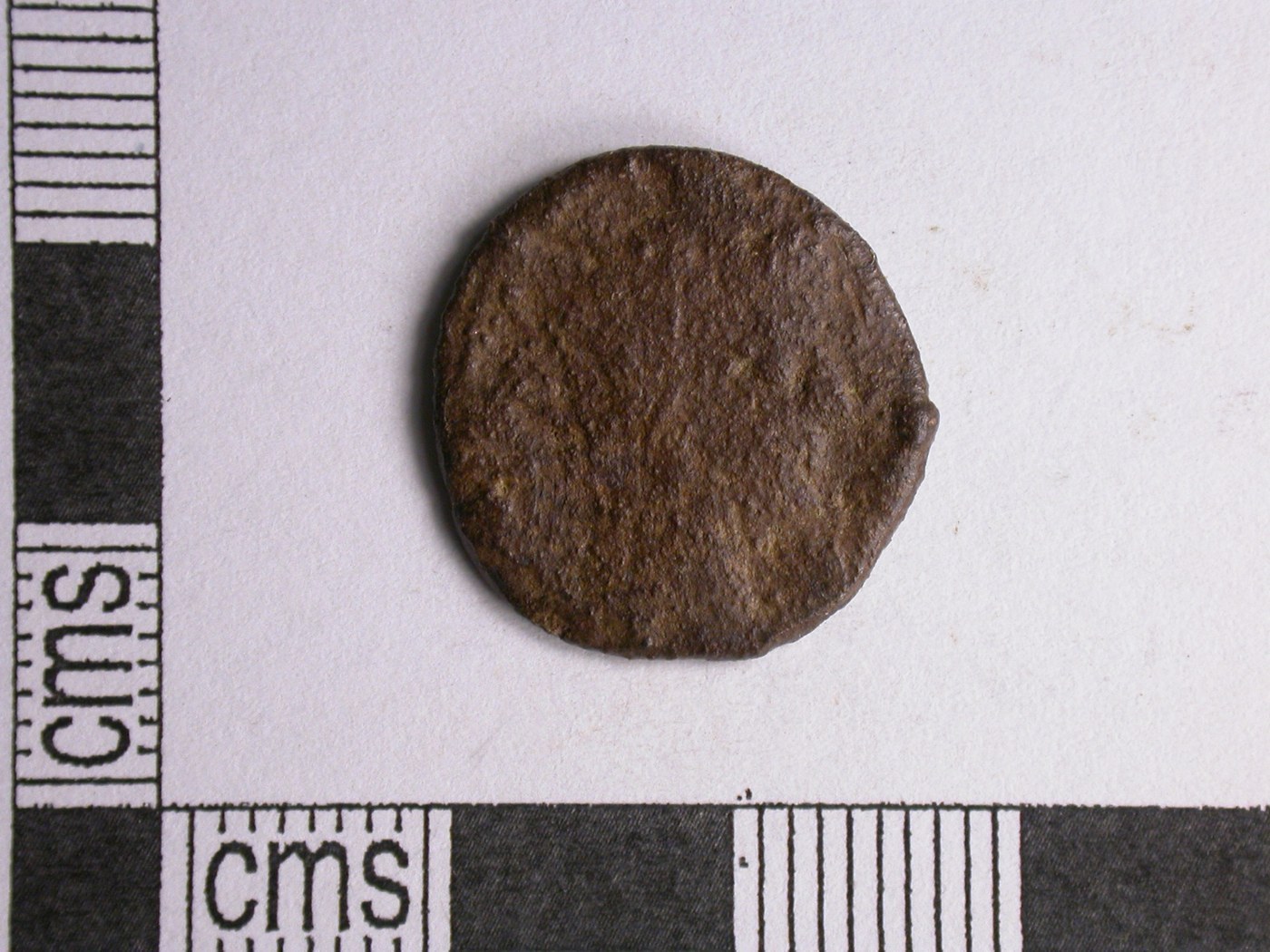
Caesar Elephant Denarius
Silver denarius of Julius Caesar (49–48 BC) showing an elephant trampling a serpent above CAESAR, paired with priestly pontifical emblems.
- Country
- Roman Republic
- Denomination
- Denarius
- Metal
- Silver
Got a coin like this?
Identify any coin from a photo, free.
Overview
The Caesar Elephant denarius is one of the most recognizable silver coins of the late Roman Republic, struck for Julius Caesar around 49–48 BC. Its reverse shows an elephant advancing right, trampling a horned serpent (sometimes read as a dragon or carnyx), with the name CAESAR spelled out in the exergue below. This reverse gives the type its popular name.
The obverse does not carry a conventional head-and-shoulders portrait. Instead it displays a group of pontifical (priestly) implements referring to Caesar's role as Pontifex Maximus: a simpulum or ladle, an aspergillum (sprinkler), a securis (sacrificial axe, often with an animal head), and the apex, the pointed cap of a Roman priest. Because these emblems fill the field like a small tableau, casual observers and image scanners sometimes describe the obverse as a 'portrait,' but no facial likeness of Caesar appears on this issue.
The coin is a denarius, the standard silver piece of the Republic, roughly 18–20 mm across and about 3.5–4.0 grams. It was produced in enormous quantity to pay Caesar's legions during the civil war, which is why genuine examples remain relatively obtainable today compared with many other ancient Roman coins.
History & Background
This denarius was issued at the outbreak of the civil war between Julius Caesar and Pompey the Great. Around 49 BC Caesar crossed the Rubicon and marched on Italy, and he needed vast amounts of coinage to pay and supply his soldiers. The elephant type was struck by a military mint traveling with his army rather than at the mint in Rome, and it was minted in extremely large numbers over roughly 49–48 BC.
The imagery has been debated by scholars for centuries. The elephant crushing a serpent is commonly read as the forces of good or of Caesar trampling evil or his enemies. Other interpretations connect the elephant to Caesar's family or to a supposed Punic word for elephant. Whatever the intended meaning, the design was a bold piece of propaganda: it placed the name CAESAR prominently on hard silver in the hands of tens of thousands of soldiers.
Notably, the obverse advertises Caesar's religious authority as Pontifex Maximus, a post he had held since 63 BC, rather than a military or personal image. Only later, in early 44 BC shortly before his assassination, did Caesar become the first living Roman to place his own portrait on the coinage. The elephant denarius therefore predates his portrait coins and belongs to the civil-war years.
How to Identify
The defining feature is the reverse: an elephant walking to the right, trampling a horned serpent or dragon-like creature beneath its feet, with the bold legend CAESAR in the exergue (the flat area below the ground line). If your coin shows an elephant and the letters CAESAR, you are looking at this family of types.
Turn to the obverse to confirm. A genuine Crawford 443/1 elephant denarius shows a cluster of priestly instruments, not a human head: the ladle-like simpulum, the aspergillum sprinkler, the sacrificial axe, and the pointed apex cap. There is no obverse legend and no facial portrait. Any elephant/CAESAR coin that pairs the reverse with a clear profile bust of Caesar is not this ancient issue and should be treated with caution.
The piece should be silver, hand-struck, and irregular rather than perfectly round, with a diameter of about 18–20 mm and a weight near 3.5–4.0 grams. Slightly off-center strikes, uneven flans, and old toning are normal and expected for a genuine ancient denarius.
Value & Collectibility
Because it was minted in huge quantities to fund a war, the Caesar Elephant denarius is one of the more affordable and widely available denarii of a famous Roman figure. Worn but honest examples in lower to middle grades commonly trade in roughly the low-to-mid hundreds of dollars, while sharp, well-centered, high-grade coins with good silver and clear detail can bring substantially more.
Value is driven by strike quality, centering, surface preservation, and how completely the elephant and the CAESAR legend are rendered. Attractive toning and a full, cleanly struck elephant add a premium; heavy wear, corrosion, cleaning marks, or edge damage reduce it. Because so many were made, condition rather than rarity sets the price for most examples.
Given the coin's fame and value, reproductions, cast copies, and fantasy pieces are common. For any purchase at a meaningful price, buy from a reputable ancient-coin dealer or auction house, and consider third-party authentication for higher-grade or higher-priced examples. Exact prices vary widely with the market, so treat these as general context rather than a quote.
Frequently asked questions
Does the Caesar Elephant denarius show a portrait of Julius Caesar?
No. The genuine 49–48 BC issue shows priestly emblems (ladle, sprinkler, axe, and apex cap) on the obverse and an elephant with CAESAR on the reverse. Caesar's living portrait only appeared on coins in 44 BC, so an elephant coin with his face is a later reproduction or fantasy piece.
Why is there an elephant on the coin?
The elephant trampling a serpent was likely propaganda showing Caesar crushing his enemies or evil. Scholars have also linked the elephant to his family or to a supposed Punic word for the animal. The precise meaning is still debated.
Is this coin rare or valuable?
It was struck in enormous numbers to pay Caesar's legions, so it is one of the more available denarii of a famous ancient figure. Worn examples are often in the low-to-mid hundreds of dollars, while high-grade coins can cost considerably more.
When was it made?
It was struck around 49–48 BC by a military mint traveling with Caesar's army during the civil war against Pompey, at the time he crossed the Rubicon and marched on Italy.
How big is the coin?
It is a silver denarius, roughly 18–20 mm in diameter and about 3.5–4.0 grams, hand-struck on an irregular flan as was typical for the period.
Caesar Elephant Denarius guides
In-depth guides for identifying, valuing, and collecting Caesar Elephant Denarius.
Other coins you may enjoy
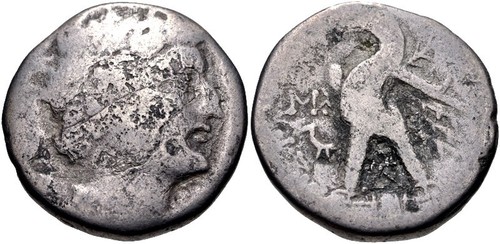
Tetradrachm of Ptolemy XII
80-51 BC
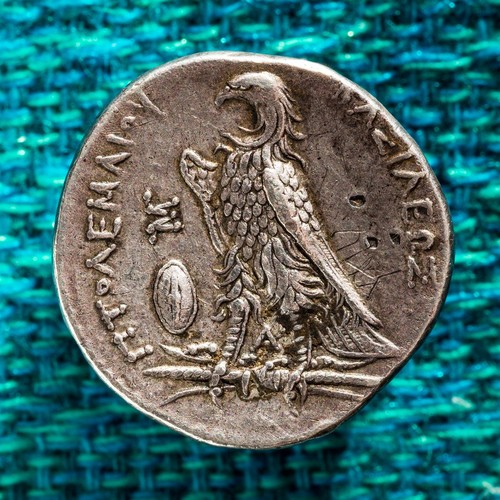
Tetradrachm of Ptolemy I
305-283 BC
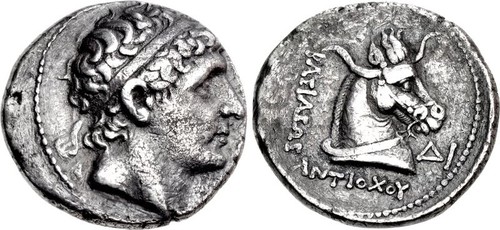
Tetradrachm of Antiochos I Soter
281-261 BC
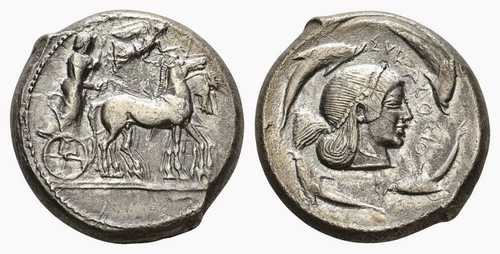
Syracuse Tetradrachm
c. 5th-4th century BC (Classical period)
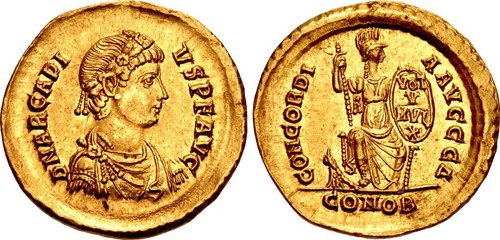
Solidus of Arcadius
AD 395-402
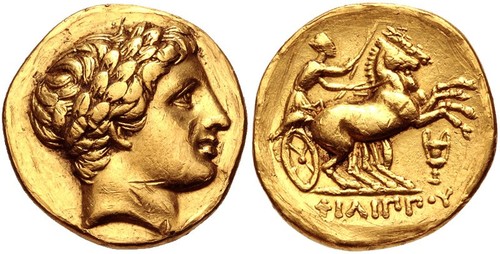
Philip III Gold Stater
323-317 BC
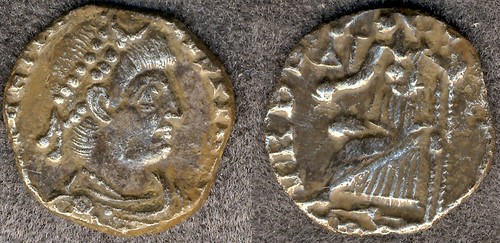
Siliqua of Gratian
AD 367-383
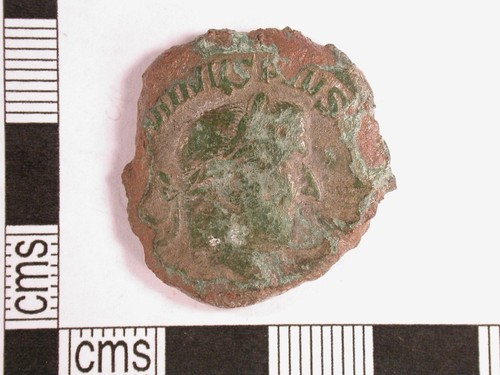
Sestertius of Maximinus Thrax
235-238 AD
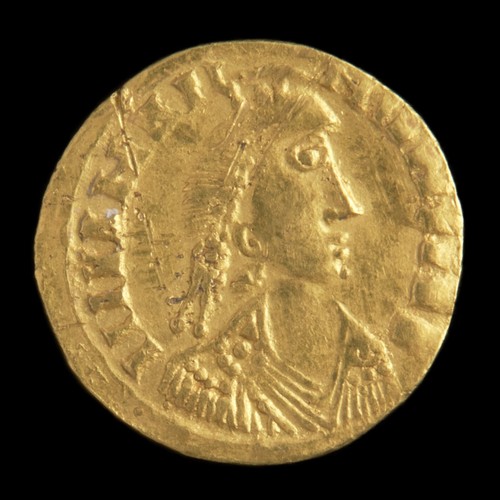
Solidus of Valentinian III
AD 425-455
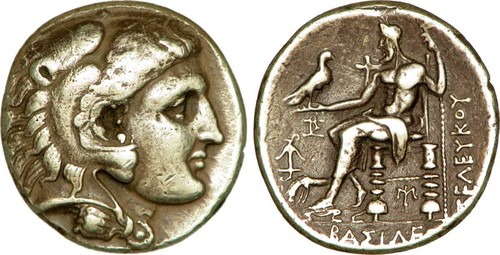
Seleucus I Nicator Tetradrachm
Late 4th-3rd century BC
Nummus of Magnentius
AD 350-353
Follis of Galerius
AD 308-310