
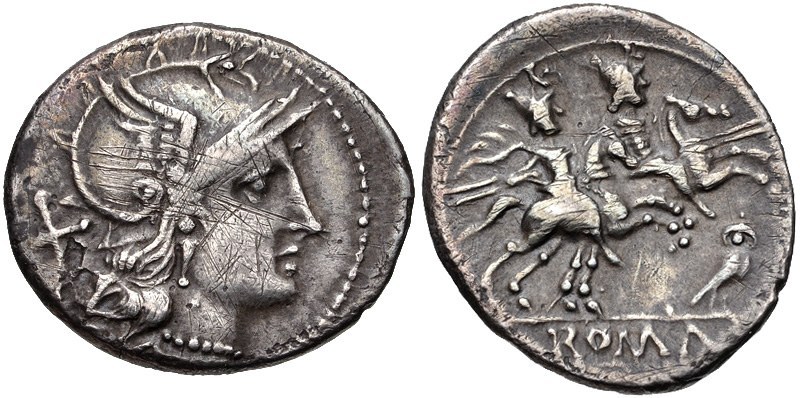
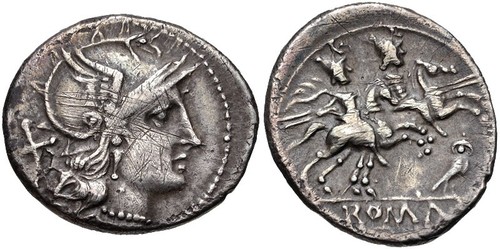
Caecidius Noctua Denarius
A silver Roman Republican denarius of the owl (noctua) symbol series, catalogued RRC 135/1 and dated c. 194–190 BC.
- Country
- Roman Republic
- Denomination
- Denarius
- Metal
- Silver
Got a coin like this?
Identify any coin from a photo, free.
Overview
This is a silver denarius of the Roman Republic belonging to the "owl" (Latin noctua) symbol series, catalogued by Crawford as RRC 135/1 and conventionally dated to about 194–190 BC. Like all denarii of this early period it follows the standard reformed type introduced in 211 BC: a helmeted head of the goddess Roma on the obverse and the Dioscuri (the twins Castor and Pollux) on horseback on the reverse. What distinguishes this particular issue is a small owl symbol placed in the reverse field, the feature that gives the series its "Noctua" name.
The symbol acted as a control mark identifying the issuing officials or workshop responsible for the coinage. Older catalogues sometimes attached the owl series to a moneyer read as Caecidius, treating the owl as a punning badge on the family name, while modern scholarship (Crawford's Roman Republican Coinage) lists it among the anonymous symbol issues.
The denarius was the backbone of the Republican silver currency, valued at ten bronze asses (the mark of value X appears behind Roma's head). Coins of this general type circulated widely across the expanding Roman world during the years following the Second Punic War.
History & Background
The denarius was created in the monetary reform of 211 BC, during the Second Punic War, replacing earlier Roman silver. In the decades that followed, the mint at Rome distinguished successive issues not by named moneyers but by small symbols, letters, or monograms placed in the field. The owl series, RRC 135, is one of these symbol issues, dated by Crawford to roughly 194–190 BC.
This was a period of rapid Roman expansion in the eastern Mediterranean, and steady silver coinage was needed to pay armies and administer newly won territory. The reverse imagery of the Dioscuri, patron horsemen of Rome believed to have aided the Republic at the Battle of Lake Regillus, was a fixed patriotic motif on the denarius for its first several decades.
The traditional attribution to a moneyer named Caecidius reflects an older cataloguing habit of assigning symbol series to gentes by punning on the emblem; the owl, associated with wisdom and with the goddess Minerva, was read as such a family badge. That link is not securely established, and the coin is most reliably identified simply as RRC 135/1.
How to Identify
A denarius of this issue should show the helmeted head of Roma facing right on the obverse, with the value mark X behind the neck. The reverse shows the Dioscuri, each with a star above his cap, riding right with couched spears, ROMA in the exergue, and the small owl symbol in the field that defines the series. The coin is struck in fairly good silver, typically around 17–20 mm across and roughly 3.5–4.0 g, on the somewhat irregular flans normal for hand-struck ancient coinage.
Note a common source of confusion: the same owl (RRC 135) series also included bronze coinage, notably the as, which carries a double-faced (Janus) head on the obverse and a ship's prow on the reverse. A double portrait plus a ship or prow points to that bronze piece rather than to the silver denarius, even though both share the owl mark and the same catalogue family.
Because of wear and off-centre striking, the owl symbol and the ROMA legend may be weak or partly off the flan. Confirming the issue depends on locating the owl in the reverse field and matching the overall type against a reference such as Crawford (RRC 135) or Sydenham.
Value & Collectibility
Value depends heavily on grade, centring, strike quality, and how clearly the diagnostic owl symbol is visible. Early Roma/Dioscuri denarii are collected types but are not among the great rarities, so worn or off-centre examples generally sit in the modest range, while sharply struck, well-centred, high-grade coins with a clear symbol command a solid premium.
As a broad guide, heavily worn or problem examples often trade in the low tens of dollars, presentable circulated coins in the tens-to-low-hundreds range, and choice pieces higher still; specific auction results vary widely with eye appeal and provenance. Ancient silver is also sensitive to surface problems such as cleaning marks, porosity, or edge cracks, all of which reduce value.
For any firm figure, weigh and measure the coin, confirm the type and symbol against a standard catalogue, and compare recent sales of the same RRC number. Given the prevalence of forgeries and tooled pieces in the ancient market, a professional opinion or a reputable dealer's assessment is worthwhile before assigning value.
Frequently asked questions
What does "Noctua" mean on this coin?
Noctua is Latin for the little owl. It refers to the small owl symbol in the reverse field that identifies this issue, catalogued as RRC 135/1.
Who is on the obverse?
The helmeted head of the goddess Roma faces right, with the value mark X behind the neck. This is the standard obverse of early Roman Republican denarii.
Why is it called the Caecidius denarius?
Older catalogues attributed the owl series to a moneyer read as Caecidius, treating the owl as a family badge. Modern scholarship lists it among anonymous symbol issues, so the safest identifier is RRC 135/1.
My coin has two faces and a ship, not Roma and horsemen. Is it the same?
That combination is the bronze as of the same owl series, which shows a double-faced Janus head and a ship's prow. It shares the owl mark but is a different denomination from the silver denarius.
Is it real silver?
Genuine denarii of this period were struck in fairly good silver, usually around 3.5–4.0 g and 17–20 mm. Weight, size, and metal help confirm authenticity, but forgeries exist, so professional verification is advised.
Caecidius Noctua Denarius guides
In-depth guides for identifying, valuing, and collecting Caecidius Noctua Denarius.
Other coins you may enjoy
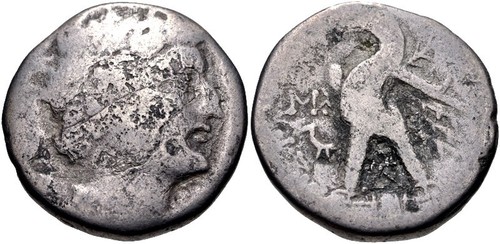
Tetradrachm of Ptolemy XII
80-51 BC
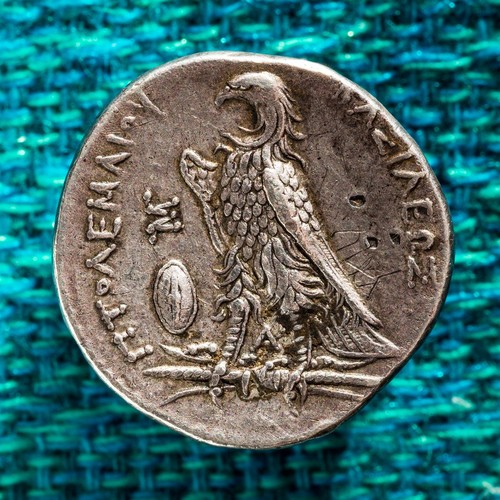
Tetradrachm of Ptolemy I
305-283 BC
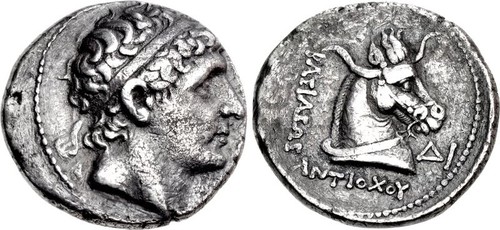
Tetradrachm of Antiochos I Soter
281-261 BC
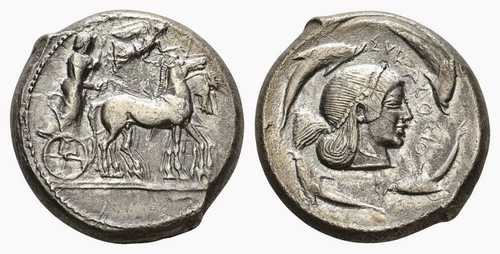
Syracuse Tetradrachm
c. 5th-4th century BC (Classical period)
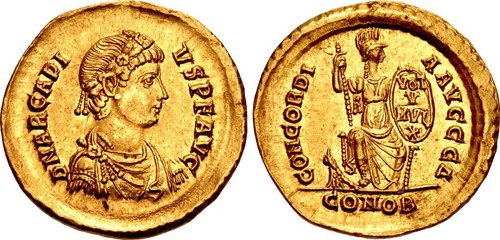
Solidus of Arcadius
AD 395-402
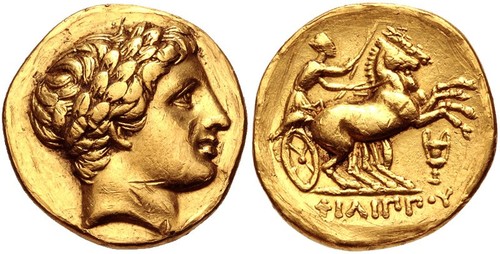
Philip III Gold Stater
323-317 BC
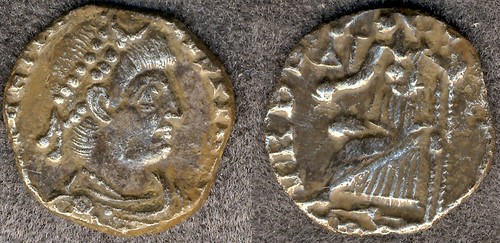
Siliqua of Gratian
AD 367-383
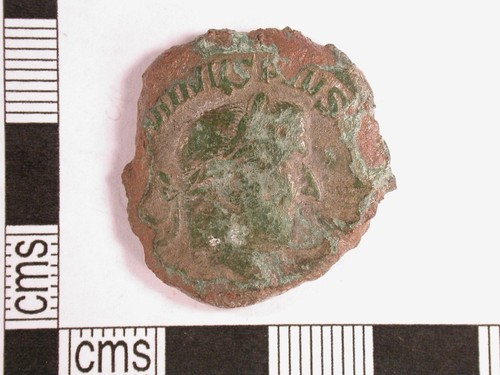
Sestertius of Maximinus Thrax
235-238 AD
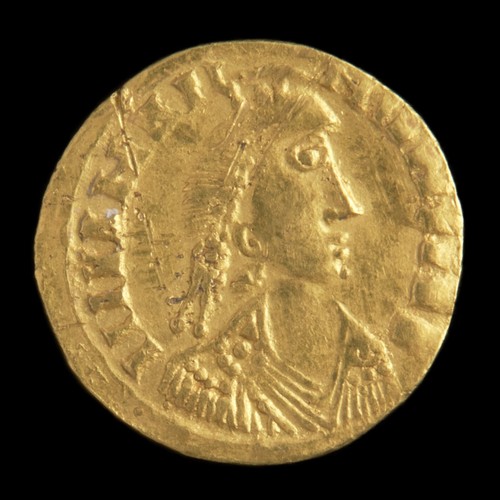
Solidus of Valentinian III
AD 425-455
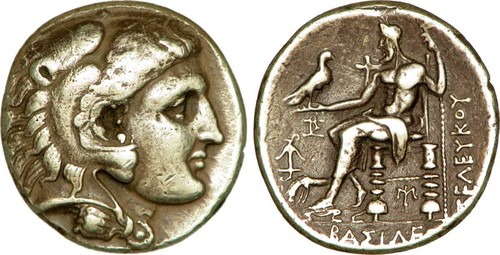
Seleucus I Nicator Tetradrachm
Late 4th-3rd century BC
Nummus of Magnentius
AD 350-353
Follis of Galerius
AD 308-310