
How to Identify the Caecidius Noctua Denarius
Spot the owl symbol, Roma obverse, and Dioscuri reverse of RRC 135/1, and tell the silver denarius apart from its bronze cousins.
Read the full Caecidius Noctua Denarius encyclopedia entry →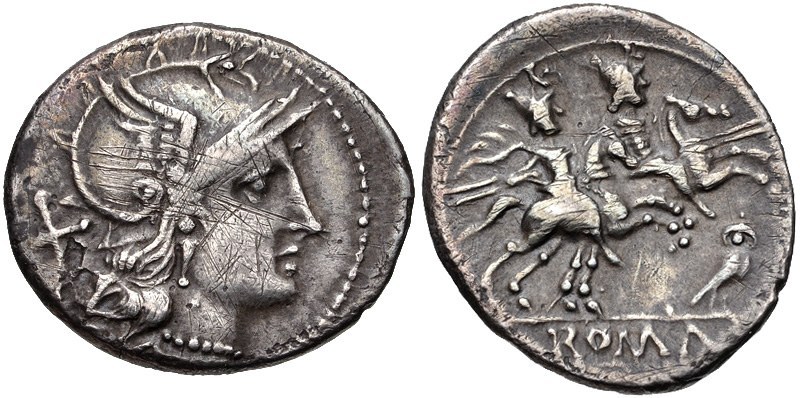
Begin with the obverse. A genuine RRC 135/1 denarius shows the helmeted head of Roma facing right, with the value mark X immediately behind the neck. The reverse shows the Dioscuri, Castor and Pollux, each with a star over his cap, galloping right with spears, and ROMA in the exergue. The single most important diagnostic is the small owl (noctua) symbol placed in the reverse field: that mark is what separates this issue from the many other early Roma/Dioscuri denarii.
Check size and metal. Expect a hand-struck silver flan roughly 17–20 mm in diameter and about 3.5–4.0 g. Flans of this era are often slightly irregular, off-centre, or unevenly struck, so the owl or the ROMA legend may be soft or partly off the edge. Good silver of the period tends to tone to a natural grey; bright, seamless, or unusually heavy pieces deserve suspicion.
Guard against the most common mix-up. The owl (RRC 135) series also comprises bronze coinage: the as carries a double-faced Janus head on the obverse and a ship's prow on the reverse. If the coin in hand shows two faces and a ship or prow rather than Roma and two horsemen, it is that bronze denomination of the same series, not the silver denarius, even though both bear the owl mark.
Watch for look-alikes among other early denarii. Dozens of issues from roughly 211–150 BC share the identical Roma/Dioscuri template and differ only by symbol, letter, or monogram; identification hinges on correctly reading that control mark, so match it against Crawford (RRC) or Sydenham rather than the general type alone.
Finally, authenticate carefully. Ancient coins are widely forged and sometimes tooled, cast, or artificially patinated. Confirm weight, diameter, edge, and fabric, look for casting seams or file marks, and when value or authenticity matters, seek a reputable ancient-coin dealer or a recognised grading and authentication service rather than relying on a single photograph.
Frequently asked questions
What is the quickest way to confirm this exact issue?
Find the owl symbol in the reverse field alongside the standard Roma obverse and Dioscuri reverse. That owl, plus a match to the RRC 135/1 type, is the confirming detail.
How do I know it is the denarius and not the bronze of the same series?
The silver denarius shows Roma and the two horsemen. The bronze as of the owl series shows a double-faced Janus head and a ship's prow. Type, not just the owl, tells them apart.
The owl symbol is worn away. Can I still identify it?
Partly. Weak strikes and wear often obscure the symbol. Use weight, size, style, and the position where the symbol should sit, and compare against catalogue plates; a specialist can help when the mark is gone.
How can I check authenticity without damaging the coin?
Start with accurate weight and diameter and a close look for casting seams, tooling, or a false patina. For a definitive answer, use a reputable ancient-coin dealer or a third-party authentication service instead of scratch or acid tests.