
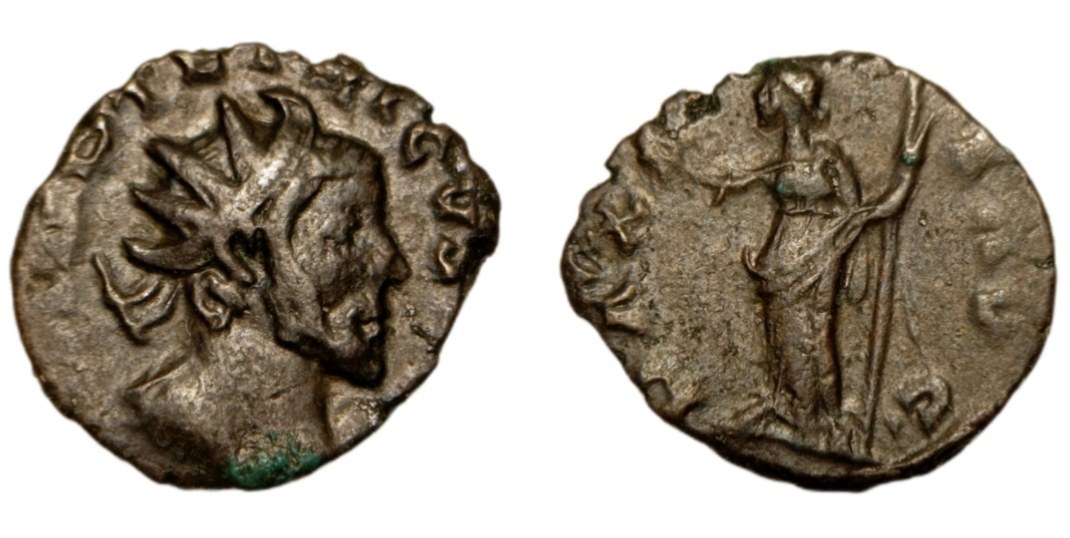
Antoninianus of Tetricus I
A billon antoninianus of the Gallic emperor Tetricus I (270–273 AD), showing his radiate portrait and a standing figure of Pax on the reverse.
- Country
- Gallic Empire
- Denomination
- Antoninianus
- Metal
- Billon/Bronze
Got a coin like this?
Identify any coin from a photo, free.
Overview
This is an antoninianus, a small radiate-crowned Roman coin, struck for Tetricus I, the last emperor of the breakaway Gallic Empire that controlled the western Roman provinces in the early 270s AD. The example shown here has the emperor's bust wearing the spiked radiate crown on the obverse and a standing figure of Pax, the personification of peace, holding an olive branch on the reverse.
By this period the antoninianus had degraded from its earlier silver content into a base billon or bronze coin with only a thin surface wash of silver, most of which has usually worn away. Coins of Tetricus I are among the most commonly encountered of all Roman antoniniani, and they turn up frequently in hoards and metal-detecting finds across France, Britain, and the Low Countries.
History & Background
Tetricus I (full name Gaius Pius Esuvius Tetricus) ruled the Gallic Empire from about 270 to 273 AD. This separatist state had split from central Roman authority in 260 under Postumus and governed Gaul, Britain, and parts of Hispania and Germania during the turbulent "Crisis of the Third Century." Tetricus, a senator and provincial governor, was raised to the purple by the army and later associated his young son, Tetricus II, with him as caesar.
His reign was marked by frontier pressure, internal revolts, and a collapsing coinage. In 274 AD the central emperor Aurelian defeated the Gallic forces and reabsorbed the western provinces. Rather than being executed, Tetricus reportedly surrendered or was pardoned, paraded in Aurelian's triumph, and afterward given an administrative post in Italy, an unusually mild fate for a defeated usurper.
The antoniniani of Tetricus I were produced in enormous quantities at mints usually attributed to Cologne (Colonia Agrippina) and a second, southern Gallic mint. Their abundance, combined with widespread contemporary imitation, means they remain plentiful and inexpensive today.
How to Identify
Identify the coin first by the radiate crown: the emperor's portrait wears a spiked, sun-ray diadem, which marks the coin as an antoninianus ("double denarius") rather than a laureate denarius. The obverse legend typically runs as a form of IMP C TETRICVS P F AVG or IMP TETRICVS AVG around a draped and cuirassed bust facing right.
The reverse of this example shows Pax standing, holding a long transverse scepter and an olive branch, usually with a legend such as PAX AVG. Tetricus used many reverse types (Spes, Salus, Laetitia, Hilaritas, Comes, Virtus, and others), so the standing Pax with branch is one of several closely related standing-figure designs. The coin is small, roughly 17–20 mm across, struck in debased billon or bronze that is now typically brown or greenish with little or no remaining silvering.
Because the son shares the family name, check the legend and portrait: Tetricus II is usually titled CAES or NOB CAES and shown as a younger, beardless bust, whereas Tetricus I carries the AVG (Augustus) title. Crude style, off-center strikes, blundered lettering, and small flans are all normal for this issue and its ancient copies.
Value & Collectibility
Antoniniani of Tetricus I are among the most affordable of all ancient Roman coins because they survive in such large numbers. Typical circulated examples with a clear portrait and readable reverse generally trade in the low tens of dollars or less, and heavily worn or partially struck pieces can be cheaper still.
Value rises with sharp detail, an attractive even patina, remaining traces of the original silvering, and a fully legible legend. Scarcer or more elaborate reverse types, well-centered strikes, and coins from documented hoards can bring modest premiums, but this remains an entry-level ancient rather than a rarity.
Contemporary imitations, small crude copies made locally in the period, are collectible in their own right but usually worth less than official issues. As always with ancient coins, condition, eye appeal, and clear attribution drive price far more than the underlying metal, which has little intrinsic value.
Frequently asked questions
Who was Tetricus I?
Tetricus I (Gaius Pius Esuvius Tetricus) was the last emperor of the breakaway Gallic Empire, ruling the western Roman provinces from about 270 to 273 AD before Aurelian reconquered them in 274.
Is this coin made of silver?
Only nominally. By this date the antoninianus was debased billon or bronze with at most a thin silver wash, which has usually worn off, leaving a brown or green base-metal surface.
Why are Tetricus I coins so common and cheap?
His mints struck antoniniani in huge quantities and the type was widely imitated, so they survive in large numbers and are among the least expensive ancient Roman coins to collect.
What does the reverse figure represent?
This example shows Pax, the Roman personification of peace, standing with an olive branch, a common propaganda type promising stability. Tetricus also used many other standing deities and personifications.
How do I tell Tetricus I from Tetricus II?
Tetricus I carries the AVG (Augustus) title and an older, often bearded bust; his son Tetricus II is titled CAES or NOB CAES and shown as a younger, beardless portrait.
Antoninianus of Tetricus I guides
In-depth guides for identifying, valuing, and collecting Antoninianus of Tetricus I.
Other coins you may enjoy
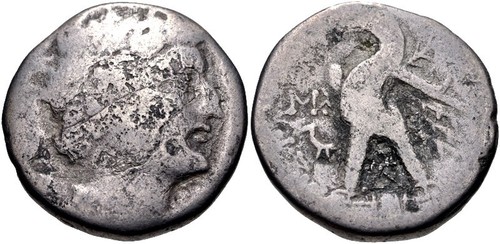
Tetradrachm of Ptolemy XII
80-51 BC
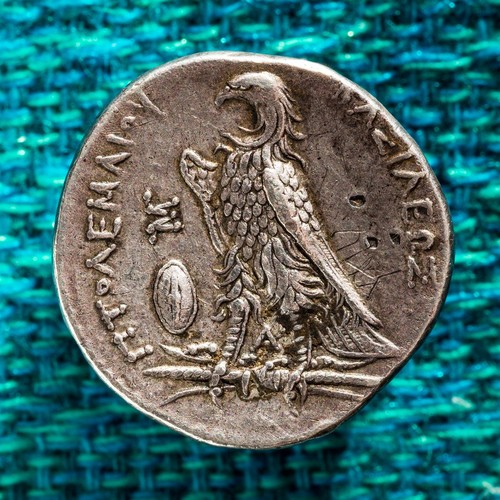
Tetradrachm of Ptolemy I
305-283 BC
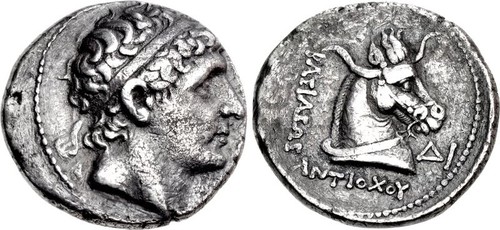
Tetradrachm of Antiochos I Soter
281-261 BC
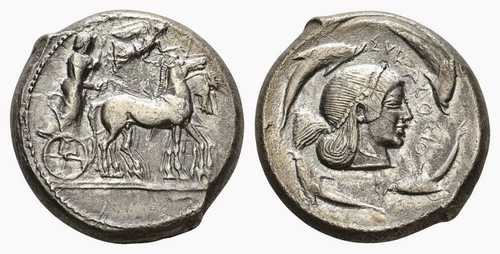
Syracuse Tetradrachm
c. 5th-4th century BC (Classical period)
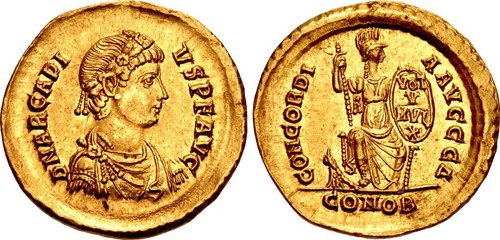
Solidus of Arcadius
AD 395-402
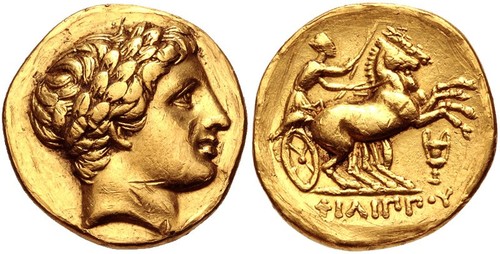
Philip III Gold Stater
323-317 BC
Siliqua of Gratian
AD 367-383
Sestertius of Maximinus Thrax
235-238 AD
Solidus of Valentinian III
AD 425-455
Seleucus I Nicator Tetradrachm
Late 4th-3rd century BC
Nummus of Magnentius
AD 350-353
Follis of Galerius
AD 308-310