
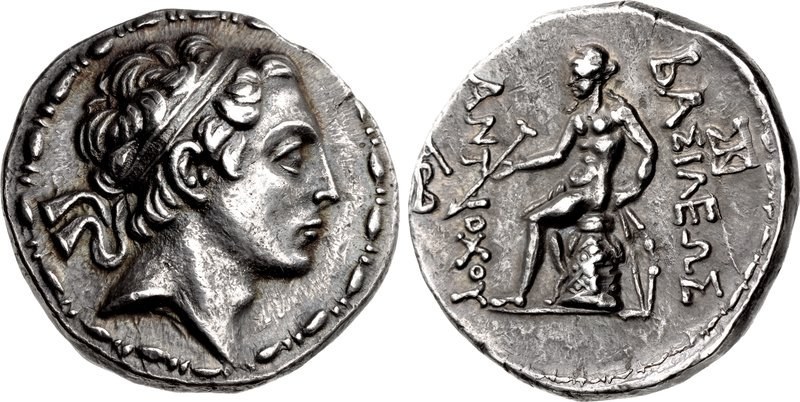
Antiochos IV Epiphanes Tetradrachm
Large silver tetradrachm of the Seleucid king Antiochos IV Epiphanes, 175-164 BC, with his diademed head and an enthroned deity reverse.
- Country
- Seleucid Empire (Ancient)
- Denomination
- Tetradrachm
- Metal
- Silver
Got a coin like this?
Identify any coin from a photo, free.
Overview
This is a large silver tetradrachm of Antiochos IV Epiphanes, king of the Seleucid Empire from 175 to 164 BC. The coin follows the standard royal Hellenistic formula: the king's own diademed head on the obverse and a seated deity holding attributes on the reverse, struck in high-grade silver on a broad flan.
The example shown belongs to Antiochos IV's reign, a turbulent period that included his wars against Ptolemaic Egypt and his interventions in Judaea that helped spark the Maccabean revolt. As the empire's premier trade coin, the tetradrachm carried the king's portrait and titles across a realm that stretched from the Levant into the Iranian plateau.
Because it names and depicts a specific ruler, the coin is a royal issue rather than a civic one. It is identified by its bearded or clean-shaven diademed portrait, its enthroned reverse deity with attributes, its Greek royal legend, and its weight and fabric as a full tetradrachm.
History & Background
Antiochos IV was a younger son of Antiochos III the Great. He seized the Seleucid throne in 175 BC after the murder of his brother Seleukos IV, and he adopted the striking epithet Epiphanes, meaning "(God) Manifest," a bold assertion of divine kingship that his portrait and coinage were designed to project. Critics reportedly punned on this as Epimanes, "the Mad."
His reign was dominated by ambition abroad and friction at home. He nearly conquered Ptolemaic Egypt in the Sixth Syrian War before Rome forced his withdrawal in the famous confrontation with the envoy Popillius Laenas in 168 BC. In Judaea his policies and the plundering of the Jerusalem Temple provoked the Maccabean revolt, an event remembered in the Jewish festival of Hanukkah.
Antiochos IV's mints produced tetradrachms in large numbers to pay armies and fund his campaigns. Over the reign his coinage grew increasingly grand in its religious imagery, reflecting his self-presentation as a divine monarch. He died on campaign in the east in 164 BC, and his silver remained in circulation as trusted trade money long after.
How to Identify
The obverse carries the diademed head of the king facing right, the royal diadem being a plain band tied at the back of the head with ends falling to the neck. The portrait is rendered in bold Hellenistic relief and fills much of the flan; on Antiochos IV's issues the features are idealized and sometimes given a radiate or heroic character in keeping with his divine claims.
The reverse shows a seated deity holding attributes, most characteristically an enthroned Zeus or a related figure holding a small Victory or bird in the outstretched hand and a long scepter in the other. Around the figure runs a Greek royal legend naming the king, typically including BASILEOS ANTIOCHOU with additional epithets such as THEOU EPIPHANOUS. Monograms or mint symbols often appear in the field or under the throne.
In hand the coin is a full tetradrachm of high-grade silver, on the order of roughly 16 to 17 grams and about 28 to 32 mm across, struck by hand so the flan is somewhat irregular and centering varies. The metal usually shows old grey or iridescent toning. The combination of a diademed royal head, an enthroned deity with attributes and a Greek legend, and tetradrachm weight and size is the core identifier.
Value & Collectibility
As genuine ancient Seleucid royal silver of a historically famous king, this tetradrachm carries a solid collector market. Worn but clearly identifiable examples typically trade from roughly the low hundreds of dollars upward, while well-centered, sharply struck coins with a strong portrait and clean surfaces can reach well into four figures.
Value is driven by the strength and style of the royal portrait, the clarity of the enthroned reverse figure and its attributes, the completeness of the Greek legend and any mint controls, the flan's centering, and overall eye appeal and toning. The connection to Antiochos IV and the Maccabean and Hanukkah history adds collector interest, and attractive style or documented provenance commands meaningful premiums.
The ranges here are general context, not appraisals. Any specific coin's price depends heavily on condition, style, mint attribution, and authenticity, and high-value ancient silver of this kind is often sold with specialist cataloguing or third-party certification.
Frequently asked questions
Who was Antiochos IV Epiphanes?
He was king of the Seleucid Empire from 175 to 164 BC. He took the epithet Epiphanes, "God Manifest," fought Ptolemaic Egypt, and provoked the Maccabean revolt in Judaea, the events remembered at Hanukkah.
What does the seated figure on the reverse represent?
It is an enthroned deity, most characteristically Zeus, holding a small Victory or bird in the outstretched hand and a long scepter, seated on a throne. A Greek royal legend naming the king runs around the figure.
Is the portrait actually Antiochos IV himself?
Yes. Unlike posthumous Alexander coinage, Seleucid royal tetradrachms show the reigning king's own diademed portrait, here idealized in keeping with his divine claims, and the accompanying Greek legend names him.
How big and heavy is the coin?
A tetradrachm is a large silver coin, on the order of roughly 16 to 17 grams and about 28 to 32 mm across. It is struck by hand, so the flan shape and centering vary from coin to coin.
Why is this coin historically significant?
Antiochos IV's reign shaped events across the Hellenistic world and the Bible, including the Temple crisis in Jerusalem that led to the Maccabean revolt and Hanukkah, and his forced retreat from Egypt marked a rise in Roman power.
Antiochos IV Epiphanes Tetradrachm guides
In-depth guides for identifying, valuing, and collecting Antiochos IV Epiphanes Tetradrachm.
Other coins you may enjoy
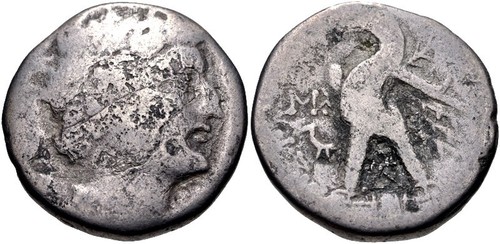
Tetradrachm of Ptolemy XII
80-51 BC
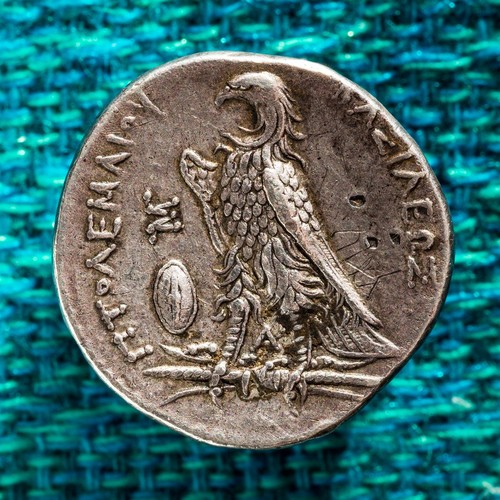
Tetradrachm of Ptolemy I
305-283 BC
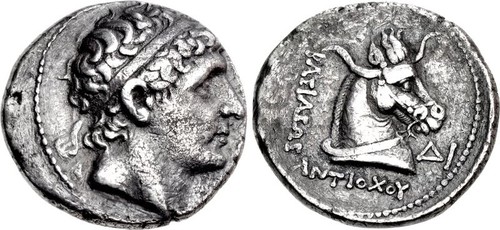
Tetradrachm of Antiochos I Soter
281-261 BC
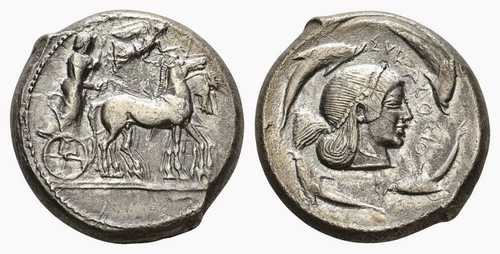
Syracuse Tetradrachm
c. 5th-4th century BC (Classical period)
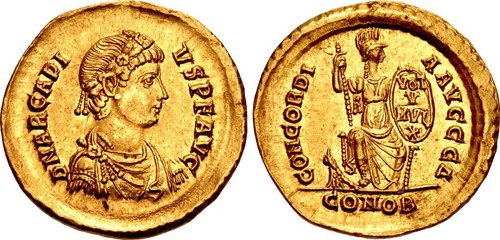
Solidus of Arcadius
AD 395-402
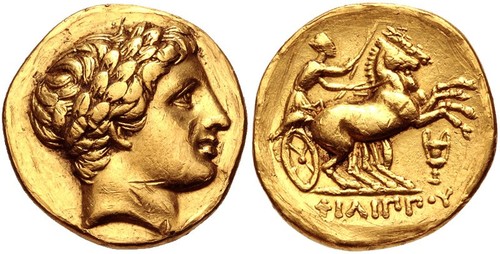
Philip III Gold Stater
323-317 BC
Siliqua of Gratian
AD 367-383
Sestertius of Maximinus Thrax
235-238 AD
Solidus of Valentinian III
AD 425-455
Seleucus I Nicator Tetradrachm
Late 4th-3rd century BC
Nummus of Magnentius
AD 350-353
Follis of Galerius
AD 308-310