
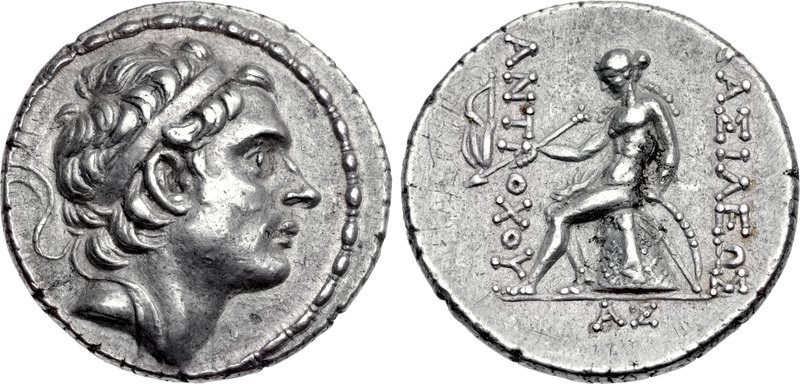
Antiochos III Tetradrachm
A large Seleucid silver coin of Antiochos III the Great, showing his diademed head and a seated deity holding shield and spear.
- Country
- Seleucid Empire (Ancient)
- Denomination
- Tetradrachm
- Metal
- Silver
Got a coin like this?
Identify any coin from a photo, free.
Overview
The Antiochos III tetradrachm is a large silver coin of the Seleucid Empire, struck in the name of King Antiochos III (reigned 222-187 BC), remembered by later writers as Antiochos the Great. The obverse carries the diademed royal head with curly hair facing right, and the reverse of this specimen shows a seated figure of Athena to the left holding a shield and spear.
A tetradrachm was worth four drachms and was the backbone denomination of Hellenistic silver coinage. Struck on the Attic weight standard at roughly seventeen grams, it served as a major coin for paying troops, funding campaigns, and settling large trade across the vast Seleucid realm.
Coinage in the name of Antiochos III was produced at many mints spread from the Mediterranean coast to the eastern provinces, so surviving tetradrachms vary considerably in style and detail from one region and issue to the next. The example dated here to 222-187 BC belongs to this broad royal coinage struck throughout his long reign.
History & Background
Antiochos III came to the Seleucid throne as a young man in 223/222 BC and spent decades trying to restore the empire to the extent it had held under its founder. His campaigns carried him east into Media, Parthia, and Bactria and as far as the borders of India, an expedition that earned him the title "the Great," and later west into Asia Minor and Greece, where he ultimately clashed with the rising power of Rome.
The wars, garrisons, and mercenary armies of such a reign demanded coinage on a large scale, and the tetradrachm was the principal instrument of that spending. Silver flowed from mints across the empire in the king's name, which is why coins of Antiochos III survive in a wide range of local styles rather than from a single central issue.
His expansion ended at Roman hands. Defeat at Magnesia in 190/189 BC and the harsh Treaty of Apamea in 188 BC stripped him of his Asia Minor holdings and imposed a crushing indemnity, and he died in 187 BC. His coinage, struck across those turbulent decades, is among the most abundant and widely collected of the Seleucid series.
How to Identify
The obverse shows the diademed head of the king facing right, the hair rendered in tight curls with the royal diadem, a plain band, tied around it and its ends falling behind the neck. There is no inscription around the portrait; the naming legend belongs to the reverse. This idealized royal head, not a god, is the primary marker of a Seleucid king's tetradrachm.
The reverse of this coin shows a seated deity, identified here as Athena, facing left and holding a shield and a spear. A Greek legend in two lines typically reads ΒΑΣΙΛΕΩΣ ΑΝΤΙΟΧΟΥ ("of King Antiochos"), usually placed to the right and left of the seated figure, and small control marks, monograms, or symbols commonly appear in the field. Note that the most familiar Seleucid reverse of this era is Apollo seated on the omphalos; a seated Athena with shield and spear is a distinct type, so the reverse figure should be read carefully.
In hand the coin is a substantial piece of silver, generally around 27 to 32 mm across and close to seventeen grams on the Attic standard. It is hand-struck, so centering, flan shape, and strike sharpness vary, and the fields show the slightly irregular surfaces expected of ancient hammered coinage.
Value & Collectibility
Tetradrachms of Antiochos III were struck in quantity over a long reign at many mints, so they are collectible but not rare as a class. Worn or off-center examples with soft detail commonly trade in the low-to-mid hundreds of dollars, while well-centered, sharply struck coins with attractive metal and clear legends can reach the high hundreds to several thousand.
Value depends heavily on the mint and specific issue, the quality of the portrait style, centering and strike, the state of the silver surfaces, and overall eye appeal. Coins from certain mints or with unusual reverse types and control marks can command premiums, and exceptional pieces in top grade sit well above the ranges given here.
These figures are general context, not appraisals. Because Seleucid silver is both faked and closely studied, a coin with a credible mint attribution or trusted pedigree will always be worth more than an unverified one.
Frequently asked questions
Is the head on the coin a god or the king?
It is the king. The diademed head with curly hair is an idealized portrait of Antiochos III, not a deity. The plain band tied in the hair is the royal diadem, and the king's name appears in the reverse legend rather than around the portrait.
Who is the seated figure on the reverse?
On this specimen the seated figure is Athena, shown to the left holding a shield and spear. Many Seleucid tetradrachms of this era instead show Apollo seated on the omphalos, so the reverse deity is worth checking closely when identifying the coin.
Why was Antiochos III called "the Great"?
The title reflects his sweeping eastern campaign, or anabasis, which briefly restored Seleucid influence as far as the frontiers of India. His later defeat by Rome at Magnesia in 190/189 BC ended that expansion, but the epithet stuck.
How large is the coin?
It is a tetradrachm, worth four drachms, and one of the larger Hellenistic silver denominations. This one is roughly 27 to 32 mm across and close to seventeen grams, struck on the Attic weight standard.
Antiochos III Tetradrachm guides
In-depth guides for identifying, valuing, and collecting Antiochos III Tetradrachm.
Other coins you may enjoy
Tetradrachm of Ptolemy XII
80-51 BC
Tetradrachm of Ptolemy I
305-283 BC
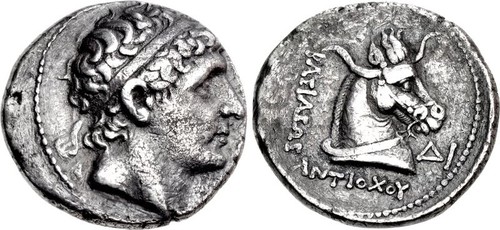
Tetradrachm of Antiochos I Soter
281-261 BC
Syracuse Tetradrachm
c. 5th-4th century BC (Classical period)
Solidus of Arcadius
AD 395-402
Philip III Gold Stater
323-317 BC
Siliqua of Gratian
AD 367-383
Sestertius of Maximinus Thrax
235-238 AD
Solidus of Valentinian III
AD 425-455
Seleucus I Nicator Tetradrachm
Late 4th-3rd century BC
Nummus of Magnentius
AD 350-353
Follis of Galerius
AD 308-310