
How to Identify the Antiochos III Tetradrachm
A collector's guide to the diademed royal head, seated deity, legend, size, and control marks that identify an Antiochos III tetradrachm.
Read the full Antiochos III Tetradrachm encyclopedia entry →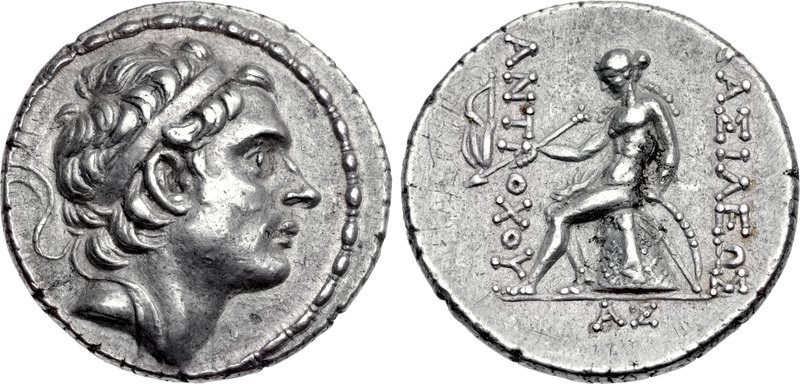
Start with the obverse portrait. A tetradrachm of Antiochos III shows a diademed male head facing right with curly hair and a plain diadem band whose ties fall behind the neck. This is the king, not a god, and there is no inscription around the head. The style of the portrait varies by mint and by phase of the reign, from youthful and idealized to older and more heavily featured, so expect regional differences rather than a single fixed face.
Turn to the reverse and read both the figure and the legend. On this coin the reverse shows a seated deity, identified as Athena, facing left with a shield and spear. Look for a two-line Greek legend reading ΒΑΣΙΛΕΩΣ ΑΝΤΙΟΧΟΥ, meaning "of King Antiochos," arranged around the seated figure, together with small monograms, letters, or symbols in the field. Those control marks are not mere decoration; specialists use them, along with style, to assign the coin to a specific mint and issue among the many that struck in the king's name.
Check size, weight, and fabric. This is a large, heavy silver coin, generally about 27 to 32 mm across and close to seventeen grams on the Attic standard. A piece that is markedly light, undersized, or made of base metal is suspect. As a hand-struck ancient coin it will show natural variation in centering and flan shape, some flatness where the dies did not fully strike up, and honest wear on the high points of the portrait and the seated figure. Perfectly round, uniform, or seamed edges are warning signs.
Mind the look-alikes. The name Antiochos was borne by many Seleucid kings, so a diademed head and a ΒΑΣΙΛΕΩΣ ΑΝΤΙΟΧΟΥ legend alone do not settle which Antiochos struck the coin; portrait style, reverse type, and control marks are needed to separate Antiochos III from Antiochos I, II, IV and later namesakes. Be aware too that the common Seleucid reverse of this period is Apollo seated on the omphalos, so a seated Athena with shield and spear is a specific type to confirm rather than assume. For any significant purchase, rely on a specialist attribution or a trusted pedigree, and watch for casting seams, grainy or bubbly surfaces, mushy detail, and off-standard weight that point to a cast copy or modern fake.
Frequently asked questions
How do I know which Antiochos struck the coin?
The legend names "King Antiochos" but does not give a number, and several Seleucid kings shared the name. Identification to Antiochos III depends on the portrait style, the reverse type, and the control marks, which together tie the coin to his reign and to a particular mint. A specialist reference or attribution is the reliable way to confirm it.
The reverse looks like a seated god. Is it Apollo or Athena?
Check the attributes. On this coin the seated figure holds a shield and spear and is identified as Athena. The very common Seleucid reverse of this era shows Apollo seated on the omphalos holding an arrow and resting on his bow, so compare the objects the figure holds before deciding.
What size and weight should it be?
Expect a large silver coin roughly 27 to 32 mm in diameter and close to seventeen grams, struck on the Attic standard. A coin well outside that weight, or one that is undersized or not silver, should be treated with caution.
How can I spot a fake?
Look for a casting seam around the rim, grainy or porous surfaces, soft or blurred detail, lettering that does not match known styles, and weight outside the normal range. Because Seleucid silver is widely faked, a specialist opinion or a trusted pedigree is the best protection on any valuable example.