
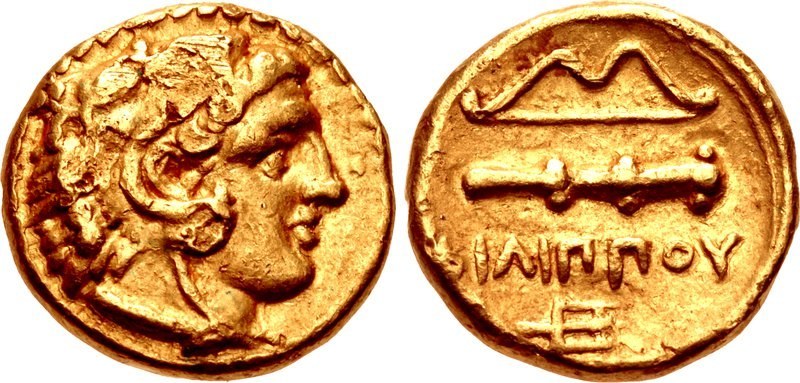
Alexander the Great Gold Quarter Stater
A small gold fraction of the Alexander the Great coinage, showing the head of Heracles and an eagle perched on a thunderbolt, the attributes of Zeus.
- Country
- Macedon
- Denomination
- Quarter Stater
- Metal
- Gold
Got a coin like this?
Identify any coin from a photo, free.
Overview
The Alexander the Great gold quarter stater is a small fractional gold coin belonging to the vast imperial coinage struck in the name of Alexander III of Macedon (reigned 336-323 BC). As its name states, it is one quarter of a gold stater, the principal gold denomination of the Greek world, and so it is a tiny piece of high-purity gold rather than a large showpiece coin.
The example described here carries a youthful head of Heracles facing right on the obverse and an eagle standing on a thunderbolt on the reverse. Heracles, the mythical ancestor from whom the Macedonian royal house claimed descent, is the standard hero of Alexander's silver coinage, while the eagle and the thunderbolt are the attributes of Zeus, the chief god emphasized throughout the series.
Gold fractions like this circulated as high-value money for large payments, and they were struck across a network of mints from Macedonia to the Near East. Because the type continued to be produced after Alexander's death, coins of this general design span a broad period, here given as roughly 340-238 BC.
History & Background
Alexander III inherited a strong, well-funded kingdom from his father Philip II and then conquered the Persian Empire, capturing enormous reserves of gold and silver bullion. To pay his armies and administer the new territory he established a standardized imperial coinage struck at mints across Macedonia, Asia Minor, the Levant, Mesopotamia, and Egypt, making his coins among the most widely produced of the ancient world.
The gold denomination was the stater, accompanied by fractions such as the half and quarter stater. These small gold pieces let the treasury move large sums in a compact, portable form. The heroic and divine imagery, Heracles and the attributes of Zeus, tied the money to the ruling house's mythical lineage and to Panhellenic religion, reinforcing Alexander's authority over a diverse empire.
Production did not end in 323 BC. Alexander's name and types remained a trusted standard, and successor kings and independent cities struck posthumous issues for generations. The date range assigned to this type, about 340 to 238 BC, reflects that long life, running from the late years of Philip II and Alexander himself through the Hellenistic kingdoms of the following century.
How to Identify
Look first at the two devices. The obverse shows the head of Heracles in right profile, a youthful, clean-featured hero often wearing the scalp of the Nemean lion as a headdress. The reverse shows an eagle standing on a thunderbolt; the eagle and the winged thunderbolt together are the symbols of Zeus and are the key to recognizing this reverse.
This is a fractional gold coin, so it is small and light. A full gold stater weighs roughly 8.6 grams; a quarter stater is about one quarter of that, on the order of two grams, and only around ten to twelve millimeters across. The metal is a bright, rich yellow gold that feels dense for its small size, and the coin is hand-struck, so centering, flan shape, and strike vary from piece to piece.
Greek lettering, monograms, or small symbols may appear in the field; the name of Alexander, ΑΛΕΞΑΝΔΡΟΥ, and royal titles are associated with the broader series. Because the Heracles-and-eagle pairing is an unusual combination within the Alexander coinage and because gold fractions are easily confused with issues of neighboring states, precise attribution to a specific mint and issue should be left to a specialist.
Value & Collectibility
Gold fractions of the Alexander coinage are scarcer than the common silver tetradrachms and drachms, and their gold content gives every genuine example a meaningful intrinsic floor. Small, worn, or off-center pieces can trade in the mid hundreds of dollars, while well-preserved, sharply struck coins with clear devices and attractive metal can reach well into the thousands.
Value is driven by the sharpness of the strike and centering, the state of the gold surfaces, the specific mint and any control marks, and overall eye appeal, along with the strength of the attribution. Ancient gold with a credible pedigree and specialist attribution consistently outperforms an unverified coin of the same apparent grade.
The figures here are general context, not appraisals, and an individual coin can fall well outside them. Because Alexander gold is heavily faked, authentication has a direct bearing on value, and the cost of an expert opinion is small next to the price of a genuine gold fraction.
Frequently asked questions
Is this a portrait of Alexander the Great?
No. The head is the hero Heracles, the mythical ancestor of the Macedonian royal house, not a portrait of Alexander. Ancient royal coins of this era generally did not show the living king's own face.
What do the eagle and thunderbolt mean?
The eagle and the thunderbolt are the attributes of Zeus, the chief Greek god emphasized across Alexander's coinage. Together they identify the reverse and tie the coin to the divine imagery of the series.
How big is a quarter stater?
It is a small gold coin, one quarter of a full stater. A stater weighs roughly 8.6 grams, so a quarter stater is around two grams and only about ten to twelve millimeters across, dense and bright for its size.
Why is the date range so wide?
Alexander's coin types remained a trusted standard long after his death in 323 BC. Successor kings and cities struck posthumous issues for generations, so coins of this general design span roughly 340 to 238 BC rather than a single short reign.
Alexander the Great Gold Quarter Stater guides
In-depth guides for identifying, valuing, and collecting Alexander the Great Gold Quarter Stater.
Other coins you may enjoy
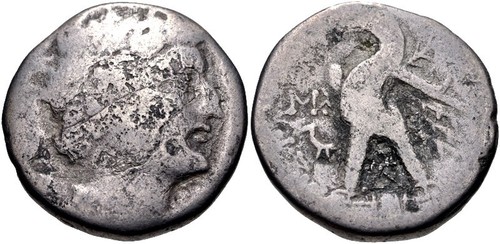
Tetradrachm of Ptolemy XII
80-51 BC
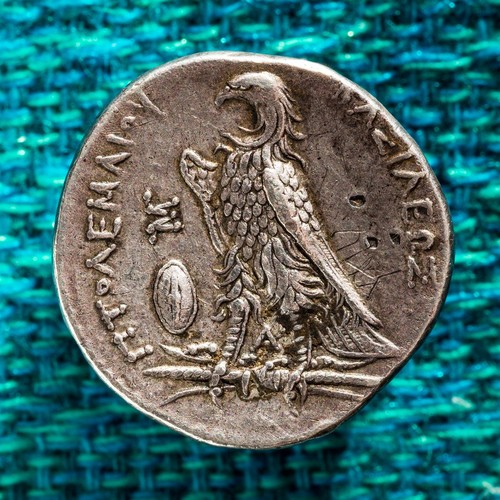
Tetradrachm of Ptolemy I
305-283 BC
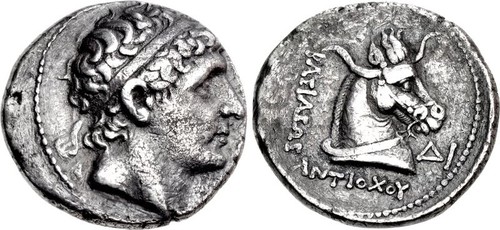
Tetradrachm of Antiochos I Soter
281-261 BC
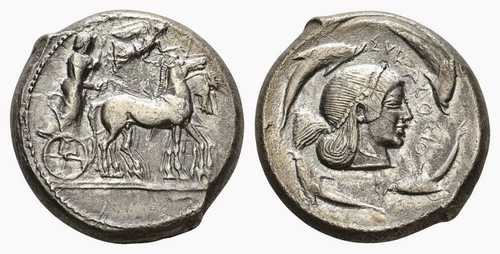
Syracuse Tetradrachm
c. 5th-4th century BC (Classical period)
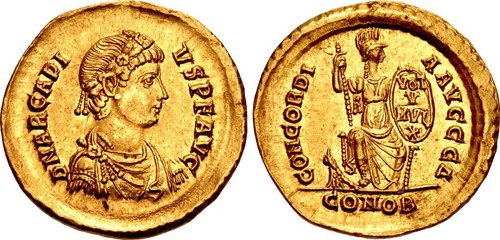
Solidus of Arcadius
AD 395-402
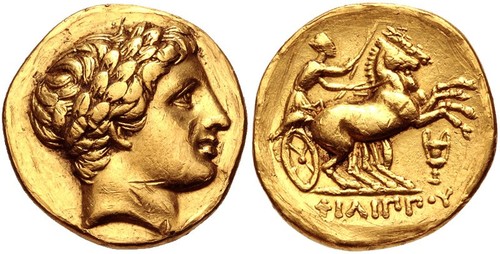
Philip III Gold Stater
323-317 BC
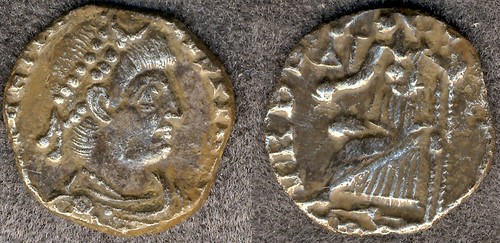
Siliqua of Gratian
AD 367-383
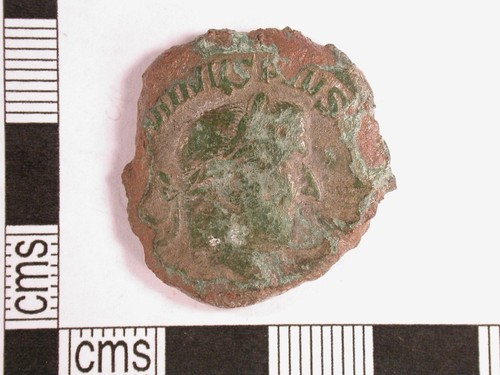
Sestertius of Maximinus Thrax
235-238 AD
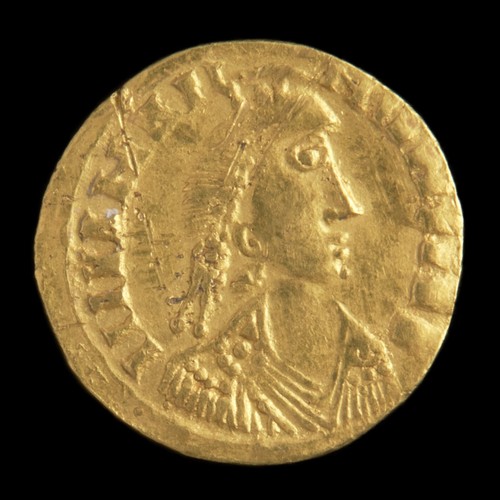
Solidus of Valentinian III
AD 425-455
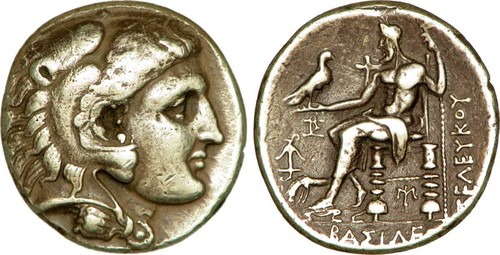
Seleucus I Nicator Tetradrachm
Late 4th-3rd century BC
Nummus of Magnentius
AD 350-353
Follis of Galerius
AD 308-310