
How to Identify the Alexander the Great Gold Quarter Stater
A collector's guide to the Heracles head, eagle-on-thunderbolt reverse, small gold flan, and authentication cautions for an Alexander-type gold quarter stater.
Read the full Alexander the Great Gold Quarter Stater encyclopedia entry →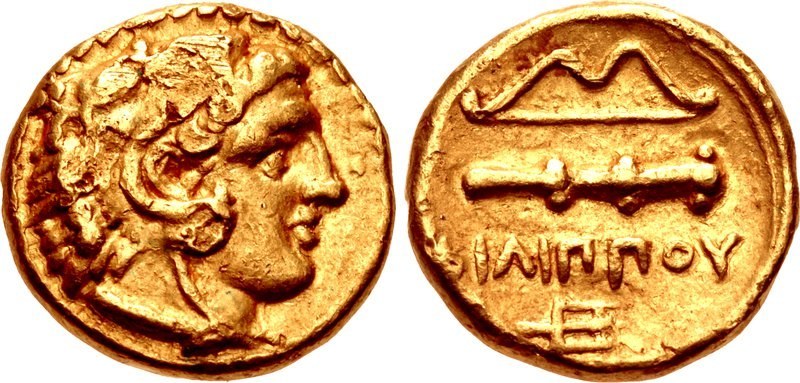
Start by reading both devices together. The obverse should show the head of Heracles in right profile, a youthful hero often wearing the lion-scalp headdress, while the reverse shows an eagle standing on a thunderbolt. The eagle and the winged thunderbolt are the symbols of Zeus, and that pairing on a small gold flan is the signature to confirm. Note that a youthful, clean-shaven or lion-scalp head is Heracles, not Alexander himself and not the bearded Zeus that appears on Philip II's coins.
Weigh and measure the coin, because size is one of the strongest tells for a fraction. A quarter stater is small and light, on the order of two grams and roughly ten to twelve millimeters across, about a quarter of the weight of a full gold stater near 8.6 grams. The metal should be a bright, rich yellow gold that feels notably dense for its diameter. As a hand-struck ancient coin it will vary in centering and flan shape and may be a little flat where the dies did not fully strike up; honest wear should sit on the high points of the head and eagle.
Look in the fields for lettering and control marks. Greek characters, the name ΑΛΕΞΑΝΔΡΟΥ, monograms, or small symbols can appear and help specialists assign the coin to a particular mint and phase of the long production run. These marks do not change the basic identification, but they matter for attribution, rarity, and value, and they are worth photographing clearly before seeking an opinion.
Be cautious with look-alikes and forgeries. Several ancient states used an eagle-on-thunderbolt reverse, including Ptolemaic Egypt, and Celtic and other peoples produced imitations of Macedonian gold, so the reverse alone does not prove an Alexander issue; read the obverse hero and any legend together. Alexander gold is also a favorite target of modern counterfeiters, including cast copies, tooled pieces, and gold-plated base-metal fakes. Warning signs include a casting seam around the rim, grainy or bubbly surfaces, soft or mushy detail, off-standard weight or diameter, and lettering that does not match known styles. For any coin of real value, rely on a specialist in Greek gold or a trusted pedigree rather than the design by itself.
Frequently asked questions
What is the quickest way to confirm the type?
Check both sides on a small gold flan: a youthful head of Heracles on the obverse and an eagle standing on a thunderbolt on the reverse. That pairing, on a coin of about two grams and ten to twelve millimeters, points to an Alexander-type gold quarter stater.
How do I tell Heracles from a portrait or from Zeus?
Heracles is youthful and often wears a lion-scalp headdress. He is not a portrait of Alexander, and he is not the bearded, laurel-wreathed Zeus seen on Philip II's coins. The lion scalp and youthful features are the giveaways.
The eagle-on-thunderbolt reverse also appears on other coins. How do I avoid confusion?
Yes, states such as Ptolemaic Egypt used an eagle and thunderbolt too. Do not rely on the reverse alone; read it together with the Heracles obverse, the fabric, and any legend, and get a specialist opinion if the attribution is unclear.
How can I spot a fake gold fraction?
Watch for a casting seam, grainy or porous surfaces, soft detail, and weight or diameter outside the expected range for a quarter stater. Because Alexander gold is heavily counterfeited, confirm any significant coin with a specialist or a trusted pedigree.