25 Pesetas (Franco)
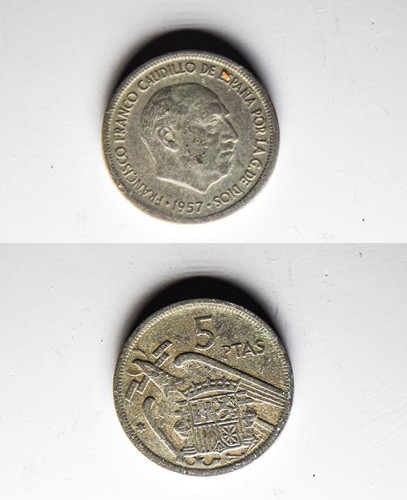
Spain's common Franco-era 25 pesetas, a silvery copper-nickel coin bearing the national coat of arms and the value 25; dated 1957 but struck into the 1970s.
- Country
- Spain
- Denomination
- 25 Pesetas
- Metal
- Copper-Nickel
Got a coin like this?
Identify any coin from a photo, free.
Overview
The 25 Pesetas of the Franco era is a mid-value circulation coin of Spain first issued in 1957, during the long rule of Francisco Franco (1939–1975). Though silvery in appearance, it is a base-metal coin struck in copper-nickel rather than precious silver, and it circulated widely across Spain for decades.
The coin pairs the crowned Spanish coat of arms of the Franco period with a large value indication of 25 and heraldic ornament inside a decorative border. Every example carries the frozen date 1957, but the type was actually produced over many years; the true year of striking is shown by a small two-digit number set inside a six-pointed star on the coin.
Because it was minted in very large quantities over a long span, the 1957 25 pesetas is one of the most frequently encountered Spanish coins of the 20th century and is a common find in accumulations, drawers, and inherited collections.
History & Background
The peseta was Spain's national currency from 1868 until it was replaced by the euro in 2002. The 25-peseta denomination reappeared in 1957 as part of Franco-era coinage that combined the personal imagery of the regime with the traditional Spanish national arms.
Spanish coins of this period commonly bore the portrait and titles of Franco as head of state alongside the national coat of arms of the era, which featured the eagle of Saint John supporting the crowned quartered shield together with the yoke-and-arrows emblem and the Pillars of Hercules. Rather than change the visible date each year, the mint kept a single design date — 1957 — and marked the real production year with two small digits punched inside a six-pointed star, a system used across several Franco-era denominations.
Production of the 1957-dated 25 pesetas continued through the late 1950s, 1960s, and into the 1970s, ending around the close of Franco's rule. After his death in 1975 Spain moved toward democratic government and new coinage, so this type belongs firmly to the final chapters of the Franco period.
How to Identify
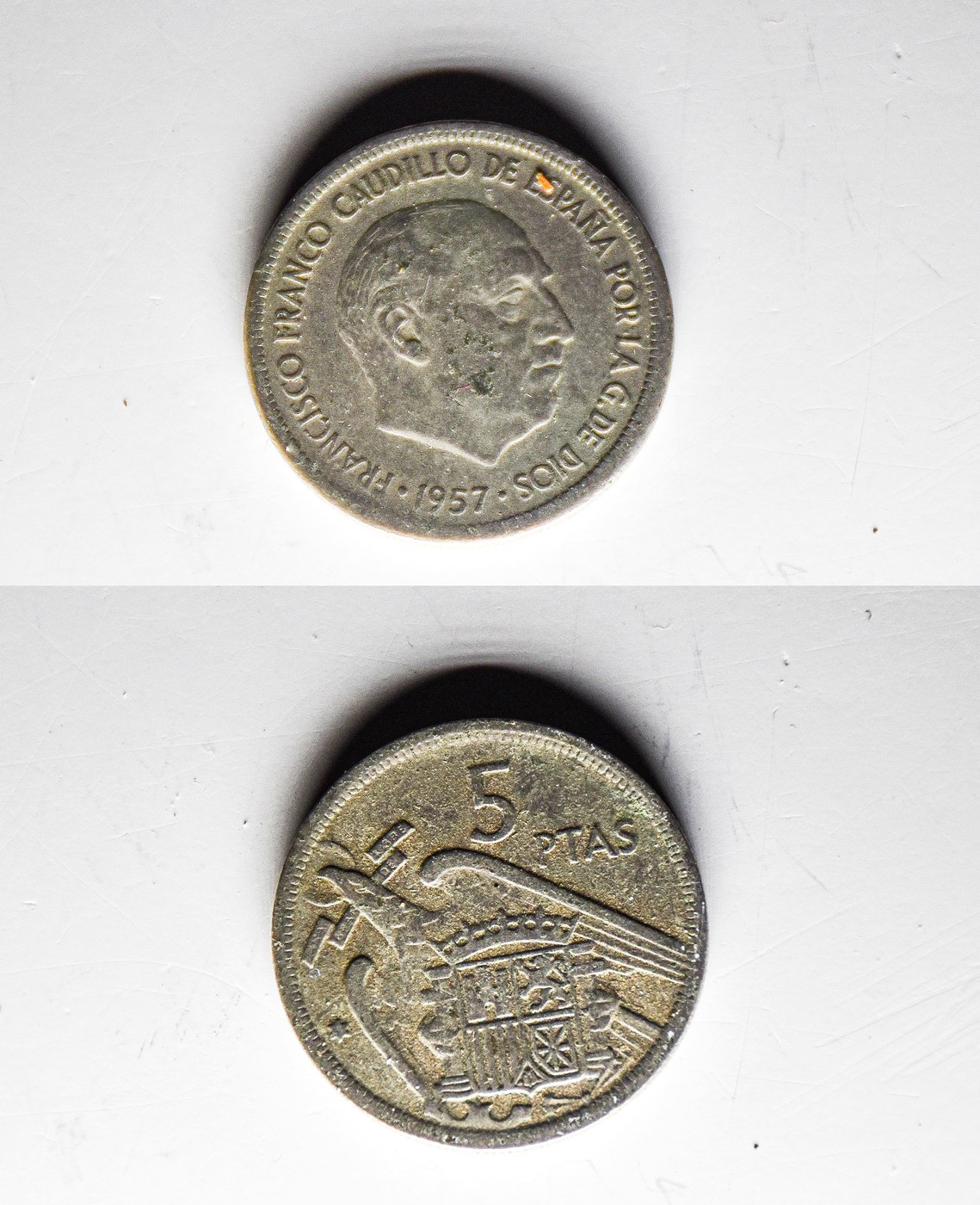
The documented coin shows the crowned Spanish coat of arms of the Franco era on one face and the large numeral 25 with heraldic ornament and a decorative border on the other; the design date 1957 appears with the legends. On the standard type the portrait side carries the bust of Franco with his Spanish titles, so a complete example will pair a head-of-state portrait with the arms-and-value design.
The single most useful identification feature is the small six-pointed star that holds two tiny digits (for example 58, 60, 68, or 75). These indicate the actual year the coin was struck, even though the field date always reads 1957. Finding and reading this star is essential, because different star years are far from equally common.
The coin is copper-nickel: silvery-grey, non-magnetic on standard alloys, with a reeded (grooved) edge, a diameter in the region of 26 mm, and a weight of roughly 8 to 9 grams. Its color can lead to it being mistaken for a silver coin, but it contains no precious metal, so a bright metallic tone alone is not evidence of silver content.
Value & Collectibility
As one of the most heavily minted Spanish coins of its century, the ordinary 1957 25 pesetas is very common and, in worn circulated grades, carries only modest value above its base-metal content. Most examples pulled from change or accumulations are collector novelties rather than significant finds.
Value is driven mainly by two factors: the star date and the state of preservation. A handful of star years were produced in smaller numbers and are scarcer than the rest, and fully uncirculated pieces with original luster command a premium over well-worn ones. Because of this, the same 1957 type can range from near-nominal worth to a meaningful sum depending on the exact star and grade.
Since it is a base-metal coin, there is no silver melt value to fall back on, so condition and the specific star year effectively set the price. Reading the star before valuing any example is the key step, and genuinely scarce dates in high grade are best confirmed by a specialist or reference catalog.
Frequently asked questions
Is the 1957 25 pesetas made of silver?
No. Despite its bright silvery color it is a copper-nickel coin with no precious-metal content. Spain did not strike a silver 25-peseta coin in this period, so the metallic tone alone does not indicate silver.
Why does my coin say 1957 if it was made later?
The Franco-era mint kept a single design date of 1957 and marked the real year of striking with two small digits inside a six-pointed star. So a 1957-dated coin may actually have been produced anywhere from 1957 into the 1970s.
Where is the actual date on the coin?
Look for a tiny six-pointed star, usually near the arms, containing two small numbers such as 58, 65, or 72. Those digits give the true year of striking; the large 1957 is only the fixed design date.
Is this coin rare or valuable?
In general it is very common and worn examples are worth little above base metal. Value depends heavily on the star year and condition, since a few star dates are scarcer and uncirculated pieces are worth more than circulated ones.
25 Pesetas (Franco) guides
In-depth guides for identifying, valuing, and collecting 25 Pesetas (Franco).