
How to Identify the 25 Pesetas (Franco)
A collector's guide to recognizing Spain's Franco-era 1957 25 pesetas by its coat of arms, value design, copper-nickel fabric, and all-important star date.
Read the full 25 Pesetas (Franco) encyclopedia entry →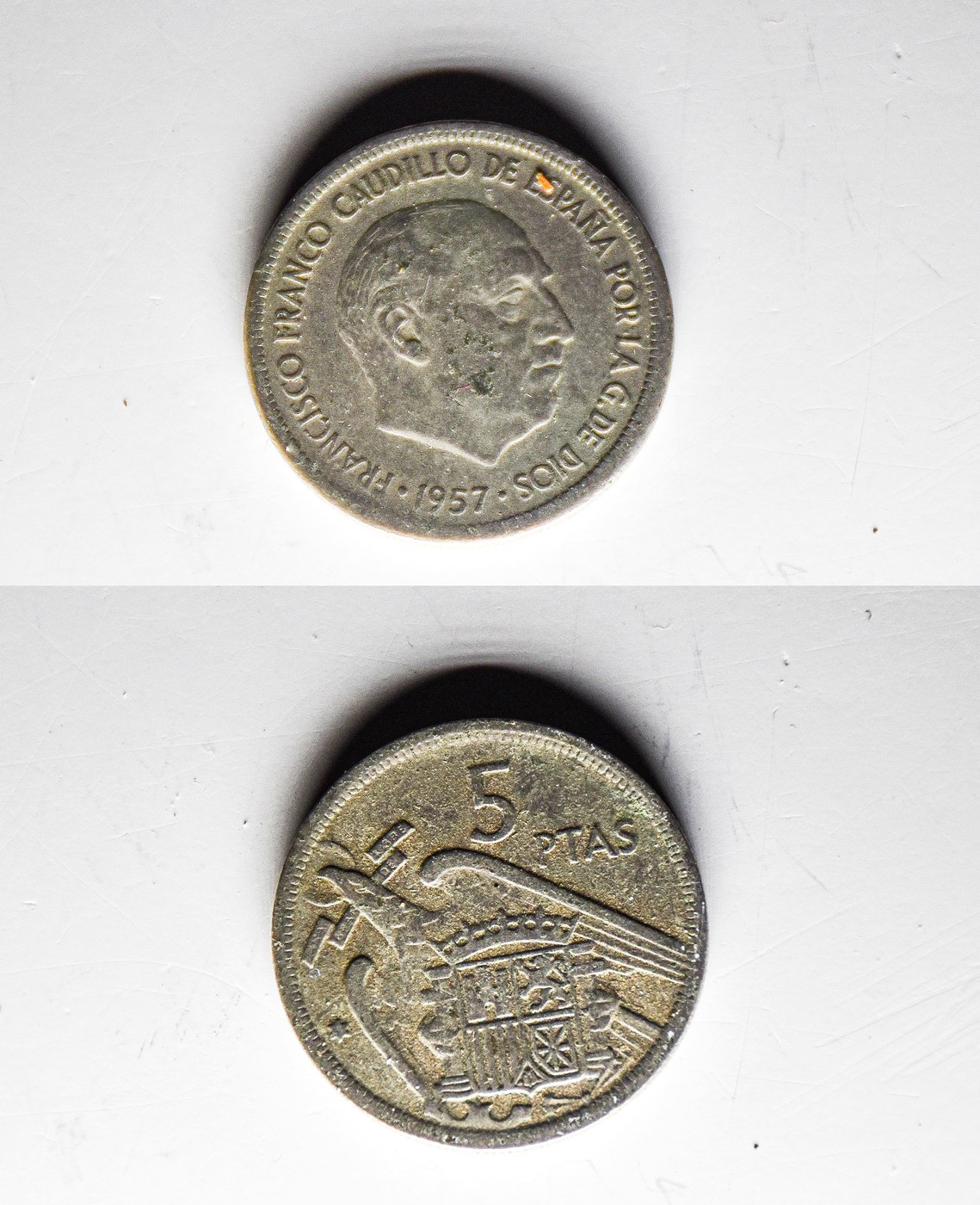
Confirm the Type
Start by reading the design. One face shows the crowned Spanish coat of arms of the Franco era; the other shows a large numeral 25 with heraldic ornament inside a decorative border, and the field date 1957. On the full type the portrait side bears the bust and titles of Francisco Franco as head of state. Together, a Franco portrait, the national arms, the value 25, and the date 1957 confirm you are looking at this type rather than another peseta denomination.
Find and Read the Star Date
The key diagnostic on this coin is not the big 1957 — it is a tiny six-pointed star that holds two small digits. Because the mint froze the design date at 1957 and marked the true production year inside the star, reading those two numbers (for example 58, 61, 68, or 75) is the single most important step in identifying and valuing the piece. Use magnification and good light; the star is small and often the first area to wear.
Check Size, Metal, and Edge
Handle the physical coin: it should be silvery copper-nickel, with a reeded (grooved) edge, a diameter of roughly 26 mm, and a weight around 8 to 9 grams. The silvery tone is a common source of confusion — it is not a silver coin and holds no precious metal, so do not treat its color as evidence of bullion value. Verifying diameter, weight, and the reeded edge helps separate it from other similar-size base-metal coins.
Watch for Look-Alikes
Several Franco-era denominations share the same visual language — a Franco portrait paired with the national arms and a star-dated system — so it is easy to confuse the 25 pesetas with the 50 pesetas or other values at a glance. Always read the actual value (25) and confirm the size, rather than relying on the general style. The frozen 1957 date also means two coins that look date-identical can be years apart in true striking date.
Authentication and Condition Cautions
Genuine counterfeits of a low-value circulation coin are uncommon, so the greater risks are misreading the star, over-cleaning, and over-grading. Harsh cleaning leaves hairline scratches and dull, unnatural surfaces that reduce collector value, so avoid polishing. For any example you believe carries a scarce star year, confirm the reading against a reliable Spanish coin catalog or a specialist before assigning a premium value.
Frequently asked questions
What is the six-pointed star on the coin?
It is the mint's date mark. The two small digits inside the star give the real year the coin was struck, because the large printed date was fixed at 1957 across the whole series.
How do I tell this from the 50 pesetas of the same era?
Read the value numeral and check the size. Franco-era denominations share a similar portrait-and-arms style, so the printed value and the coin's diameter and weight are what distinguish the 25 pesetas from larger denominations.
Should I clean the coin to see the details better?
No. Cleaning scratches the surface and removes original luster, lowering collector value. Use magnification and angled light instead to read the star and design without altering the coin.
Does a shiny, silvery look mean it is valuable silver?
No. The coin is copper-nickel and contains no precious metal; the silvery color is just the alloy. Its value comes from the star year and condition, not from metal content.