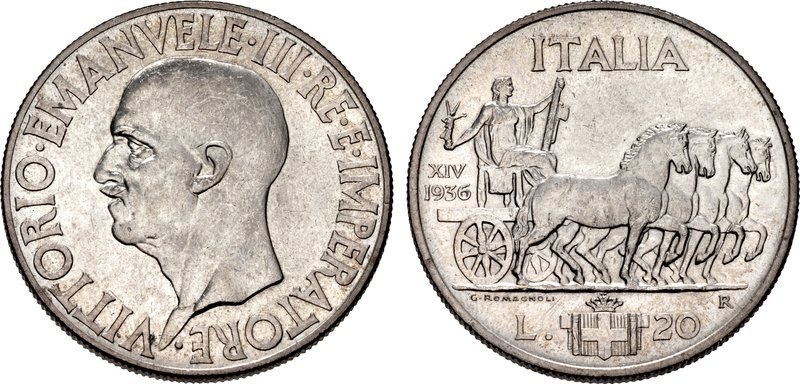
20 Lire
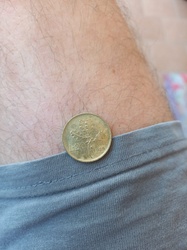
Silver-colored Italian 20 Lire piece of the Fascist era, showing a Mussolini profile and a horse-drawn chariot, dated 1936.
- Country
- Italy
- Denomination
- 20 Lire
- Metal
- Silver
Got a coin like this?
Identify any coin from a photo, free.
Overview
This is a silver-colored Italian 20 Lire piece associated with the Fascist era, dated 1936. The obverse carries a bare profile portrait of Benito Mussolini, while the reverse shows a horse-drawn chariot (a quadriga) with a driving figure, an image drawn from classical Roman symbolism the regime favored.
Pieces of this design circulate widely among collectors of 20th-century Italian and militaria-adjacent material. It is important to know that official legal-tender coinage of the Kingdom of Italy in this period bore the portrait of King Victor Emmanuel III, not Mussolini, so Mussolini-portrait 20 Lire pieces are most often encountered as fantasy, commemorative, or replica strikes rather than as circulating currency.
History & Background
The Lira was the currency of the Kingdom of Italy, and 20 Lire denominations were struck in silver during the interwar decades, including the mid-1930s. The Fascist government led by Benito Mussolini governed Italy from the 1920s into World War II, and it heavily borrowed the imagery of ancient Rome, including the fasces and the chariot, in its propaganda and public art.
The year 1936 fell within this period and coincided with Italy's proclamation of empire following the invasion of Ethiopia. Because Italian legal tender of the era placed the reigning king on the obverse, a 20 Lire piece bearing Mussolini's likeness reflects the regime's cult of personality expressed through medals and privately produced pieces rather than through the official coinage of the realm. Many examples in the market today are later reproductions inspired by this Fascist-era iconography.
How to Identify
Look for a right- or left-facing bare male profile on the obverse identified with Mussolini, typically accompanied by Italian legends and the date 1936. The reverse shows a chariot drawn by horses with a standing driver, and usually the denomination L. 20 or the words for twenty lire.
Silver 20 Lire of this general era are roughly 35 mm in diameter and around 15 grams in a fine silver alloy, though fantasy and replica pieces vary in size, weight, and metal. Check the edge, the sharpness of lettering, and the overall wear pattern. A magnet test, careful weighing, and diameter measurement help flag base-metal or off-standard strikes.
Compare the portrait and legends against reference images before concluding what you have. Genuine circulating Kingdom of Italy 20 Lire of the 1930s show King Victor Emmanuel III, so a Mussolini portrait is itself a strong signal that the piece is a commemorative, medallic, or reproduction issue.
Value & Collectibility
Value depends heavily on what the piece actually is. Genuine period silver 20 Lire of the Kingdom of Italy carry both a silver-bullion floor and a numismatic premium tied to date and condition, but those official coins depict the king, not Mussolini.
Mussolini-portrait 20 Lire pieces are most commonly modern fantasy or replica strikes, and these typically trade as inexpensive novelty or militaria items rather than as scarce coins, with worn or base-metal examples worth only a few dollars. Any piece being sold as a rare original should be verified by weight, dimensions, metal content, and ideally third-party authentication before a significant sum changes hands.
Because reproductions of Fascist-era imagery are abundant, treat high asking prices with caution and price the item on confirmed metal and confirmed authenticity, not on the portrait alone.
Frequently asked questions
Is a 1936 20 Lire with Mussolini a real Italian coin?
Official legal-tender 20 Lire of the Kingdom of Italy in this period showed King Victor Emmanuel III, not Mussolini. Pieces bearing Mussolini's portrait are usually fantasy, commemorative, or replica strikes rather than circulating currency.
What is shown on the coin?
The obverse has a profile portrait identified with Benito Mussolini, and the reverse shows a horse-drawn chariot with a driving figure, an image echoing ancient Roman symbolism used by the Fascist regime.
What is it made of?
It presents as a silver-colored 20 Lire piece. Period silver 20 Lire used a fine silver alloy, but replicas and fantasy pieces can be made of base metal or plated stock, so the metal should be confirmed by testing.
How much is it worth?
If it is a modern fantasy or replica, it usually trades as a low-cost novelty or militaria item. A verified period silver piece would carry bullion value plus a numismatic premium. Authenticate before paying a high price.
How can I tell a replica from an original?
Weigh it, measure the diameter, and confirm the metal. Compare the portrait and legends to reference images, and remember that a Mussolini portrait on a 20 Lire is itself a strong indication of a commemorative or reproduction piece.
20 Lire guides
In-depth guides for identifying, valuing, and collecting 20 Lire.
20 Lire identified by the community
Real coins identified with Coin Identifier.