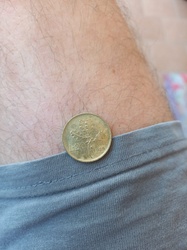
How to Identify the 20 Lire
A collector's walkthrough for identifying the Fascist-era Mussolini 20 Lire, its chariot reverse, and telling originals from replicas.
Read the full 20 Lire encyclopedia entry →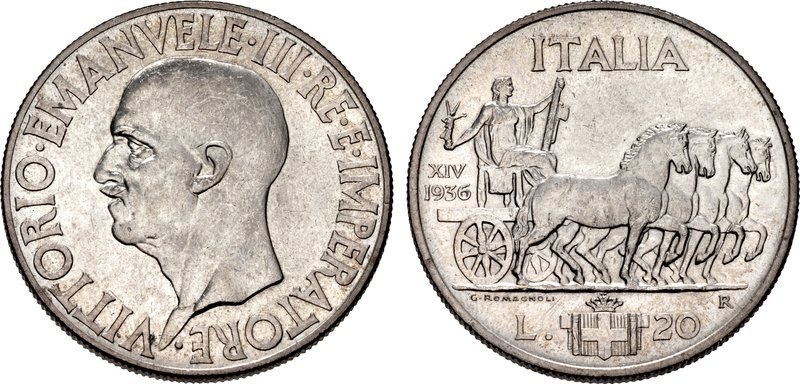
Start with the two faces. The obverse of this type carries a bare profile portrait identified with Benito Mussolini, usually with Italian legends and the date 1936. The reverse shows a chariot pulled by horses with a standing or driving figure, plus the denomination expressed as L. 20 or the words for twenty lire. Confirm both sides before drawing any conclusion, because the portrait is the single most diagnostic feature.
Measure and weigh the piece. Silver 20 Lire of the mid-1930s Kingdom of Italy run about 35 mm in diameter and roughly 15 grams in a fine silver alloy. Anything markedly lighter, smaller, magnetic, or off-color suggests a base-metal or plated reproduction. A caliper, an accurate scale, and a magnet are your quickest screening tools.
Know the key context point: official circulating 20 Lire of this era depict King Victor Emmanuel III, not Mussolini. A Mussolini portrait therefore points strongly toward a medallic, commemorative, or replica piece rather than legal-tender coinage. This is not a defect to hide but the central fact that determines what you are holding.
Inspect strike and surfaces closely. Genuine older silver shows appropriate wear on high points, crisp original lettering, and a consistent edge treatment. Many reproductions show soft or mushy detail, seams, casting bubbles, or lettering that does not match reference images. Compare your piece side by side with trusted photographs of documented examples.
When value is on the line, do not rely on the portrait alone. Have the metal content confirmed and, for anything sold as a scarce original, seek third-party authentication. Fascist-era imagery is heavily reproduced, so authenticate first and price second.
Frequently asked questions
What is the fastest way to screen this piece?
Weigh it, measure the diameter, and run a magnet test. Period silver is non-magnetic and near 35 mm and 15 grams; off-standard results point to a replica or base-metal fantasy piece.
Does the Mussolini portrait mean it is rare?
No. Because official Italian 20 Lire of the era showed the king, a Mussolini portrait usually indicates a commemorative or reproduction piece, many of which are common and inexpensive.
What look-alikes should I watch for?
Watch for cast copies, plated base-metal strikes, and modern novelty tokens using Fascist-era imagery. Soft detail, seams, and off-standard weight or diameter are common tells.
Should I get it authenticated?
Yes, if it is being sold as a genuine original or at a high price. Confirm the metal and obtain third-party authentication rather than trusting the design alone.
20 Lire identified by the community
Recent 20 Lire coins identified with Coin Identifier.