20 Lei
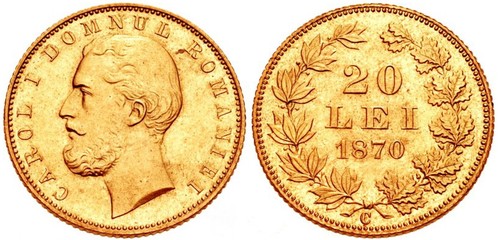
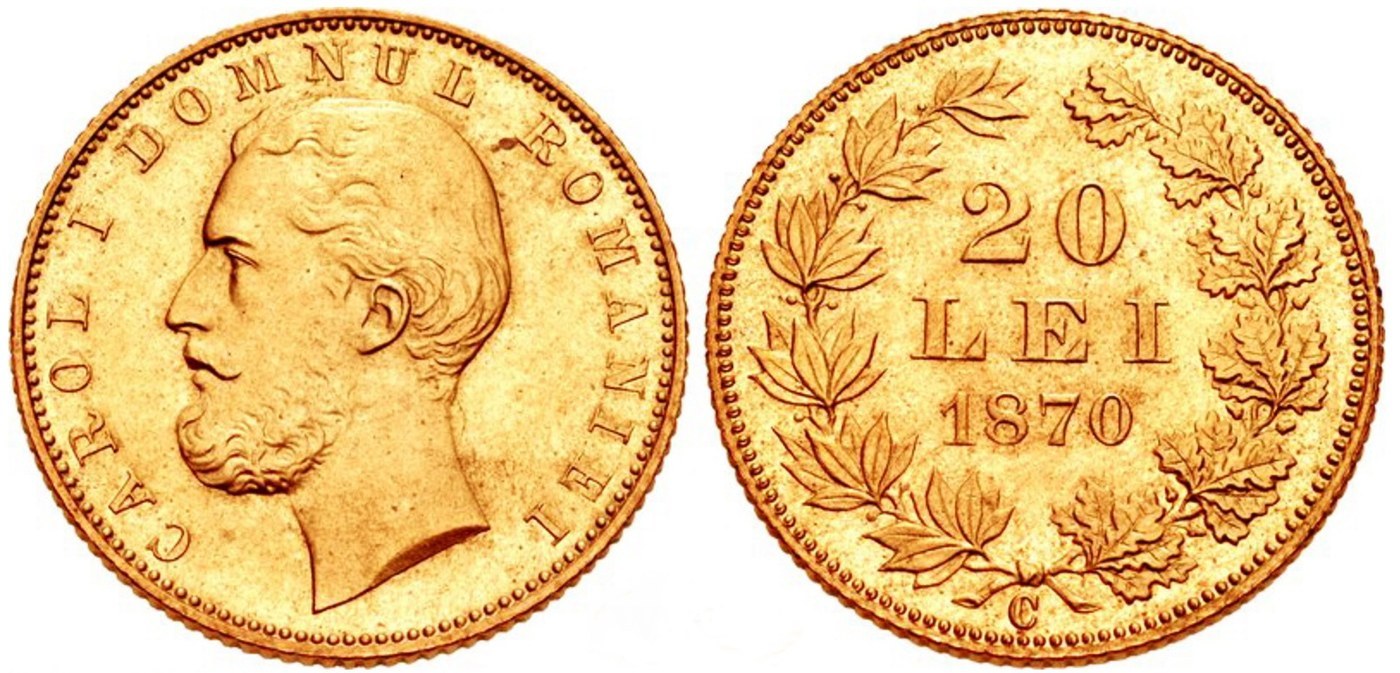
Romania's first gold coin, the 1870 20 Lei of Prince Carol I, pairing his left-facing portrait with the national coat of arms.
- Country
- Romania
- Denomination
- 20 Lei
- Metal
- Gold
Got a coin like this?
Identify any coin from a photo, free.
Overview
The 20 Lei of 1870 is a gold coin of Romania struck under Carol I and is widely regarded as the young principality's first national gold piece. It carries the left-facing portrait of Carol I on the obverse and the Romanian coat of arms on the reverse, with the value plainly given as 20 LEI.
This is a genuine precious-metal issue, a small but heavy gold coin made to the Latin Monetary Union standard, so it corresponds in size and weight to the 20-franc gold pieces of the era. Because it was produced in modest numbers early in Romania's coinage, it is both historically important and scarce, making it a landmark of Romanian numismatics.
Collectors prize the 1870 20 Lei as a foundational type: the first gold coin of the modern Romanian state and a tangible record of Carol I's early reign as ruling prince before Romania became a kingdom.
History & Background
Romania emerged as a unified principality in 1859 through the union of Moldavia and Wallachia, and in 1866 the German prince Carol of Hohenzollern-Sigmaringen was installed as ruling prince, taking the name Carol I. His government moved to establish a modern national currency, the leu, divided into 100 bani, aligned with the Latin Monetary Union that governed much of Europe's gold and silver coinage.
The 20 Lei of 1870 was issued in this state-building period as the country's first gold denomination. Its value of 20 lei matched the 20-franc gold standard of the Union, so the coin fit seamlessly into international trade of the time. It was struck during Carol I's years as Domnitor (ruling prince), before he was proclaimed King of Romania in 1881.
Romania continued to issue gold coinage into the twentieth century, but the 1870 20 Lei stands at the very beginning of that tradition. Its early date, its role as the first Romanian gold coin, and its limited production make it a cornerstone piece in the story of modern Romanian money.
How to Identify
The obverse shows the bare head of Carol I in profile facing left, surrounded by a legend naming him as ruler of the Romanians (readings such as CAROL I DOMNULU ROMANILORU appear on issues of this period). The absence of a crown on the portrait reflects his status as ruling prince rather than king at this date.
The reverse displays the Romanian coat of arms, a shield bearing the quartered national emblems with decorative surrounds, together with the denomination 20 LEI and the date 1870. The value and date on the reverse are the quickest confirmation of the type.
The coin is small but dense, struck in gold to the Latin Monetary Union standard, roughly 21 mm across and about 6.45 grams at .900 fineness, the same specification as a 20-franc gold piece. That heavy feel for its small diameter, the left-facing princely bust, the coat of arms, and the clear 20 LEI / 1870 legend together identify the type.
Value & Collectibility
As an early gold coin issued in limited numbers, the 1870 20 Lei is a scarce and valuable piece that trades well above its gold content. Even worn examples command strong prices as a sought-after first-year Romanian gold type, and attractive, well-detailed coins bring substantial premiums.
Condition, originality, and authenticity drive the price spread. Because the coin is small and made of soft gold, wear shows on the high points of the portrait and the arms, so problem-free pieces with sharp detail are worth clearly more than heavily circulated, cleaned, or damaged coins. Its rarity also makes it a frequent target for counterfeits, which strongly affects real market value.
Exact prices vary widely with grade, market conditions, and the price of gold, so treat any figure as a general range rather than a fixed quote. Higher-grade certified examples can bring considerably more, while fakes and problem coins trade far below genuine pieces.
Frequently asked questions
Is the 1870 Romania 20 Lei real gold?
Yes. It is a genuine gold coin struck to the Latin Monetary Union standard, about .900 fine gold, which is why it is small but noticeably heavy and dense in hand.
Who is on the obverse?
The portrait is Carol I, Romania's ruling prince at the time. He is shown bare-headed facing left, reflecting his status as Domnitor before Romania became a kingdom in 1881.
Why is it considered important?
The 1870 20 Lei is widely regarded as Romania's first national gold coin, making it a foundational type in Romanian numismatics and a key early issue of Carol I's reign.
What is on the reverse?
The reverse shows the Romanian coat of arms with its shield and decorative elements, along with the value 20 LEI and the date 1870.
Is this coin valuable?
Yes. It is scarce and desirable, trading well above its gold value. Prices depend heavily on grade, originality, authenticity, and the gold market, and genuine high-grade examples are especially prized.
20 Lei guides
In-depth guides for identifying, valuing, and collecting 20 Lei.