
How to Identify the 20 Lei
A collector's guide to confirming the 1870 Romanian 20 Lei gold coin by its princely portrait, coat of arms, denomination, and gold-standard format.
Read the full 20 Lei encyclopedia entry →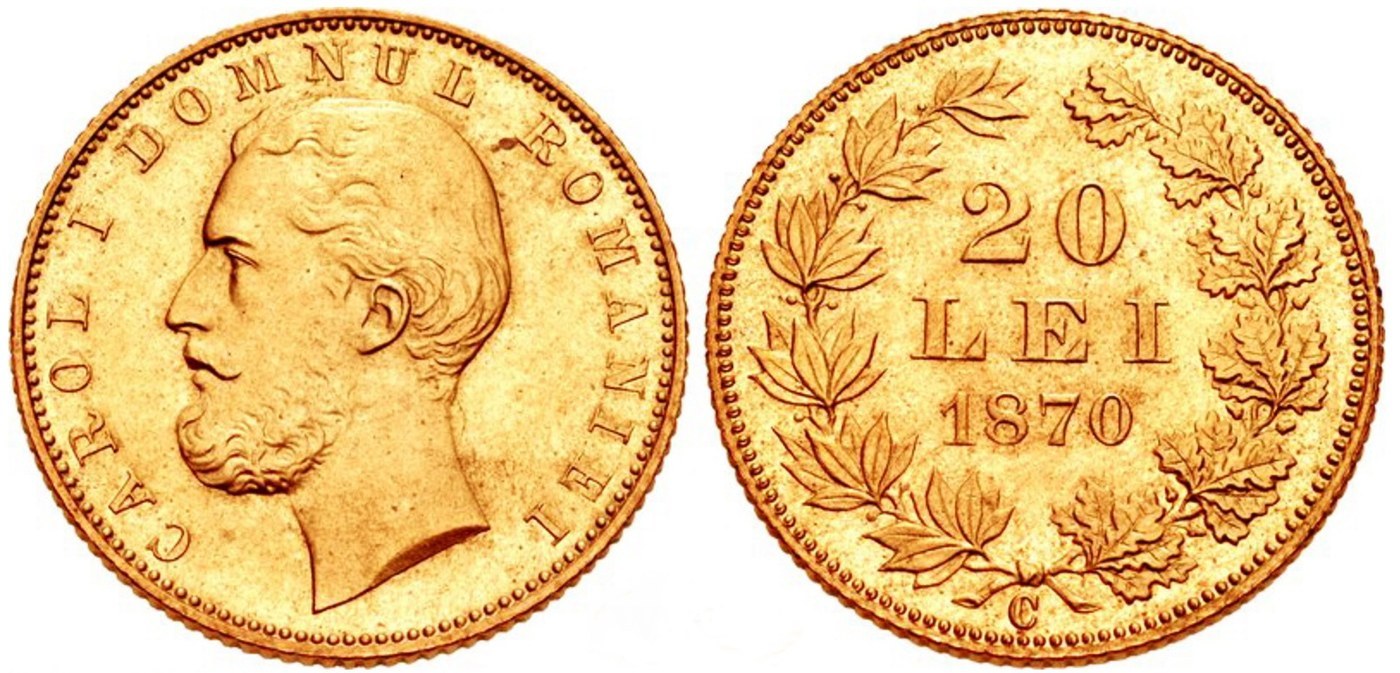
Read the Portrait and Legend
Start with the obverse. The genuine type shows the bare head of Carol I in profile facing left, encircled by a legend naming him as ruler of the Romanians (readings such as CAROL I DOMNULU ROMANILORU). The head is uncrowned, which fits his position as ruling prince, not king, at this date. A crowned bust or a different name points to a different coin or a later Romanian issue.
Confirm the Reverse and Denomination
The reverse must show the Romanian coat of arms, a shield with quartered emblems and decorative surrounds, together with the value 20 LEI and the date 1870. The written denomination and date are the surest confirmation of the type. If the value reads something other than 20 LEI, or the date differs, you are looking at another coin.
Check Size, Weight, and Metal
This is a small gold coin made to the Latin Monetary Union standard, roughly 21 mm in diameter and about 6.45 grams at .900 fineness, the same specification as a 20-franc gold piece. It should feel dense and heavy for its modest size and be non-magnetic. A lightweight, oversized, magnetic, or off-color example is an immediate warning sign.
Rule Out Look-Alikes
Romania and neighboring Latin Monetary Union countries struck many gold pieces of similar diameter, including later Romanian gold and the 20-franc and 20-lira coins of other nations. Matching every cue together, the left-facing bare-headed Carol I bust, the Romanian arms, the 20 LEI value, the 1870 date, and the correct gold weight, is what pins down this exact first-year type rather than a similar-sized foreign coin.
Authentication Cautions
Because it is a scarce and valuable early gold coin, this type attracts counterfeits, cast copies, and altered pieces. Weigh and measure the coin precisely and compare the portrait, arms, and lettering to trusted reference images, watching for wrong weight, soft or mushy detail, seams, or incorrect color. Cleaning and damage reduce value, so favor original surfaces, and for any significant purchase seek third-party authentication before relying on the coin as genuine.
Frequently asked questions
How can I tell it is the 1870 first-year type?
Confirm the left-facing bare-headed Carol I portrait, the Romanian coat of arms on the reverse, and the legend 20 LEI with the date 1870. All of these together, plus the correct small heavy gold format, identify the type.
Why is the portrait uncrowned?
In 1870 Carol I was Romania's ruling prince (Domnitor), not yet king. Romania was proclaimed a kingdom in 1881, so the early gold shows him bare-headed rather than crowned.
How do I avoid buying a fake?
Check that weight and diameter match the gold standard (about 6.45 g, 21 mm, .900 fine, non-magnetic), compare fine detail against reference images, and for valuable examples rely on professional third-party authentication.
Is it the same as a 20-franc gold coin?
It shares the Latin Monetary Union specification, so it matches a 20-franc piece in size, weight, and fineness, but the design and legends are Romanian. Always read the 20 LEI value and Carol I portrait to distinguish it.