20 Francs (Leopold II)
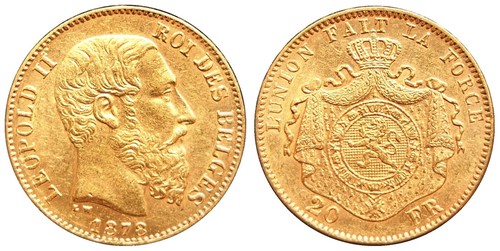
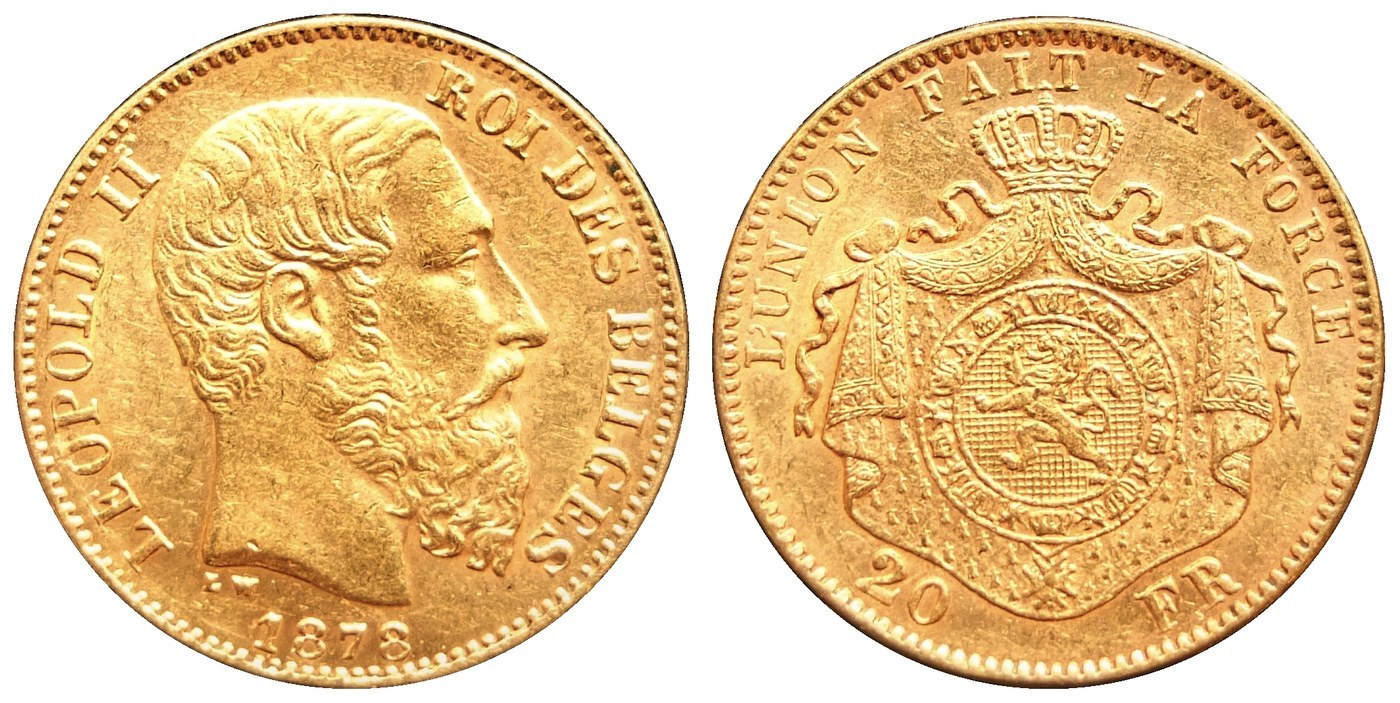
Belgium's gold 20 francs under King Leopold II, a small Latin Monetary Union coin with the bearded king's profile and the crowned national arms.
- Country
- Belgium
- Denomination
- 20 Francs
- Metal
- Gold
Got a coin like this?
Identify any coin from a photo, free.
Overview
The 20 Francs of Leopold II is a small gold coin struck by the Kingdom of Belgium during the reign of King Leopold II. The obverse carries the king's mature profile with curly hair and a full beard, while the reverse shows the crowned Belgian coat of arms with its lion and laurel wreath. The example seen here is dated 1878.
This is a genuine gold trade coin built to the Latin Monetary Union standard, meaning it matches the French, Swiss, and Italian 20-franc pieces in size and gold content. It is a compact coin of about 21 mm containing roughly a fifth of an ounce of gold, so it feels dense despite its modest diameter.
Collectors and bullion buyers alike pursue these coins. They combine an attractive nineteenth-century royal portrait with a reliable, internationally recognized gold weight, which keeps them liquid and popular in type sets of European gold.
History & Background
Leopold II ruled Belgium from 1865 to 1909, a long reign during which the country was a member of the Latin Monetary Union, an 1860s currency agreement that fixed the gold and silver content of the franc across several European nations. Under this system a Belgian 20 francs was interchangeable in weight and fineness with a French or Swiss 20 francs.
Belgium struck 20-franc gold pieces bearing Leopold II's portrait in several years of his reign, including 1878, as workaday international money rather than commemoratives. The coins circulated in commerce and cross-border trade at a time when gold coinage underpinned everyday high-value payments.
Production of these small gold francs wound down as Europe moved away from the gold standard around the First World War. Today the surviving coins are collected as historic examples of Belgium's monarchy-era gold and of the wider Latin Monetary Union coinage.
How to Identify
The obverse shows the profile bust of Leopold II facing left, rendered as an older man with curly hair and a full beard, surrounded by a legend naming him as king of the Belgians. The bearded, mature portrait is the key marker distinguishing his coins from those of his father, Leopold I, and later Belgian rulers.
The reverse displays the crowned Belgian coat of arms, the shield bearing the rampant lion, framed by a laurel or oak wreath, with the value 20 FR and the date, here 1878. Belgian coins of this era appear with either a French-language or a Dutch-language legend, so the surrounding wording may read in French (BELGIQUE) or Dutch (BELGIE), which is a normal variety, not a fault.
The coin is small but heavy: roughly 21 mm across and about 6.45 grams of .900 fine gold. Its size, weight, warm gold color, and the pairing of the bearded king with the crowned arms together identify it as a Leopold II 20 francs.
Value & Collectibility
The 20 Francs of Leopold II is valued chiefly as a gold coin, so its price tracks closely with its gold content, roughly a fifth of a troy ounce, plus a modest collector premium. Common dates in circulated grades typically trade a little above their gold melt value, making them an accessible way to own a nineteenth-century European gold coin.
Condition and date drive the premium above melt. Well-worn examples sell close to bullion, while sharp, lustrous, high-grade pieces and scarcer dates command stronger premiums with collectors. Because these coins circulated, light rim and high-point wear is common and normal.
Exact figures move with the gold market and with grade, so treat any quoted price as a general range rather than a fixed value. Damaged, cleaned, mounted (ex-jewelry), or counterfeit pieces trade below sound original coins, and certified high-grade examples can bring meaningful premiums.
Frequently asked questions
Is the Belgium 20 Francs Leopold II real gold?
Yes. It is a genuine gold coin of .900 fineness containing about 5.8 grams of pure gold, roughly a fifth of a troy ounce, which is why it is small but noticeably heavy.
Who is the man on the obverse?
He is Leopold II, King of the Belgians from 1865 to 1909, shown in profile as an older man with curly hair and a full beard. The bearded portrait helps separate his coins from those of Leopold I.
Why do some coins have French text and others Dutch?
Belgium is bilingual, so 20-franc coins were struck with either French (BELGIQUE) or Dutch (BELGIE) legends. Both are official and normal; the language is a variety, not a defect or a sign of a fake.
Is this the same as a French 20 francs?
It is the same weight and gold content. Belgium struck these to the Latin Monetary Union standard, so a Belgian 20 francs matches French, Swiss, and Italian 20-franc gold coins in size and fineness, though the designs differ.
How much is it worth?
Most trade a bit above their gold melt value. Common dates in worn grades sit near bullion, while high-grade or scarcer pieces bring collector premiums. Value depends on gold price, date, and condition.
20 Francs (Leopold II) guides
In-depth guides for identifying, valuing, and collecting 20 Francs (Leopold II).