20 Drachmai
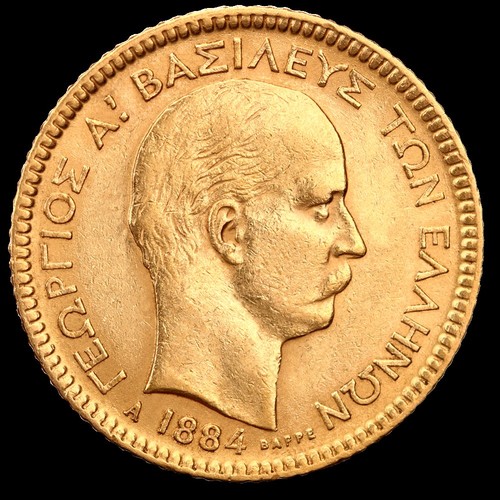
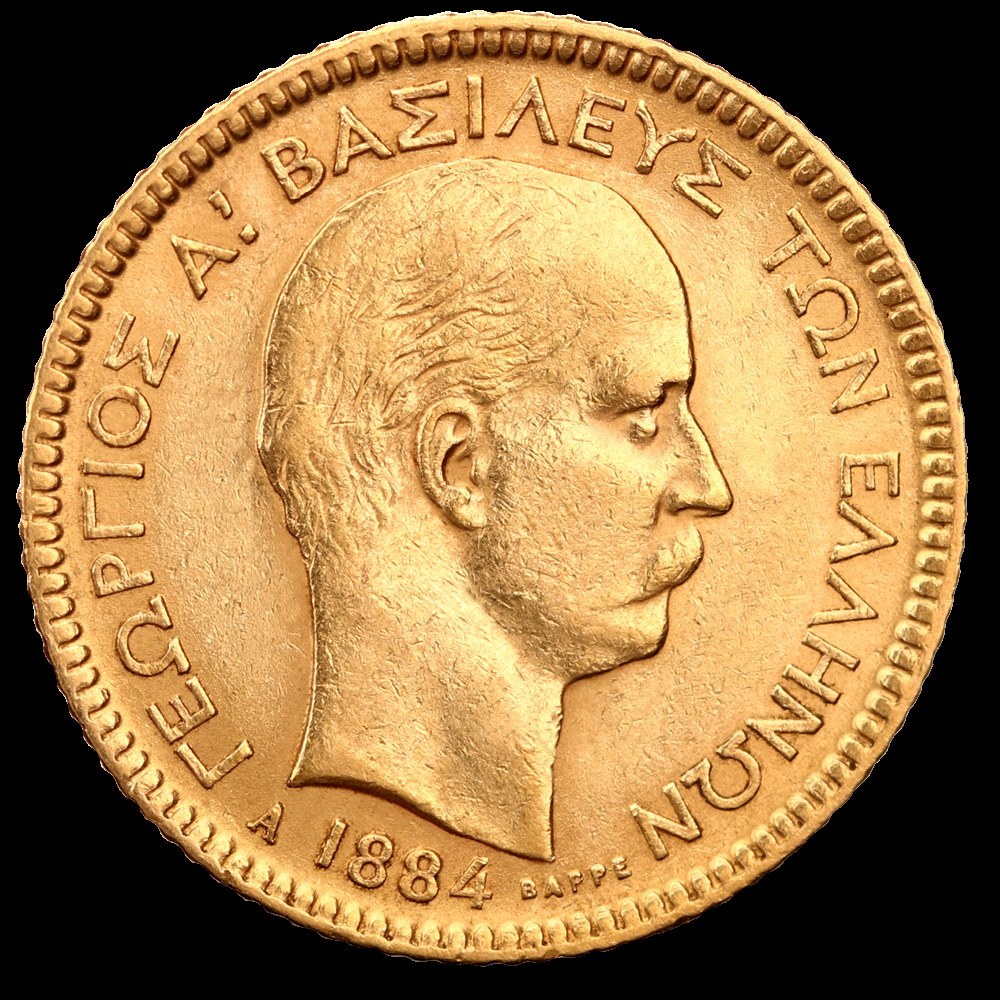
Greece's 1884 gold 20 Drachmai of King George I: a small Latin Monetary Union gold coin with the king's portrait and the crowned royal arms.
- Country
- Greece
- Denomination
- 20 Drachmai
- Metal
- Gold
Got a coin like this?
Identify any coin from a photo, free.
Overview
The 20 Drachmai of 1884 is a small gold coin of the Kingdom of Greece struck under King George I. It pairs the king's right-facing portrait on the obverse with the crowned Greek royal coat of arms on the reverse, and it carries the single date 1884.
This is a genuine gold issue struck to the Latin Monetary Union standard, meaning it shares the size, weight, and fineness of the French 20 francs and similar European gold pieces of the era. It is a compact coin, roughly 21 mm across and about 6.45 grams of .900 fine gold, so it feels dense and substantial despite its modest diameter.
As the principal gold denomination of George I's reign and effectively a one-year type in this design, it is prized by collectors of Greek and world gold. Its combination of a named monarch, an attractive heraldic reverse, and precious-metal content makes it a centerpiece of nineteenth-century Greek coinage.
History & Background
George I came to the Greek throne in 1863 as a Danish-born prince chosen to rule the young kingdom, and he reigned for nearly fifty years until 1913. During his reign Greece was a member of the Latin Monetary Union, an agreement that harmonized the gold and silver coinages of France, Belgium, Italy, Switzerland, Greece, and others so their coins would circulate interchangeably.
The 1884 gold 20 Drachmai was struck within this system, matching the internationally accepted 20-franc gold standard. Greece produced relatively little gold coinage compared with its larger partners, and the 20 Drachmai was minted only in limited numbers, which is why surviving examples are comparatively scarce today.
The drachma remained Greece's currency until the country adopted the euro in 2002. This 1884 gold piece belongs to the classic Latin Monetary Union era, a period when small standardized gold coins served as reliable international money across much of Europe.
How to Identify
The obverse shows the bare-headed portrait of King George I facing right, surrounded by a Greek legend naming him as king of the Hellenes. Reading the ruler's name and the right-facing bust is the quickest way to confirm the type.
The reverse displays the crowned Greek royal coat of arms, a shield bearing the cross, flanked by supporters and topped by a royal crown, with the value 20 ΔΡΑΧΜΑΙ and the date 1884. Coins of this type were struck at the Paris mint and typically carry a small mint mark and engraver or privy marks in the reverse field beside the date.
Key identifiers are the right-facing George I portrait, the crowned arms with supporters, the Greek denomination 20 ΔΡΑΧΜΑΙ, the 1884 date, and the small gold format of about 21 mm and 6.45 grams. The metal is .900 fine gold, giving the coin a warm yellow color, real heft for its size, and a non-magnetic response.
Value & Collectibility
As a scarce nineteenth-century gold coin, the 1884 20 Drachmai carries both collector and bullion value, and it generally trades well above its raw gold content. Even worn examples command a clear premium over melt because of the coin's limited mintage and historical appeal, while sharp, lightly circulated pieces bring considerably more.
Condition and originality drive the price spread. High-grade coins with strong portrait detail, full crown and shield definition, and undisturbed surfaces are the most desirable, whereas cleaned, scratched, or mounted pieces (the coin was sometimes used in jewelry) trade at a discount. Because it is a one-date gold type, demand from type and country collectors is steady.
Exact prices vary with grade, market conditions, and the gold price, so treat these as general ranges rather than fixed quotes. Certified problem-free examples in higher grades can bring substantial premiums, while damaged or counterfeit pieces are worth far less.
Frequently asked questions
Is the 1884 Greek 20 Drachmai real gold?
Yes. It is struck in .900 fine gold to the Latin Monetary Union standard, about 6.45 grams total. That is why it is small but heavy, warm yellow in color, and non-magnetic.
Who is on the obverse?
The portrait is King George I of Greece, shown bare-headed and facing right. The surrounding Greek legend names him as king of the Hellenes, confirming the ruler and reign.
What is on the reverse?
The reverse shows the crowned Greek royal coat of arms, a cross shield with supporters beneath a crown, together with the value 20 ΔΡΑΧΜΑΙ and the date 1884.
Where was it minted?
This gold type was struck at the Paris mint under contract, in keeping with Greece's participation in the Latin Monetary Union. Small mint and privy marks usually appear near the date.
Is it valuable?
Yes. As a scarce one-year gold type it trades above its gold value, with higher grades bringing strong premiums. Value depends on condition, originality, and the current gold price.
20 Drachmai guides
In-depth guides for identifying, valuing, and collecting 20 Drachmai.