2 Litai
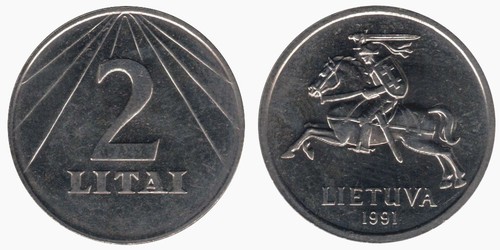
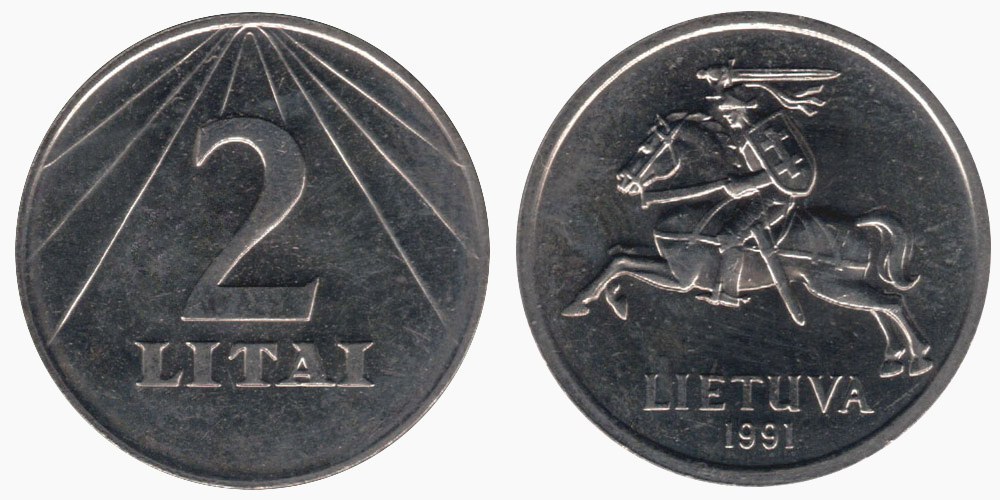
A white base-metal 2 litai of newly independent Lithuania, dated 1991, showing the value in a radiating sunburst on one side and the Vytis mounted knight on the other.
- Country
- Lithuania
- Denomination
- 2 Litai
- Metal
- Nickel
Got a coin like this?
Identify any coin from a photo, free.
Overview
The 2 Litai dated 1991 is an early litas-denomination coin of the Republic of Lithuania, struck in a hard white base metal soon after the country restored its independence in 1990. It belongs to Lithuania's first post-Soviet coinage program, in which the historic litas name and national symbolism were revived.
The design is deliberately national and self-assured for a young state. One face carries the denomination 2 LITAI set within a burst of radiating lines, while the other shows the Vytis, the armored knight on horseback that has served as Lithuania's coat of arms for centuries. Together the two sides announce both the currency and the nation behind it.
Because it dates from a turbulent transitional moment, this piece is collected today more as a historical marker of Lithuania's return to independence than as an everyday coin. It is popular with collectors of Baltic and post-Soviet issues as an affordable, symbol-rich type.
History & Background
Lithuania declared the restoration of its independence in March 1990, becoming one of the first republics to break from the Soviet Union. As it built the institutions of a sovereign state, it also prepared its own money, reviving the litas, the interwar currency of the independent Lithuania of the 1920s and 1930s.
Coins dated 1991, including this 2 litai and its 1 and 5 litai companions, were produced as part of that early program. The economic reality on the ground was chaotic: the Soviet ruble was still in use, a temporary coupon currency known as the talonas circulated during 1991 to 1993, and severe inflation delayed a stable currency reform. The full-fledged litas was formally introduced only in 1993, which complicated the release and circulation of these 1991-dated litai.
As a result the 1991 litai occupy an unusual place in Lithuanian numismatics, remembered as the first coins of the reborn republic and closely tied to the dramatic events surrounding independence. Their imagery, especially the revived Vytis, made them a statement of national identity as much as instruments of commerce.
How to Identify
One face is dominated by the denomination 2 LITAI rendered against a field of straight radiating lines that fan out like a sunburst; the value and this radiating pattern are the quickest confirmation of the 2 litai type. The opposite face shows the Vytis, an armored knight on a galloping horse facing left, brandishing a sword, which is the national coat of arms of Lithuania. The date 1991 appears with the design.
The coin is struck in a hard, white base metal (nickel-toned) rather than silver or gold, so it has a pale metallic color and a firm, light feel rather than precious-metal heft. It is a modest circulation-size piece; use the stated value 2 LITAI to separate it from the similar 1 litas and 5 litai coins of the same 1991 series, which share the Vytis and sunburst styling but differ in size and denomination.
Key identifiers are the LITAI denomination in the radiating sunburst, the mounted-knight Vytis emblem, the 1991 date, and the white base-metal fabric. These cues distinguish it from Lithuania's small aluminum centai of the same era and from the later litas coins introduced from 1993 onward, which use different designs.
Value & Collectibility
As an early republic base-metal coin, the 1991 2 litai is modestly priced and accessible to most collectors. Typical examples change hands for a few dollars, with worn circulated pieces at the low end and crisp uncirculated coins bringing a somewhat higher, though still moderate, premium.
Condition and eye appeal are the main value drivers, since there is no precious-metal content to set a floor. Sharp detail on the knight and horse of the Vytis and clean, unmarked fields in the sunburst area help an example stand out. The coin's historical significance as a first-issue of independent Lithuania supports steady collector interest.
Treat any figures as general context rather than firm quotes, because prices for modern world coins vary by grade, venue, and demand. The appeal here is chiefly historical and thematic, as a tangible piece of Lithuania's return to independence, rather than as a bullion or high-rarity investment.
Frequently asked questions
What is the knight on the reverse?
It is the Vytis, an armored knight on horseback wielding a sword, which has been the coat of arms of Lithuania for centuries. Its revival on this coin was a deliberate statement of restored national identity.
Is the 1991 2 litai made of silver?
No. It is struck in a hard white base metal (nickel-toned), so it has no precious-metal value. Its worth is historical and collector-driven rather than bullion-based.
Why is it dated 1991 when the litas came in 1993?
Lithuania prepared its first coins soon after restoring independence in 1990, but economic turmoil and a temporary coupon currency delayed the full litas reform until 1993. That is why these first litai carry the earlier 1991 date.
Is this coin rare or valuable?
It is affordable and generally available to collectors, typically worth only a few dollars. High-grade uncirculated examples bring a modest premium, but it is prized more for its historical role than its scarcity.
What does litai mean?
Litai is the plural form of litas, Lithuania's national currency. The name was revived from the interwar litas used by independent Lithuania in the 1920s and 1930s.
2 Litai guides
In-depth guides for identifying, valuing, and collecting 2 Litai.