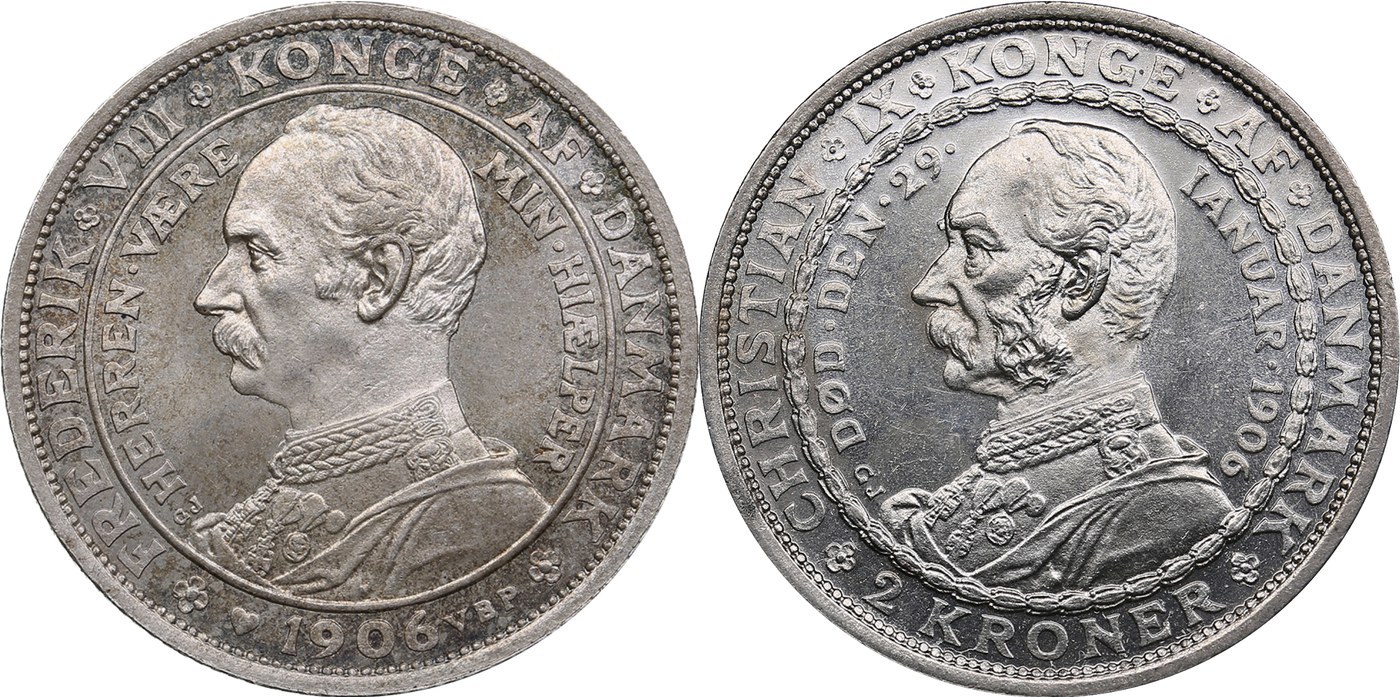
2 Kroner
A Danish silver 2 Kroner dated 1875, the first year of the krone, showing the crowned Danish coat of arms and the denomination 2 KRONER.
- Country
- Denmark
- Denomination
- 2 Kroner
- Metal
- Silver
Got a coin like this?
Identify any coin from a photo, free.
Overview
The 2 Kroner is a large silver coin of Denmark, and the example shown here is dated 1875, the very first year of the krone currency. One face carries the crowned Danish coat of arms (the shield of the kingdom beneath a royal crown), while the other shows the denomination 2 KRONER with the date and inscriptions. It is a substantial 'crown-sized' silver piece, the highest silver denomination of the new decimal system.
The krone, divided into 100 øre, replaced the older rigsdaler currency and was introduced under the Scandinavian Monetary Union that linked Denmark, Sweden and Norway. A 2 Kroner represented a meaningful sum in everyday terms, and its bright silver surfaces and crowned heraldic design mark it as a prestige coin of the realm rather than small change.
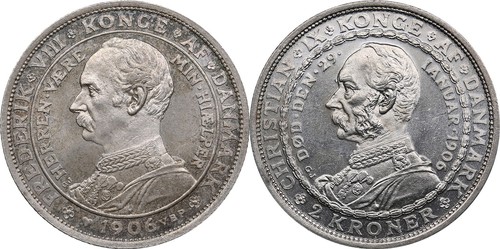
The coin belongs to the reign of King Christian IX (1863–1906), whose portrait appears on the type. Dated squarely to 1875, this piece is one of the founding issues of modern Danish coinage, and the pairing of the crowned arms with the plain 2 KRONER value statement is its signature look.
History & Background
Denmark adopted the krone in 1875, converting from the old rigsdaler system to a decimal currency of 100 øre to the krone. The change was part of the Scandinavian Monetary Union, an agreement that from the 1870s tied the currencies of Denmark, Sweden and Norway to a common gold standard and allowed their coins to circulate across the three kingdoms. The silver 1 Krone and 2 Kroner were the large-denomination coins of this new system.
The 1875 issue therefore marks a starting point: it is among the first coins struck for the krone, produced during the long reign of Christian IX. Danish coins of this period were made at the Copenhagen mint, which traditionally marked its output with a small heart symbol together with the initials of the mint official responsible, alongside the royal legends and the coat of arms.
Over the following decades further 2 Kroner were struck, including a number of commemorative issues marking royal jubilees, weddings and successions. The plain 1875 circulation type, however, stands apart as one of the founding coins of the modern Danish monetary system rather than a commemorative, which is why its date is of particular interest to collectors of the series.
How to Identify
Look first for the crowned coat of arms. One face of this piece shows the Danish shield surmounted by a royal crown, the heraldic emblem of the kingdom. The other face is dominated by the denomination, spelled out as 2 KRONER, together with the date 1875 and surrounding inscriptions. The type also carries the right-facing portrait and legend of King Christian IX, whose name and title identify the reign.
The coin is a large silver piece in the 'crown' size class, on the order of 31 mm across and about 15 grams, struck in high-grade (roughly 80%) silver. In hand it has real heft and the bright, coolly reflective surfaces of a substantial silver coin; circulated examples take on the soft grey tone typical of worn silver rather than the yellow of a base-metal or gold coin, and it is non-magnetic.
Confirm the type by reading the elements together: the crowned Danish arms, the value written as 2 KRONER, the date 1875, and the Danish royal legend. Near the arms or value, look also for the small heart mintmark of Copenhagen and the mintmaster's initials. These features distinguish a genuine 1875 2 Kroner from the smaller 1 Krone, from later dates, and from the many commemorative 2 Kroner that share the denomination but carry different designs and inscriptions.
Value & Collectibility
As a large silver coin, the 1875 2 Kroner carries value from its silver content, its age as a first-year krone issue, and collector demand for early Danish coinage. Its worth rests on a combination of bullion value and a collector premium that depends heavily on condition.
Prices vary widely with grade, eye appeal and authenticity. A well-worn example sits toward the lower end, close to its silver value, while a sharp, lightly circulated or uncirculated piece can command a solid premium above bullion. Because ranges are broad and condition-driven, a specific coin is best appraised individually rather than valued from a single figure. Commemorative 2 Kroner of other dates trade on their own separate merits and should not be assumed to match a plain 1875 circulation piece.
As with any silver 'crown', condition and originality drive value. Cleaned, damaged or repaired coins are worth notably less than untouched examples, and any piece being bought or sold at a meaningful price is best confirmed by a knowledgeable dealer or a recognised grading service.
Frequently asked questions
What is this coin made of?
It is a large silver coin, the highest silver denomination of the early Danish krone system. An 1875 2 Kroner is a 'crown-sized' piece of high-grade silver, roughly 31 mm across and about 15 grams.
Why is the 1875 date significant?
1875 was the first year of the krone, when Denmark switched from the old rigsdaler to a decimal currency of 100 øre. The 2 Kroner is one of the founding coins of that new system.
Whose coat of arms is on the coin?
The crowned shield is the coat of arms of the Kingdom of Denmark. The coin was struck under King Christian IX, whose portrait and royal legend also appear on the type.
What does the other side show?
The value side states the denomination as 2 KRONER together with the date 1875 and Danish inscriptions, and near it the small heart mintmark of the Copenhagen mint with the mintmaster's initials.
Is an 1875 2 Kroner rare?
It is a collectible early type rather than a great rarity. Value depends mostly on condition: worn pieces trade near silver value, while sharp, high-grade examples bring a stronger premium.
2 Kroner guides
In-depth guides for identifying, valuing, and collecting 2 Kroner.