100 Lire
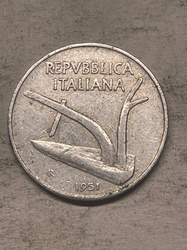
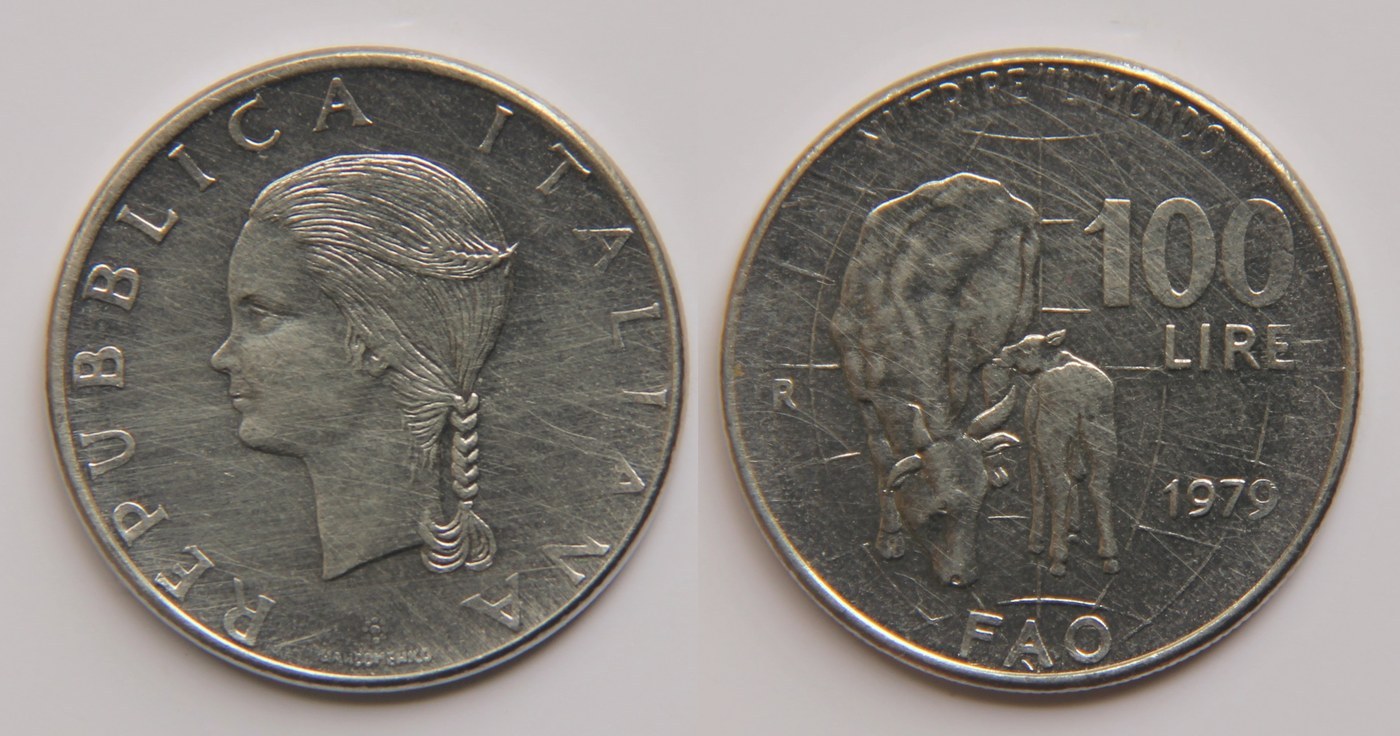
Italy's 1979 100 Lire, a nickel-hued FAO commemorative with a woman's profile on the obverse and an allegorical figure beside the value on the reverse.
- Country
- Italy
- Denomination
- 100 Lire
- Metal
- Nickel
Got a coin like this?
Identify any coin from a photo, free.
Overview
This coin is a 100 Lire piece struck by the Italian Republic in 1979 as part of the worldwide FAO (Food and Agriculture Organization) commemorative coin program. The obverse shows a woman's head in profile facing left with the legend REPVBBLICA ITALIANA, while the reverse carries an allegorical figure alongside the large value 100 LIRE, the date 1979, and an FAO reference tying it to the campaign against world hunger.
Unlike Italy's standard circulating 100 Lire of the era, which features the goddess Minerva, this FAO issue uses a distinct one-year design. It is small, light, and made of a silvery, nickel-colored steel alloy, giving it the look of a everyday coin rather than a precious-metal collectible.
As a modern circulation-grade commemorative, it is widely available and inexpensive, making it a common find in mixed lots of European coins and a familiar example of the FAO coinage collected as a thematic set.
History & Background
The FAO coin program was organized so that member nations could issue coins carrying messages about food production and the fight against hunger, with proceeds and public attention directed toward agricultural development. Many countries participated across the 1960s, 1970s, and beyond, and Italy contributed several denominations, including this 100 Lire dated 1979.
At the time, the lira was Italy's national currency and the 100 Lire was a modest everyday denomination. This FAO commemorative was produced in the same general format and size as circulating coinage rather than as a bullion or proof-only rarity, so it could reach ordinary hands and spread the FAO message.
The lira remained in use until Italy adopted the euro at the start of the 2000s, after which lira coins ceased to be legal tender. Surviving 100 Lire pieces like this 1979 FAO issue are now kept by collectors and holdover savers rather than spent.
How to Identify
Look first at the obverse: a woman's head in profile facing left, paired with the legend REPVBBLICA ITALIANA. The reverse is the decisive feature for this type, showing an allegorical human figure next to a bold 100 LIRE denomination, the year 1979, and an FAO mark or wording that identifies it as part of the Food and Agriculture Organization series.
The coin is small and lightweight, struck in a silvery, nickel-toned steel alloy (the Italian mint's stainless "acmonital"-type metal) rather than a yellow or copper color. It has a plain, non-precious appearance and a reeded or plain edge typical of Italian minor coinage of the period.
The surest confirmation is the combination of the 100 LIRE value, the 1979 date, and the FAO reference on the reverse. If a 100 Lire instead shows the helmeted goddess Minerva without any FAO wording, it is the standard circulating type, not this commemorative issue.
Value & Collectibility
This is a common modern coin with a low intrinsic and collector value. In worn, circulated condition it is typically worth only a small fraction of a dollar and is often sold in bulk world-coin lots rather than individually.
Crisp, uncirculated examples with full luster and no marks carry a modest premium and may sell for a few dollars, especially to collectors assembling a complete FAO thematic set. Original mint or proof-quality packaging, where it exists, can add to desirability.
Because it was made in quantity for a general audience and contains no precious metal, condition and completeness of a set drive nearly all of its value. It should be viewed as an affordable, entry-level collectible rather than an investment piece.
Frequently asked questions
What country and year is this 100 Lire from?
It is an Italian coin dated 1979, struck by the Italian Republic (Repubblica Italiana) as part of the FAO commemorative program.
What does the FAO mark mean?
FAO stands for the Food and Agriculture Organization of the United Nations. Many nations issued FAO-themed coins to promote food production and the fight against hunger; this 1979 100 Lire is Italy's contribution for that date.
Is this 100 Lire made of silver?
No. It is struck in a silvery, nickel-colored steel alloy, not precious metal. Its color comes from the alloy, not from silver content.
Is my 1979 100 Lire worth much?
In circulated condition it is a common, low-value coin worth only a small amount. Uncirculated examples or complete FAO sets can bring a modest premium of a few dollars.
Can I still spend it in Italy?
No. Italy replaced the lira with the euro in the early 2000s, so lira coins like this are no longer legal tender and are kept as collectibles.
100 Lire guides
In-depth guides for identifying, valuing, and collecting 100 Lire.
100 Lire identified by the community
Real coins identified with Coin Identifier.