100 Lei
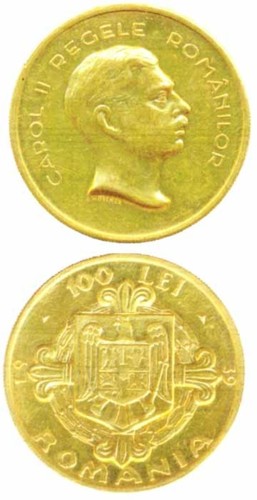
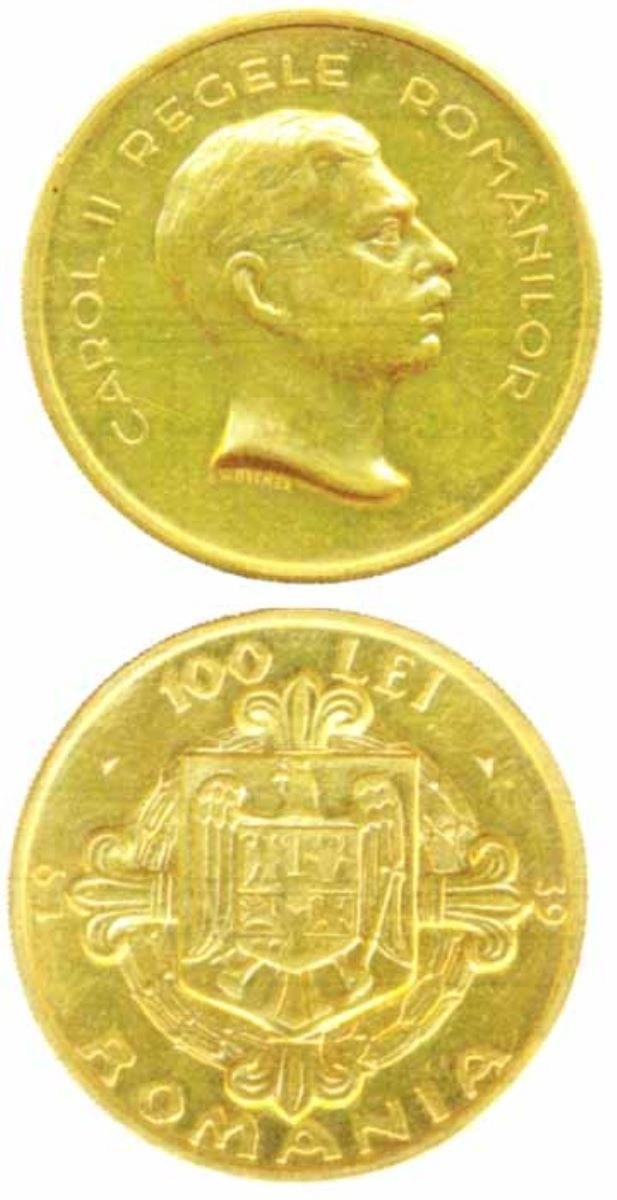
A scarce Kingdom of Romania gold 100 Lei of 1939, showing King Carol II in profile on the obverse and the crowned Romanian coat of arms on the reverse.
- Country
- Romania
- Denomination
- 100 Lei
- Metal
- Gold
Got a coin like this?
Identify any coin from a photo, free.
Overview
The 100 Lei is a gold coin of the Kingdom of Romania struck during the reign of King Carol II. The 1939 issue pairs a right-facing portrait of the king with the crowned national coat of arms, and belongs to a short series of gold pieces produced by the Bucharest state mint late in the interwar period.
Unlike the base-metal and silver coins that carried the same 100 Lei denomination in everyday commerce, this gold version was a limited, prestige issue rather than money intended for broad circulation. It was made in small quantities, so genuine examples are comparatively scarce today and are collected as part of Romanian royal gold rather than for spending.
As a small gold coin from a turbulent moment just before the Second World War reshaped Romania, the 1939 100 Lei is prized both for its precious-metal content and for its association with the last full years of the Romanian monarchy under Carol II.
History & Background
Carol II ruled Romania from 1930 to 1940, a period that ended with his abdication in favor of his son Mihai (Michael) I as the war closed in around the country. His coinage carries his profile and royal titulature, and the gold pieces of the late 1930s were struck near the end of his reign.
Romania had a long tradition of gold coinage stretching back to the 20 lei of King Carol I in the 1860s and 1880s, when the leu was tied to the gold-based Latin Monetary Union standards. By the late 1930s gold coins were no longer meant for circulation; they were commemorative and presentation pieces produced in modest numbers by the Monetaria Statului (State Mint) in Bucharest.
The 1939 100 Lei sits at the tail end of this royal gold tradition. Within a year Carol II had abdicated, and Romania soon lost territory and entered the wider conflict, making the gold coins of 1939 and 1940 among the last struck under the interwar monarchy before dramatic political change.
How to Identify
The obverse shows the bare or uniformed head of King Carol II facing right, encircled by a Romanian royal legend naming him as king (typically CAROL II and a title such as REGELE ROMANILOR), with the date 1939 in the design.
The reverse displays the coat of arms of the Kingdom of Romania: a shield bearing the quartered arms of the historic provinces, set on a mantle or supporters and surmounted by the royal crown, with the value 100 LEI stated in the field or legend. The metal is yellow gold, and the coin is physically small but noticeably dense for its diameter.
Key identifiers are the right-facing Carol II portrait, the crowned Romanian arms, the 100 LEI value, the 1939 date, and the warm gold color combined with heavy heft relative to size. The gold striking is what separates this piece from the far more common base-metal and silver 100 Lei coins that share the same denomination but were made for circulation.
Value & Collectibility
As a low-mintage gold coin, the 1939 100 Lei is worth far more than its face value and trades chiefly on a combination of gold content, scarcity, and grade. Because it is uncommon and was made in small numbers, sound genuine examples generally command strong collector prices, typically ranging from the mid hundreds into the low thousands of dollars depending on condition and market.
Condition and originality matter a great deal: sharply struck, lightly handled pieces with full detail on the portrait and arms bring the highest prices, while examples that have been mounted in jewelry, polished, or damaged sell for much less. Certified coins from recognized grading services command a premium because gold Romanian royals are targets for counterfeiting.
Exact figures vary widely with grade, provenance, and where the coin is sold, so the ranges here are general context rather than firm quotes. Anyone buying should treat authentication as part of the value, since the gold content alone makes fakes worthwhile to produce.
Frequently asked questions
Is the 1939 Romanian 100 Lei really made of gold?
Yes. This issue is a gold coin, which is why it is scarce and valuable. It is distinct from the common base-metal and silver 100 Lei coins that carried the same denomination for everyday use.
Who is on the obverse?
The obverse shows King Carol II of Romania in right-facing profile, with a royal legend naming him as king and the date 1939.
What is on the reverse?
The reverse shows the crowned coat of arms of the Kingdom of Romania, a quartered shield of the historic provinces beneath the royal crown, together with the 100 LEI value.
Why is this coin scarce?
Late-1930s Romanian gold pieces were limited prestige and presentation issues, not circulating money, so they were struck in small quantities. Carol II abdicated in 1940, and few genuine examples survive in good condition.
How much is it worth?
It is worth well above face value, generally from the mid hundreds into the low thousands of dollars depending on grade, originality, and authentication. Damaged or jewelry-mounted pieces are worth considerably less.
100 Lei guides
In-depth guides for identifying, valuing, and collecting 100 Lei.