1 Riksdaler Specie
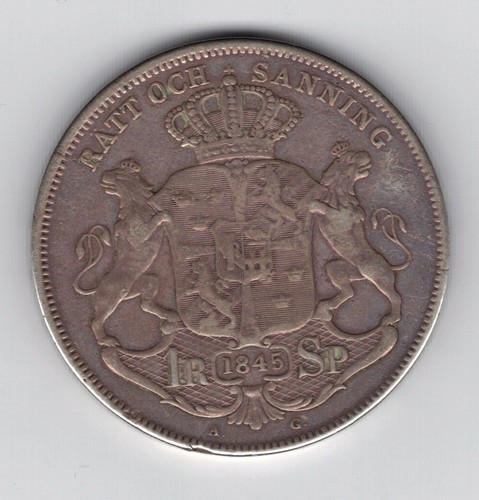
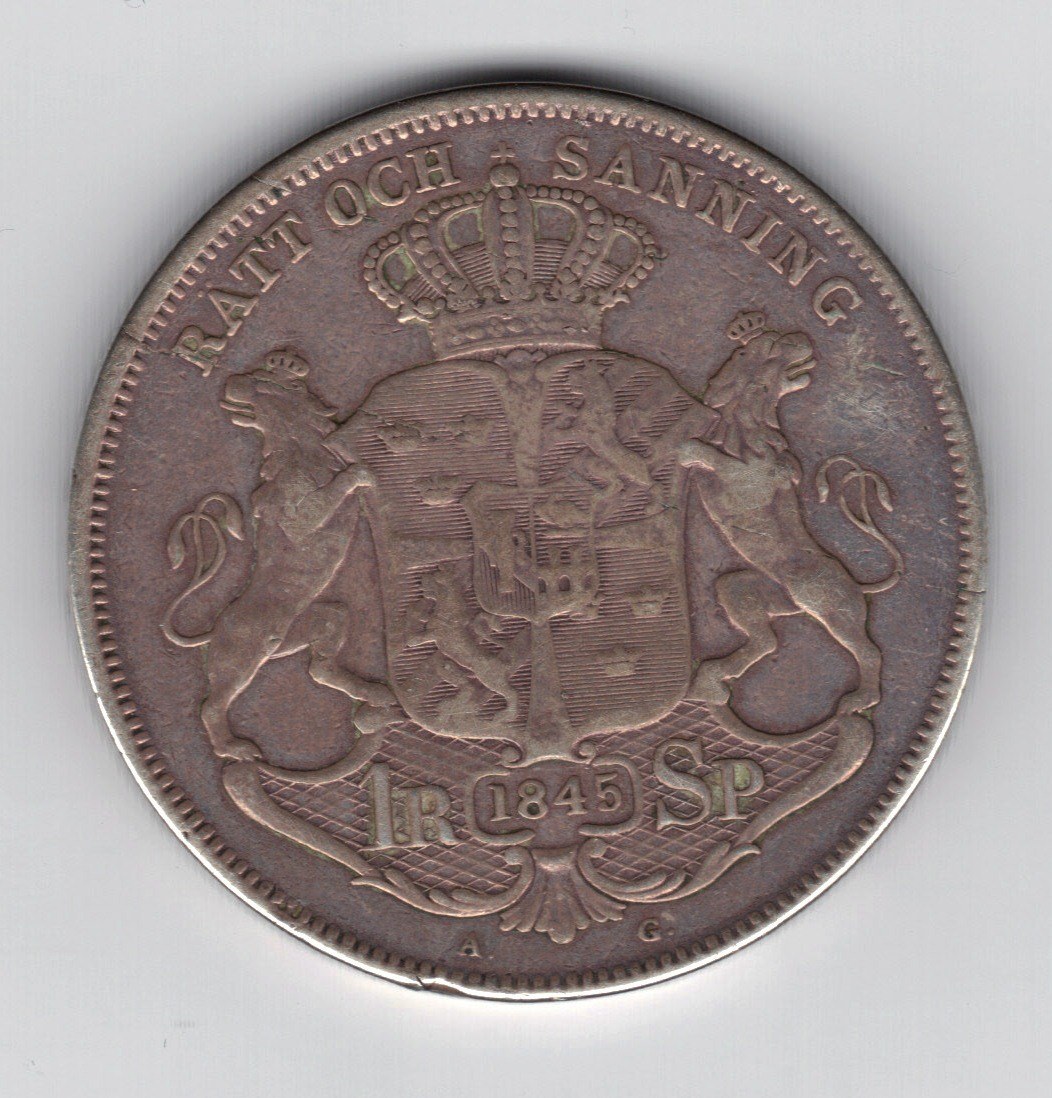
Large silver Riksdaler Specie of Sweden under King Oscar I, dated 1845, bearing his right-facing portrait, royal motto, and the Swedish coat of arms.
- Country
- Sweden
- Denomination
- 1 Riksdaler
- Metal
- Silver
Got a coin like this?
Identify any coin from a photo, free.
Overview
The 1 Riksdaler Specie is a large silver crown-sized coin of the Kingdom of Sweden. The 1845 issue was struck during the reign of King Oscar I (1844-1859) and represents the principal hard-silver denomination of Sweden's mid-19th-century coinage, the standard against which the country's other money was reckoned.
The observed coin shows a male portrait facing right, the king, encircled by the royal motto RATT OCH SANNING ("Justice and Truth"), Oscar I's personal device. The reverse carries the Swedish royal coat of arms, a crowned shield flanked by lion supporters. It is a substantial piece, considerably larger and heavier than everyday small change of its day.
As a full-weight silver specie coin from a named Scandinavian monarch, the 1845 Riksdaler Specie is a recognizable and collectible type among those interested in Swedish, Scandinavian, and 19th-century world silver.
History & Background
The Riksdaler had been Sweden's leading silver unit for centuries, but by the 19th century the currency existed in several parallel forms. The Riksdaler Specie was the "specie" or hard-coin standard, the heavy full-silver piece, while lighter accounting Riksdaler such as the Riksdaler Banco and later Riksdaler Riksmynt were reckoned as fractions of it.
The 1845-dated coin belongs to the reign of Oscar I, who came to the throne of Sweden and Norway in 1844 on the death of his father, Carl XIV Johan, the former French marshal Bernadotte. Oscar I continued striking the large silver Riksdaler Specie that his predecessor had issued, now with his own portrait and the motto RATT OCH SANNING.
Sweden reformed its currency in 1855, replacing the older system with a decimal Riksdaler Riksmynt in which one Riksdaler Specie equalled four Riksdaler Riksmynt. The Specie was in turn superseded, and in 1873 Sweden adopted the krona under the Scandinavian Monetary Union. The 1845 Riksdaler Specie therefore dates from the last generation of Sweden's pre-decimal, full-silver crown coinage.
How to Identify
This is a large silver coin, crown-sized, on the order of 38-40 mm in diameter and roughly 34 grams, struck in high-grade silver. It should feel heavy and dense in the hand, ring with the tone of genuine silver, and be non-magnetic.
The obverse shows the bare or laureate head of King Oscar I facing right, surrounded by the royal legend and the motto RATT OCH SANNING ("Justice and Truth"). The reverse displays the Swedish royal coat of arms, a crowned shield supported by two lions, with the denomination and date, 1845, in the surrounding legend. Reading the RATT OCH SANNING motto together with the Swedish arms is the surest way to confirm the type and reign.
Key identifiers are the right-facing male royal portrait, the RATT OCH SANNING motto identifying Oscar I, the lion-supported Swedish coat of arms, the 1845 date, and the heavy silver crown format. Small mintmaster initials or symbols may appear near the arms; these are workshop marks, not part of the country identification.
Value & Collectibility
As a large, full-weight silver coin of a named 19th-century monarch, the 1845 Riksdaler Specie carries collector value well above its silver bullion content. Circulated examples of the type generally trade from the mid-tens into the low hundreds of dollars, with the exact figure depending heavily on grade and eye appeal.
Condition is the main driver of price. Wear shows first on the king's cheek and hair and on the high points of the arms, so coins with sharp portraits, full detail, and original undisturbed surfaces command clear premiums over heavily worn, cleaned, or scratched pieces. Attractively toned original examples are especially desirable.
Because values vary by specific date, grade, and market demand for Swedish silver, treat these as broad ranges rather than fixed quotes. Certified high-grade or lustrous examples can sell for substantially more, while cleaned or damaged coins trade below problem-free pieces of the same grade.
Frequently asked questions
Who is on the 1845 Riksdaler Specie?
It portrays King Oscar I of Sweden and Norway, who reigned from 1844 to 1859. His right-facing portrait is paired with his personal motto, RATT OCH SANNING, meaning "Justice and Truth."
What does RATT OCH SANNING mean?
It is Swedish for "Justice (or Right) and Truth," the royal motto adopted by Oscar I. Its appearance around the portrait helps identify the coin as an issue of his reign.
Is the Riksdaler Specie real silver?
Yes. It is a large, high-grade silver coin, which is why it is heavy and crown-sized. Its silver content contributes to its value, though its collector premium as a historic type usually exceeds the bullion value.
What was a Riksdaler Specie worth?
It was Sweden's hard-silver standard coin. Under the 1855 reform, one Riksdaler Specie equalled four Riksdaler Riksmynt, and the system was later replaced by the krona in 1873.
Is this coin rare?
The Riksdaler Specie is a collectible but obtainable type. Value depends far more on grade and eye appeal than on outright rarity, with sharp, original examples worth notably more than worn ones.
1 Riksdaler Specie guides
In-depth guides for identifying, valuing, and collecting 1 Riksdaler Specie.