
How to Identify the 1 Riksdaler Specie
A collector's guide to confirming Sweden's silver Riksdaler Specie by its royal motto, portrait, lion-supported arms, date, and heavy silver format.
Read the full 1 Riksdaler Specie encyclopedia entry →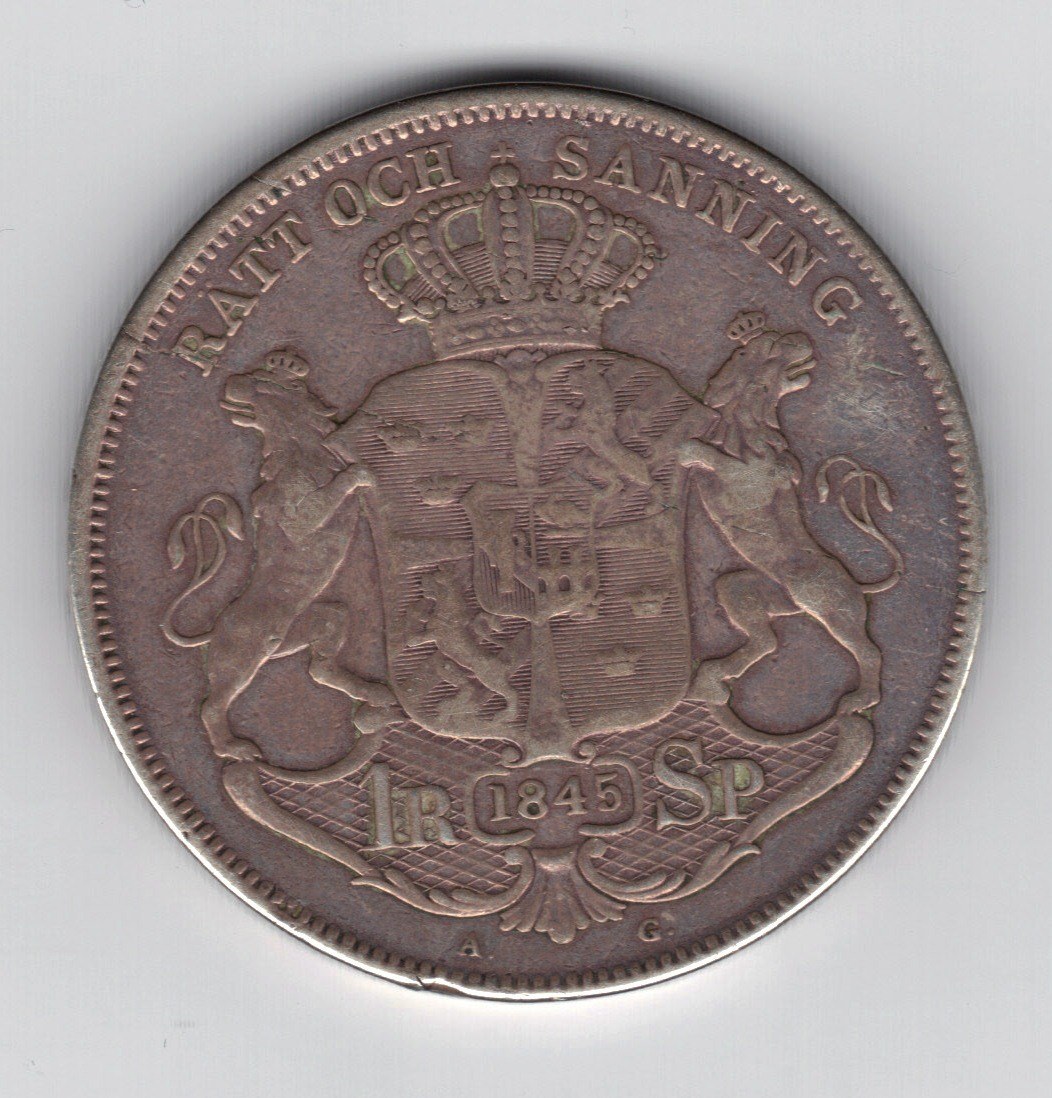
Read the Royal Motto First
The most decisive clue on this type is the motto around the portrait: RATT OCH SANNING ("Justice and Truth"). This was the personal device of King Oscar I, so the motto together with a right-facing male portrait points directly to his reign (1844-1859). If the legend gives a different motto or a different ruler's name, you are looking at another Swedish monarch's coinage.
Confirm the Portrait and the Arms
The obverse shows the head of Oscar I facing right, encircled by his royal titles and motto. The reverse carries the Swedish royal coat of arms, a crowned shield flanked by two lion supporters, with the denomination and date in the surrounding legend. Both sides should be present and consistent; a coin that shows a different bust direction, a plain three-crowns shield without supporters, or no motto is likely a different type or reign.
Verify the Denomination and Date
This piece is a Riksdaler Specie, the heavy silver standard coin, and the observed example is dated 1845. Read the denomination in the legend carefully, since Sweden used several parallel Riksdaler units (Specie, Banco, and later Riksmynt) that differ greatly in size and value. Confirm that the date matches the coin you are attributing and is not a later reform-era Riksdaler.
Check Size, Weight, and Metal
Expect a large silver crown roughly 38-40 mm across and about 34 grams. It should feel heavy and dense, be non-magnetic, and show the muted tone of genuine high-grade silver. A lightweight, undersized, magnetic, or obviously base-metal piece bearing this design is a warning sign and should be examined closely.
Rule Out Look-Alikes and Fakes
Sweden struck Riksdaler in several standards and under successive kings, so the same general arms-and-portrait layout appears on coins of Carl XIV Johan and Carl XV as well; always read the motto, portrait, and denomination rather than trusting the overall design. As a large silver type, the Riksdaler Specie attracts cast copies and altered dates. Weigh and measure the coin, inspect the lettering and rim for casting seams or tooling, and for higher-grade or higher-value examples consider third-party authentication.
Frequently asked questions
How do I know it is an Oscar I coin?
Look for the motto RATT OCH SANNING ("Justice and Truth") around a right-facing male portrait. That motto was Oscar I's personal device, so its presence identifies the reign; other Swedish kings used different mottoes.
What size and weight should it be?
Expect a large silver crown of roughly 38-40 mm and about 34 grams. It should feel heavy and dense for a coin, be non-magnetic, and show a genuine silver tone rather than the lightness of a base-metal piece.
How is the Specie different from other Swedish Riksdaler?
The Specie is the heavy full-silver standard. Sweden also used lighter accounting Riksdaler (Banco and later Riksmynt) worth fractions of a Specie, so read the denomination in the legend rather than assuming from the design alone.
Is it worth authenticating?
For anything beyond a well-worn example, yes. Large 19th-century silver crowns are faked by casting and sometimes carry altered dates, so verifying weight, diameter, and design detail, or using certification, guards against counterfeits.