1 Lira
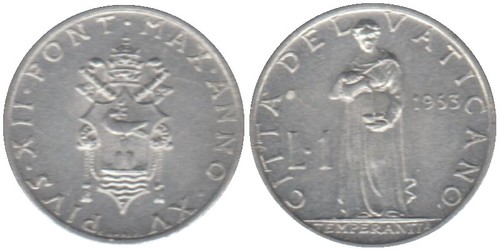
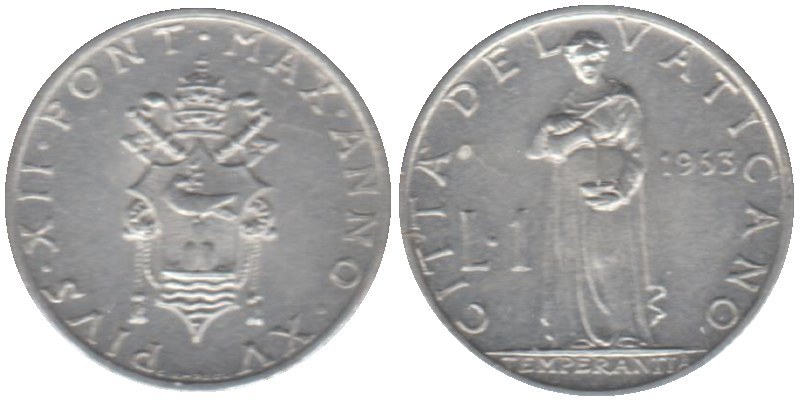
A tiny, lightweight Vatican City lira of the 1950s under Pius XII, with the tiara-and-keys arms on the obverse and a standing figure of Charity on the reverse.
- Country
- Vatican City
- Denomination
- 1 Lira
- Metal
- Silver-colored Italma (aluminum-magnesium alloy)
Got a coin like this?
Identify any coin from a photo, free.
Overview
The 1 Lira is one of the smallest circulating denominations issued by Vatican City, the sovereign enclave within Rome that mints its own coinage in parallel with Italy. The 1953 piece belongs to the series struck during the pontificate of Pope Pius XII, pairing the state arms of Vatican City with an allegorical figure.
Despite its bright, silvery look, this is not a precious-metal coin. It was struck in Italma, a light aluminum-magnesium alloy also used for the contemporary Italian 1 and 2 lire, so the piece feels almost weightless in hand. Collectors pursue it as part of a Vatican type set or a run of Pius XII issues rather than for any bullion content.
Because Vatican coins were produced in modest numbers and largely reached collectors and pilgrims rather than heavy daily use, many survive in high grade, and complete date sets from the 1950s are a popular and attainable goal.
History & Background
Vatican City resumed its own coinage in 1929 following the Lateran Treaty, which re-established the papal state as an independent entity and granted it the right to strike a limited coinage tied by convention to the Italian lira. Vatican coins circulated interchangeably with Italian money inside Italy under monetary agreements.
The 1953 1 Lira was issued under Pope Pius XII, who reigned from 1939 to 1958. After the Second World War, Vatican small change moved to the same lightweight Italma alloy adopted for low-value Italian coins, replacing the heavier prewar metals. The reverse figure of Charity reflects the long tradition of placing Christian virtues and allegories on the minor denominations.
The lira remained the Vatican's unit of account until the country adopted the euro in 2002, after which Vatican euro coins replaced the old lira series. The 1950s lira coins are now purely collectible.
How to Identify
The obverse shows the coat of arms of Vatican City: a shield bearing the crossed keys of Saint Peter, surmounted by the papal tiara (triple crown), ringed by the legend STATO DELLA CITTA DEL VATICANO with the date 1953 in the design.
The reverse depicts a standing allegorical female figure representing Charity, accompanied by the value expressed as L. 1 (one lira). The overall diameter is small, around 17-18 mm, and the coin is strikingly light because it is struck in Italma rather than a heavy metal, an important clue when separating it from silver issues.
Key identifiers are the Italian-language Vatican legend, the tiara-and-keys arms, the single-lira value mark, and the very low weight. Do not confuse the silvery surface for actual silver; the alloy is aluminum-based and non-magnetic, and genuine examples show crisp, matte-to-lustrous metal rather than the deep tone of a struck silver coin.
Value & Collectibility
As a common Italma minor coin, the 1953 Vatican 1 Lira carries very little intrinsic value and is affordable for most collectors. Typical circulated examples trade for a few dollars, while fully uncirculated pieces with original luster bring a modest premium; the appeal lies in completing a date run or a Pius XII set rather than in bullion.
Condition drives most of the difference in price because the soft alloy dents and scratches easily, so well-preserved, spot-free coins are worth noticeably more than worn ones. Coins originally sold in Vatican mint sets tend to survive in the best grades.
Exact prices vary with grade, eye appeal, and where the coin is sold, so ranges here are general context rather than fixed quotes. There are no meaningful precious-metal considerations, since the piece contains no silver despite its appearance.
Frequently asked questions
Is the 1953 Vatican 1 Lira made of silver?
No. Although it looks silvery, it is struck in Italma, a light aluminum-magnesium alloy, and contains no precious metal. The silvery color is simply the alloy's natural appearance.
Who is the figure on the reverse?
The reverse shows a standing allegorical figure of Charity, one of the Christian virtues traditionally used on Vatican minor coinage, next to the value L. 1.
What is on the obverse?
The obverse displays the arms of Vatican City, a shield with the crossed keys of Saint Peter beneath the papal tiara, ringed by the legend STATO DELLA CITTA DEL VATICANO.
Which pope issued this coin?
It was issued under Pope Pius XII, who reigned from 1939 to 1958. The 1 Lira was part of the small-change coinage of his pontificate.
Is it worth much?
It is a common, inexpensive collector coin. Circulated pieces are worth only a few dollars, with uncirculated, lustrous examples bringing a small premium; value comes from set-building, not metal content.
1 Lira guides
In-depth guides for identifying, valuing, and collecting 1 Lira.