
How to Identify the 1 Lira
A quick collector's guide to confirming a 1953 Vatican City 1 Lira by its arms, Charity reverse, small size, and lightweight Italma alloy.
Read the full 1 Lira encyclopedia entry →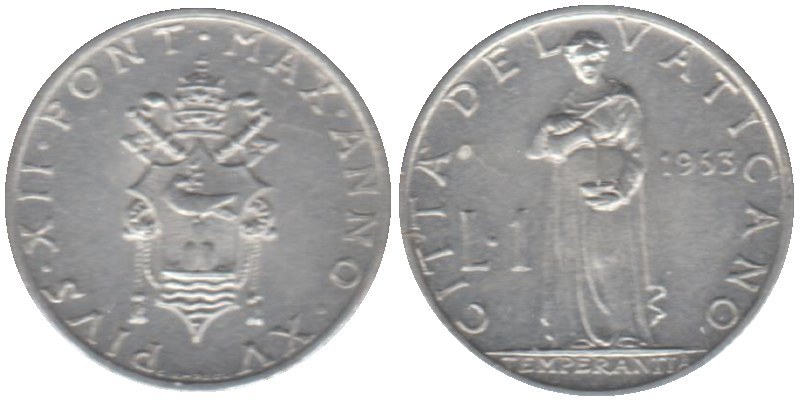
Read the Legend First
Vatican coins are labeled in Italian, so start there. Look for STATO DELLA CITTA DEL VATICANO around the arms; this text confirms a Vatican City issue rather than an Italian or San Marino lira. The date 1953 appears in the design, and the value on the reverse is written as L. 1.
Match Both Sides to the Type
The obverse must show a shield with the crossed keys of Saint Peter topped by the papal tiara, a tall triple crown. The reverse must show a single standing female figure, the allegory of Charity, not a portrait bust, an eagle, or a numeral-only design. A portrait of the pope on the obverse would indicate a different, larger denomination or a commemorative, not this coin.
Confirm Size, Weight, and Metal
The 1 Lira is small, roughly 17-18 mm across, and remarkably light because it is Italma, an aluminum-magnesium alloy. If a coin of this design feels heavy or dense, or tones like tarnished silver, treat that as a red flag. The genuine alloy is non-magnetic and stays bright to matte-gray rather than developing dark silver toning.
Rule Out Look-Alikes
Contemporary Italian 1 and 2 lire use the same Italma alloy and similar size but carry Italian legends (REPVBBLICA ITALIANA) and different designs such as a cornucopia or a bee. Earlier Vatican lire from the 1930s and 1940s are heavier and use different reverses. Matching all three cues, Vatican legend, tiara-and-keys arms, and standing Charity, is what pins down this exact type and year.
Authentication Cautions
Focus on strike sharpness and correct weight rather than metal tests, since the coin has no bullion value to fake. Genuine examples show clean, well-defined details in the keys, tiara, and drapery. Because the value is low, deceptive counterfeits are uncommon; the more frequent errors are misattributing an Italian lira or overestimating the coin as silver.
Frequently asked questions
How do I tell a Vatican lira from an Italian lira of the same era?
Read the legend. Vatican coins say STATO DELLA CITTA DEL VATICANO and show the tiara-and-keys arms, while Italian lire read REPVBBLICA ITALIANA and use secular designs like a cornucopia or a bee.
Can I test whether it is silver?
It is not silver, so a positive silver test would indicate the wrong coin. The genuine 1 Lira is lightweight, non-magnetic Italma; its low weight and bright alloy tone are the identifying traits, not precious-metal content.
What size and weight should it be?
Expect a small coin of roughly 17-18 mm diameter that feels almost weightless in the hand, consistent with the thin aluminum-magnesium alloy used for these minor issues.
Which details confirm the exact type?
The combination of the Vatican Italian legend, the crossed keys under the papal tiara on the obverse, the standing figure of Charity on the reverse, and the L. 1 value mark together confirm the 1953 Vatican 1 Lira.