1 Koruna
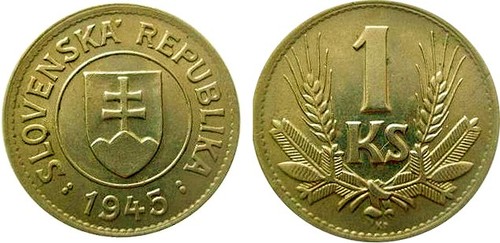
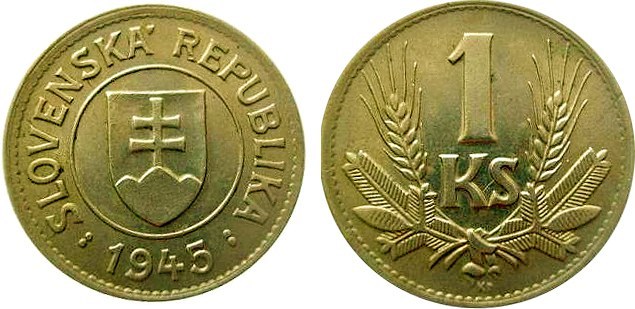
A lightweight aluminum 1 Koruna of the wartime Slovak state, showing the double-cross national shield on one side and the value 1 Ks flanked by wheat ears.
- Country
- Slovakia
- Denomination
- 1 Koruna
- Metal
- Aluminum
Got a coin like this?
Identify any coin from a photo, free.
Overview
The 1 Koruna is a small aluminum coin of Slovakia, issued during the World War II era when Slovakia existed as a separate state. The example here is dated 1945, near the end of that period. It pairs the Slovak coat of arms on the obverse with the denomination, written as 1 Ks, framed by wheat ears on the reverse.
Struck in aluminum rather than a precious or heavier base metal, the coin is very light and thin for its size, a common feature of small-change coinage produced under wartime metal shortages. It served as an everyday circulating unit, worth one koruna, in a currency divided into 100 halierov.
As a modest, mass-produced minor coin it is collected mainly as a historical artifact of the short-lived wartime Slovak coinage rather than for intrinsic metal value. It remains a recognizable and accessible piece for collectors of Central European and 20th-century coins.
History & Background
Slovakia became a separate state in 1939 after the breakup of Czechoslovakia, and it issued its own coinage in the Slovak koruna during the years that followed. The 1 Koruna in aluminum belongs to this wartime series of national coins, of which the 1945-dated pieces are among the last struck before the state ended.
The choice of aluminum reflects the economic conditions of the war years, when scarce metals were reserved for military and industrial use and low-value coins were made from cheap, light alloys. Grain motifs such as the wheat ears on the reverse were common on European small coins of the period, symbolizing agriculture and everyday sustenance.
After the war Czechoslovakia was re-established and this wartime Slovak koruna coinage was superseded. The 1945 1 Koruna therefore marks the closing chapter of an unusual, short-lived national currency, which is a large part of its interest to collectors today.
How to Identify
The obverse shows the Slovak coat of arms: a shield bearing a double cross set upon a base of hills, the historic emblem of Slovakia, typically accompanied by the country name and the date, here 1945. This heraldic double-cross shield is the key marker identifying the coin as Slovak.
The reverse carries the denomination expressed as the large numeral 1 above the abbreviation Ks, standing for one koruna, with an ear of wheat curving up each side of the value. The design is simple and uncluttered, typical of wartime minor coinage.
Key identifiers are the double-cross shield on the obverse, the 1 Ks value with flanking wheat ears on the reverse, and the aluminum fabric. The coin is notably light and thin, has a pale silvery-gray tone that can darken or spot with age, and is non-magnetic, which together distinguish it from heavier bronze or nickel small coins of the same era.
Value & Collectibility
As a common aluminum minor coin, the 1 Koruna generally carries modest value. Well-worn circulated examples typically trade for a small sum, often in the low single digits of dollars, and the coin is widely available to collectors of the period.
Condition drives most of the price difference. Aluminum is soft and prone to nicks, bends, and surface spotting, so bright, undamaged, high-grade pieces with full detail command a clear premium over dented, corroded, or heavily circulated coins. Original, uncleaned surfaces are preferred.
Exact prices vary with grade, demand, and the specific date within the series, so treat these figures as general context rather than fixed quotes. Damaged, corroded, or cleaned coins sell for less, while pristine uncirculated examples can bring noticeably more.
Frequently asked questions
What country and period is this 1 Koruna from?
It is from Slovakia during the World War II era, when Slovakia issued its own koruna coinage. The example shown is dated 1945, near the end of that wartime period.
What does 1 Ks mean on the reverse?
Ks is the abbreviation for koruna, the currency unit. So 1 Ks simply means one koruna, the coin's face value, shown with a wheat ear on each side of the numeral.
Is the coin made of real silver?
No. It is struck in aluminum, which is why it is so light and thin. It has a pale silvery-gray look but contains no precious metal, so its value is historical rather than intrinsic.
What is the emblem on the obverse?
It is the Slovak coat of arms: a shield with a double cross standing on a base of hills. This double-cross emblem is the historic national symbol of Slovakia.
Is this coin valuable?
It is a common, affordable minor coin in most grades. Value depends mainly on condition, with bright, undamaged high-grade examples worth more than worn, dented, or corroded pieces.
1 Koruna guides
In-depth guides for identifying, valuing, and collecting 1 Koruna.