
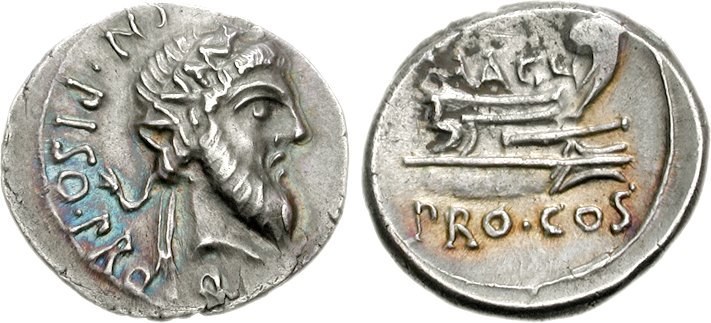
Denarius of Cn. Pompeius Magnus
Silver Roman Republican denarius of the Pompeian party (46–45 BC), with a bearded portrait of Pompey the Great and a galley reverse reading PRO COS.
- Country
- Roman Republic
- Denomination
- Denarius
- Metal
- Silver
Got a coin like this?
Identify any coin from a photo, free.
Overview
This silver denarius belongs to the civil-war coinage struck in the name of Cnaeus Pompeius Magnus, better known as Pompey the Great. It was issued by the Pompeian faction during the final campaigns against Julius Caesar, and it honors Pompey with a portrait even though he himself had already died. The example shown here is dated to roughly 46–45 BC.
The obverse carries a bearded male head facing right, understood to represent Pompey. The reverse shows a galley, or warship, together with the abbreviation PRO COS, standing for proconsul, a reference to the proconsular military authority under which the coinage was struck. The ship motif recalls Pompey's fame as a naval commander. It is a historically charged issue, prized by collectors for its direct link to the Roman civil wars.
History & Background
Cnaeus Pompeius Magnus (106–48 BC) was one of the most powerful figures of the late Roman Republic, celebrated for clearing the Mediterranean of pirates and for his eastern conquests. His rivalry with Julius Caesar erupted into open civil war, ending in Pompey's defeat at Pharsalus in 48 BC and his assassination shortly afterward in Egypt.
After Pompey's death, his sons and supporters continued the struggle against Caesar, chiefly in Spain and at sea, until their defeat at the Battle of Munda in 45 BC. It was in this period, around 46–45 BC, that denarii bearing Pompey's portrait and the proconsular legend PRO COS were struck to pay and rally the Pompeian forces. Coinage in this era served as both money and propaganda, keeping the name and image of a fallen leader before the troops.
Because these issues were produced under wartime conditions by a faction rather than the central Roman mint, they were struck in limited quantities over a short span, which contributes to their scarcity and appeal today.
How to Identify
Identify this type first by its silver fabric and its denomination: it is a Roman Republican denarius, a small hand-struck silver coin typically around 18–20 mm in diameter and roughly 3.5–4 grams, often on an irregular or slightly oval flan. Expect the toning, minor porosity, and off-center striking normal for hand-made ancient silver.
The obverse shows a bearded head of Pompey facing right; the beard and mature features are diagnostic and help distinguish it from clean-shaven imperial portraits. The reverse presents a galley or warship and the abbreviated legend PRO COS (proconsul). Additional lettering or magistrate names may appear in the fields or exergue depending on the exact variety.
Because several closely related Pompeian and Sextus Pompey issues share the bearded portrait and naval imagery, precise attribution rests on the exact legends and the reverse composition. Compare the inscriptions carefully against a standard reference such as Crawford's Roman Republican Coinage to pin down the specific catalog number.
Value & Collectibility
As a historically significant Roman Republican civil-war issue tied to Pompey the Great, this denarius carries a meaningful premium over common Republican silver. Values depend heavily on grade, centering, portrait clarity, and the completeness of the legends.
Well-worn or off-center examples with a legible portrait and reverse commonly trade in the low-to-mid hundreds of dollars, while sharp, well-centered pieces with strong detail can reach into the high hundreds or into the low thousands. Exceptional coins with fine style and excellent surfaces sell for more at specialist ancient-coin auctions.
Because condition and eye appeal drive value so strongly for ancient silver, and because varieties differ in scarcity, treat any figure as a range rather than a fixed price. Professional attribution and, for higher-value pieces, third-party authentication are worthwhile before buying or selling.
Frequently asked questions
Who is on this denarius?
The bearded portrait represents Cnaeus Pompeius Magnus, or Pompey the Great. The coin was struck by his supporters during the Roman civil wars, honoring him even after his death in 48 BC.
What does PRO COS mean on the reverse?
PRO COS is an abbreviation of proconsul, the military and provincial authority under which the coinage was issued. It appears alongside the galley on the reverse.
Why is there a ship on the coin?
The galley recalls Pompey's renown as a naval commander, famous for sweeping pirates from the Mediterranean, and reflects the naval dimension of the Pompeian war effort.
Is it real silver?
Yes. The Roman denarius of this period was struck in good silver, typically weighing about 3.5 to 4 grams and measuring roughly 18 to 20 mm across.
Is this coin rare?
Pompeian civil-war denarii were struck in limited numbers under wartime conditions, so they are considerably scarcer than routine Republican issues and are actively sought by collectors of Roman history.
Denarius of Cn. Pompeius Magnus guides
In-depth guides for identifying, valuing, and collecting Denarius of Cn. Pompeius Magnus.
Other coins you may enjoy
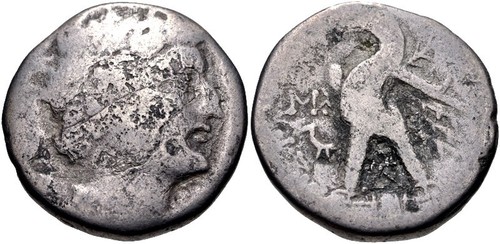
Tetradrachm of Ptolemy XII
80-51 BC
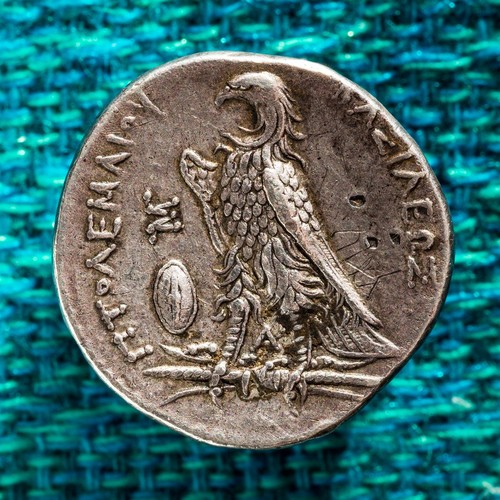
Tetradrachm of Ptolemy I
305-283 BC
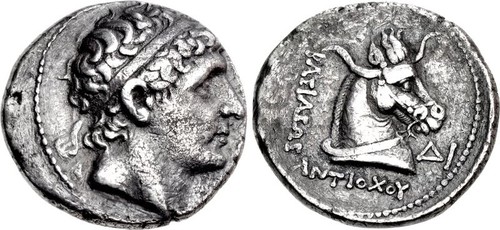
Tetradrachm of Antiochos I Soter
281-261 BC
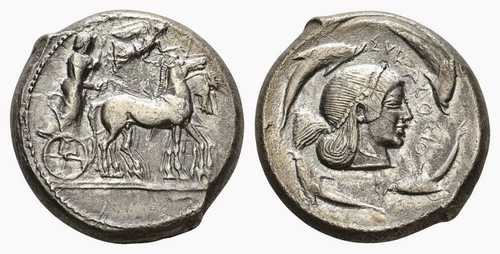
Syracuse Tetradrachm
c. 5th-4th century BC (Classical period)
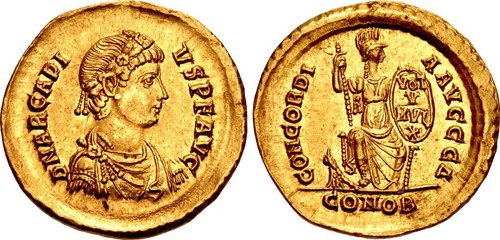
Solidus of Arcadius
AD 395-402
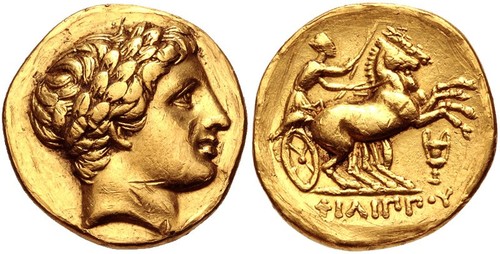
Philip III Gold Stater
323-317 BC
Siliqua of Gratian
AD 367-383
Sestertius of Maximinus Thrax
235-238 AD
Solidus of Valentinian III
AD 425-455
Seleucus I Nicator Tetradrachm
Late 4th-3rd century BC
Nummus of Magnentius
AD 350-353
Follis of Galerius
AD 308-310